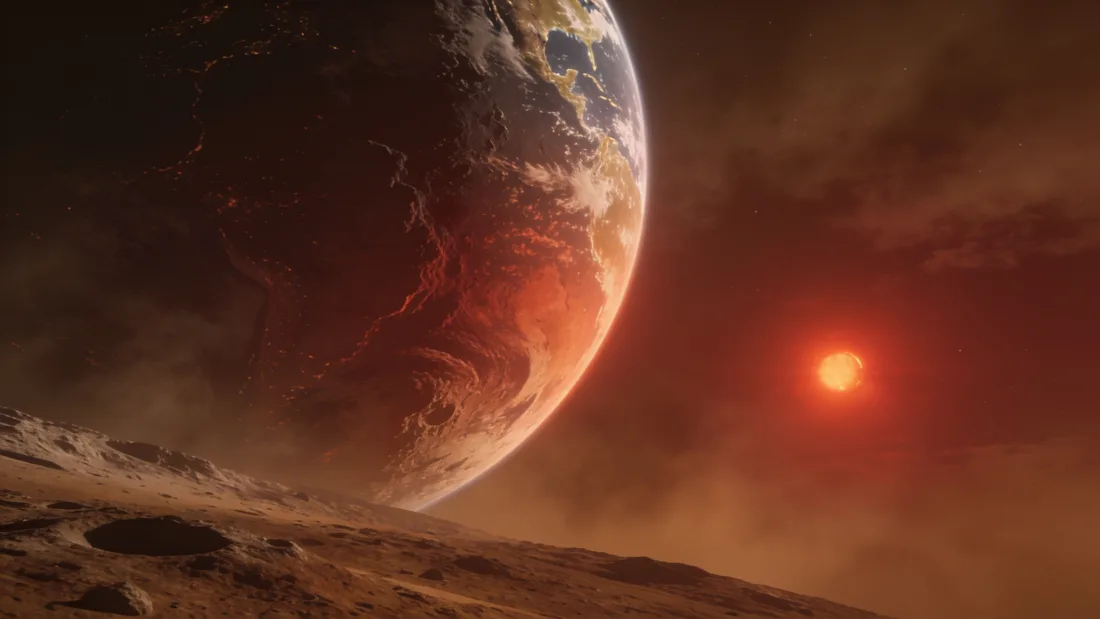
One hundred and twenty-four light-years away — that is, 124 times the distance light travels in an entire year — a small, dim star hosts at least two planets. One of them is called TOI-237 c, and it is a fascinating case study in how scientists piece together what a distant world is made of using just a handful of careful measurements.
A Tiny Star Out in the Neighborhood
TOI-237 is the star that TOI-237 c orbits. It belongs to a family of stars called red dwarfs. Red dwarfs are stars smaller and cooler than our own Sun. They glow with a reddish or deep orange light, and they burn their fuel so slowly that they can live for hundreds of billions of years.
The surface temperature of TOI-237 has been measured at 3,226 K (K stands for Kelvin, a scale scientists use to measure heat; zero Kelvin is as cold as anything can possibly get). By comparison, our Sun’s surface sits around 5,778 K. So TOI-237 is noticeably cooler and less bright than the Sun.
Because red dwarfs are so dim, any planet that sits in the zone where liquid water could exist has to orbit very close in. That closeness brings its own challenges, as we will see.
Meeting TOI-237 c

TOI-237 c was discovered in 2026 using the transit method, a technique we will explain shortly. When astronomers measured its size and mass, here is what they found.
The planet’s radius — that is, the distance from its center to its surface — is about 1.21 times Earth’s radius. That makes it only a little larger than Earth. Its mass, or how much matter is packed inside it, comes in at about 1.9 times Earth’s mass. So it is nearly twice as heavy as Earth while being only slightly wider.
Those two numbers together already tell scientists a great deal. You can explore how size and mass relate for many worlds using the mass-radius diagram, which plots planets by these two measurements to reveal patterns in their compositions.
Reading the Insides from the Outside
Scientists cannot yet send a probe to TOI-237 c, and we cannot see its surface directly. So how do we know what it might be made of? The trick is density. Density is how much mass is squeezed into a given space. A rock is denser than a sponge, and an iron ball is denser than a rock.
When you know a planet’s radius and its mass, you can calculate its average density. TOI-237 c is only about 21 percent wider than Earth but carries nearly twice Earth’s mass. That means a lot of mass is packed into a relatively small space. This points toward a rocky, possibly iron-rich composition — similar in structure to Earth or Venus — rather than a puffy world full of light gases or thick layers of water-ice.
Scientists use a range of models — like recipes that combine different materials in different amounts — to see which mix best explains the numbers. For TOI-237 c, the numbers are most consistent with a rocky body. That said, these are careful estimates. Scientists cannot be fully certain without more data, and some portion of water or other materials cannot be completely ruled out yet.
If you are curious about how Earth compares in size to worlds like this one, the size comparison tool lets you set planets side by side to get a sense of scale.
A World in a Hurry
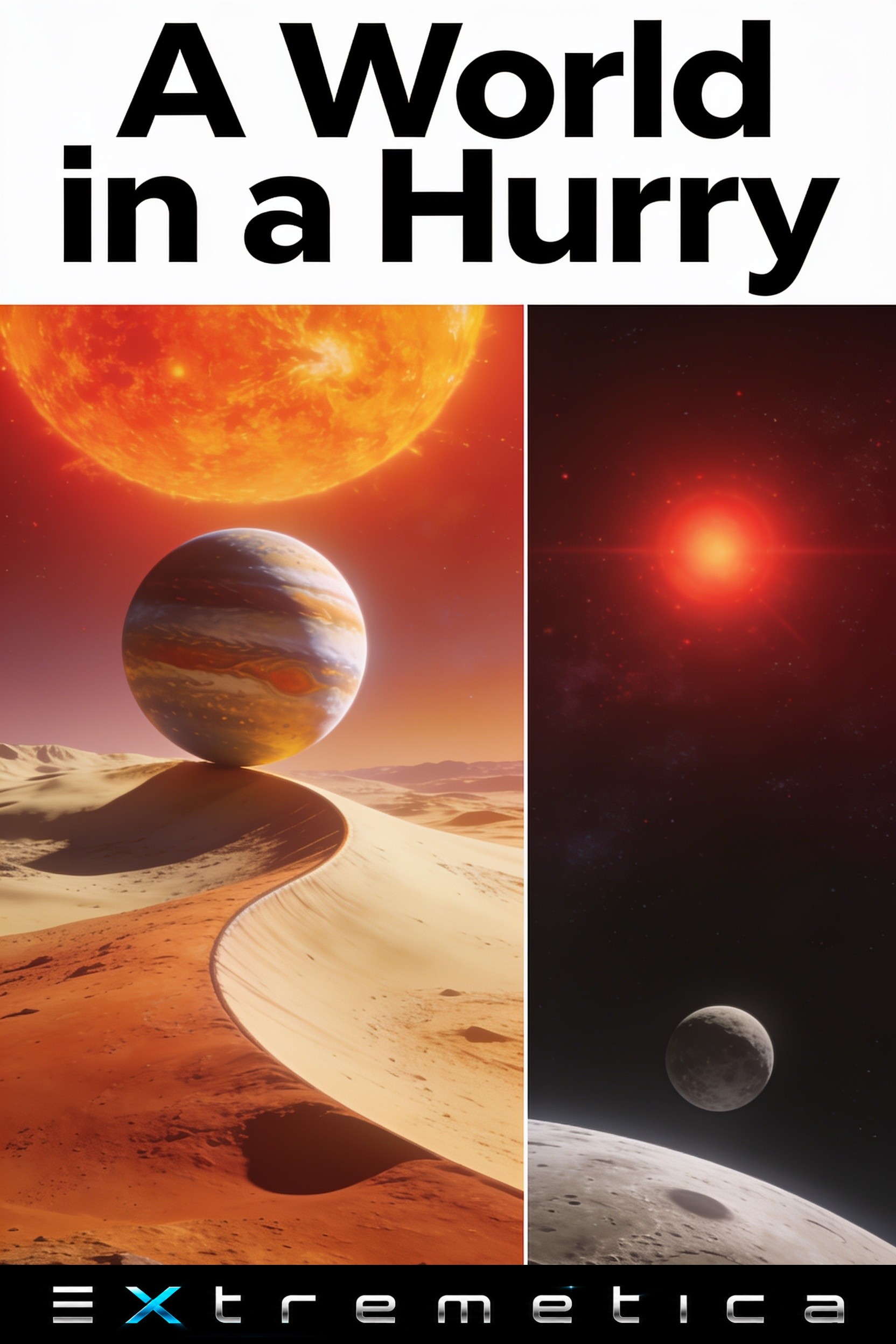
One of the most striking things about TOI-237 c is how fast it travels around its star. One full orbit — what we would call a year on that planet — takes only 1.74 Earth days. In the time it takes most of us to get through a school week, this world has already lapped its star more than twice.
To move that quickly, the planet must be orbiting extremely close to TOI-237. We do not have a direct measurement of exactly how far away it sits, but a 1.74-day orbit around a cool, small star tells us the gap between planet and star is very small indeed — far closer than Mercury is to our Sun.
Orbiting so close has consequences. Tidal forces — the same kind of gravitational tugging that the Moon uses to create Earth’s ocean tides — may lock the planet so that the same side always faces the star. Scientists call this tidal locking. If that is the case, one hemisphere bakes in constant starlight while the other sits in permanent darkness. We are not certain this has happened to TOI-237 c, but it is a real possibility worth noting.
Hot and Hostile
Scientists have estimated the likely temperature of TOI-237 c at around 515 K, which is roughly 242 degrees Celsius. That is hotter than a kitchen oven set to its highest setting, and hot enough to melt some metals.
This temperature puts TOI-237 c well outside the habitable zone — the band of distances around a star where liquid water could sit on a planet’s surface without instantly boiling away or freezing solid. TOI-237 c is simply too close, and too warm, for liquid water on its surface as we understand it. That does not make it an uninteresting world — rocky planets at all temperatures teach us about geology, atmosphere, and planetary chemistry — but it does mean we should not expect life as we know it there.
The Two-Planet System
So far, astronomers have confirmed two planets orbiting TOI-237. TOI-237 c is one of them. The other is TOI-237 b, which orbits even closer to the star with a shorter year. Details about TOI-237 b’s size and mass have not been included in this article, as we want to stick to what has been carefully verified for TOI-237 c specifically.
Finding two planets in a system like this is common. Red dwarf systems often turn out to pack several planets into tight orbits close to the star. Whether TOI-237 hides additional, farther-out planets that have not yet been detected is something future observations may answer.
How We Found It
TOI-237 c was discovered using the transit method. Here is how it works. When a planet passes in front of its star as seen from Earth, it blocks a tiny fraction of the star’s light. Telescopes watching the star see a small, regular dip in brightness. Each dip is one transit — one lap of the planet in front of the star.
By measuring how deep the dip is, scientists can figure out the planet’s size relative to the star. By measuring how often the dips repeat, they get the length of the planet’s year. Combining transit data with other measurements — such as the tiny wobble a planet’s gravity causes in its star — can then give scientists a mass estimate.
TOI-237 c is a good reminder of how much careful science hides behind a single name in a star catalog. A small dip in a light curve, repeated at regular intervals, eventually became a portrait of a hot, dense rocky world racing around a cool, patient red dwarf star, 124 light-years from the planet where you are sitting right now.