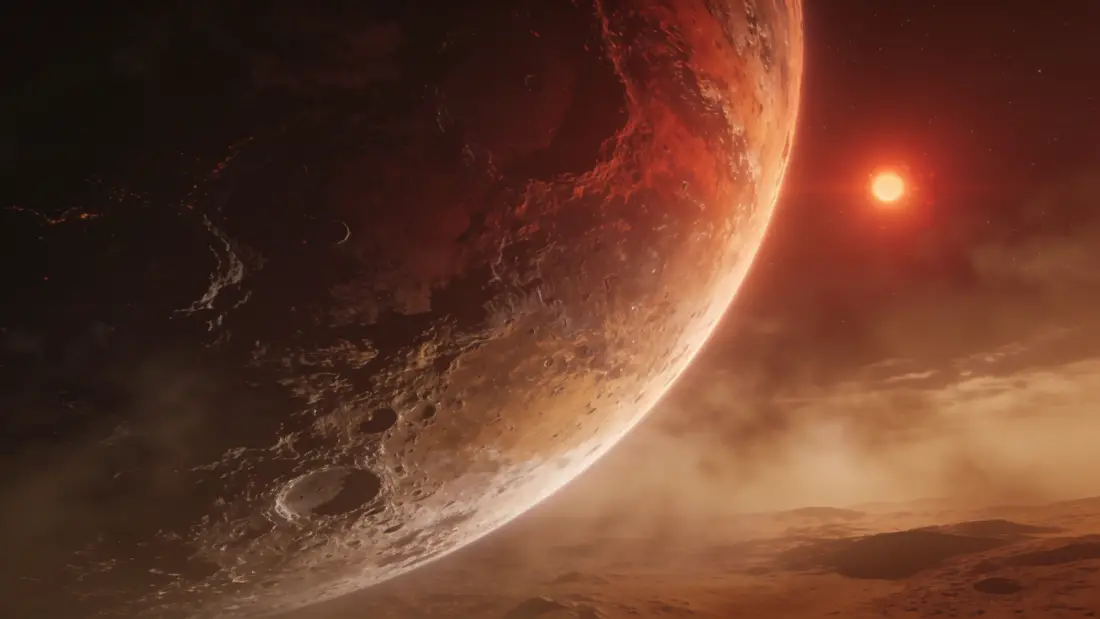
GJ 887 b is one of the closest known exoplanets — planets orbiting stars other than our Sun — to Earth. At just 10.7 light-years away, its host star is practically next door by cosmic standards. Yet even this short distance reveals just how vast space truly is.
How Far Away Is 10.7 Light-Years?
A light-year is the distance light travels in one year. Light is the fastest thing in the universe. It covers about 300,000 kilometers every single second. In one year, that adds up to roughly 9.46 trillion kilometers.
Multiply that by 10.7, and GJ 887 b’s star sits about 101 trillion kilometers from Earth. That number is almost impossible to picture. So let’s try a comparison instead.
Our whole Solar System — from the Sun out to the distant edge where the planets end — is less than one light-day across. GJ 887’s star is more than 3,900 times farther away than that. Even the fastest spacecraft humans have ever launched would take tens of thousands of years to reach it.
And yet, among the hundreds of billions of stars in our galaxy, 10.7 light-years is remarkably close. GJ 887 sits within a small bubble of stellar neighbors around the Sun. You can explore how these nearby stars relate to one another using the Cosmic Map.
What We Know About GJ 887 b
GJ 887 b is what scientists call a super-Earth — a planet bigger than Earth but smaller than the ice giants Uranus and Neptune. Its radius is about 1.8 times Earth’s, and its mass is about 3.9 times Earth’s. Those two numbers together tell scientists something useful.
If a planet is much heavier than its size would suggest, it is probably made mostly of rock and metal. If it is lighter than expected, it likely holds a thick layer of gas or liquid. GJ 887 b’s mass and radius suggest it could be a rocky world, though scientists haven’t confirmed that yet.
One year on GJ 887 b lasts just 9.26 Earth days. That is how long it takes the planet to complete one full orbit around its star. Such a short year means the planet is orbiting very close to GJ 887 — much closer than Mercury orbits our Sun.
Because it sits so close to its star, GJ 887 b is warm. Scientists estimate its likely temperature at around 426 K, which is about 153 degrees Celsius. That is hotter than any oven in a kitchen. At that temperature, liquid water on the surface seems very unlikely, though scientists haven’t measured it directly. What the planet’s surface is actually like — whether it has air, mountains, or anything else — we simply don’t know yet.
The Star GJ 887 — A Cool, Quiet Neighbor
GJ 887 is a red dwarf, a type of star that is smaller, cooler, and dimmer than our Sun. Its surface temperature is about 3,688 K. Our Sun’s surface, by comparison, burns at around 5,778 K, so GJ 887 is noticeably cooler.
Red dwarfs are the most common type of star in the Milky Way. They burn their fuel slowly and can live far longer than stars like our Sun. Many red dwarfs are known to flare — that means they suddenly release large bursts of energy that could strip away a nearby planet’s atmosphere. GJ 887, however, has been noted by researchers as one of the quieter red dwarfs in our stellar neighborhood, which makes its planets a little more interesting to study.
Even so, because GJ 887 b orbits so close to its star, any relationship between the planet and its star’s energy is complicated. Scientists are still working to understand how that closeness shapes the planet’s environment.
A System of Four Worlds
GJ 887 b is not alone. Scientists currently know of four planets in the GJ 887 system. That makes it a multi-planet system, which is quite common around red dwarfs.
GJ 887 b is one of the inner planets in this family. Beyond what we know about GJ 887 b itself, the details of the other three worlds — their sizes, masses, and temperatures — aren’t included in the confirmed data available here. Scientists haven’t fully published all those measurements yet, or the measurements carry enough uncertainty that it’s better to wait for more observations.
Having four planets in a system around such a nearby star gives researchers a valuable opportunity. Each world adds information about how planetary systems form and evolve around red dwarfs — the galaxy’s most common stars.
How Scientists Found GJ 887 b
GJ 887 b was discovered in 2020 using a technique called the radial velocity method. Here is how it works. When a planet orbits a star, its gravity gives the star a tiny tug. That tug causes the star to wobble slightly toward and away from Earth. As the star wobbles toward us, the light it sends reaches us slightly compressed — we call that a blueshift. As it wobbles away, the light stretches out — a redshift. By measuring these tiny shifts in the starlight very precisely, scientists can detect the presence of a planet and work out its mass and orbit.
This method does not take a photo of the planet. It detects the planet’s gravitational influence on its star. That means the numbers scientists get — like the mass and orbit — are careful estimates, not perfect measurements. Researchers are always refining them as more data comes in.
The radial velocity method works especially well for planets that orbit close to their stars, because closer planets tug harder and more often. GJ 887 b’s short 9.26-day orbit made it a good candidate for this technique.
What a Journey There Would Really Look Like
Imagining a trip to GJ 887 b puts the distance in perspective. The fastest spacecraft ever launched by humans travel at tens of kilometers per second. Even at those speeds, reaching GJ 887’s star would take well over 100,000 years.
To get there in a human lifetime, a spacecraft would need to travel at a significant fraction of the speed of light. No technology today comes close to that. Scientists and engineers think about concepts like laser-pushed sails or nuclear propulsion for future probes, but these remain ideas, not working ships.
If you want to see just how long the journey would take at different speeds, the Distance & Travel Time tool lets you compare real spacecraft velocities against the stars in our neighborhood.
GJ 887 b reminds us that even our nearest cosmic neighbors require us to think in completely different units of time and distance. It is close enough to study with powerful telescopes, yet so far that visiting it remains far beyond anything humans can do today. That gap between what we can see and what we can reach is one of the most thought-provoking things about exploring the universe from Earth.