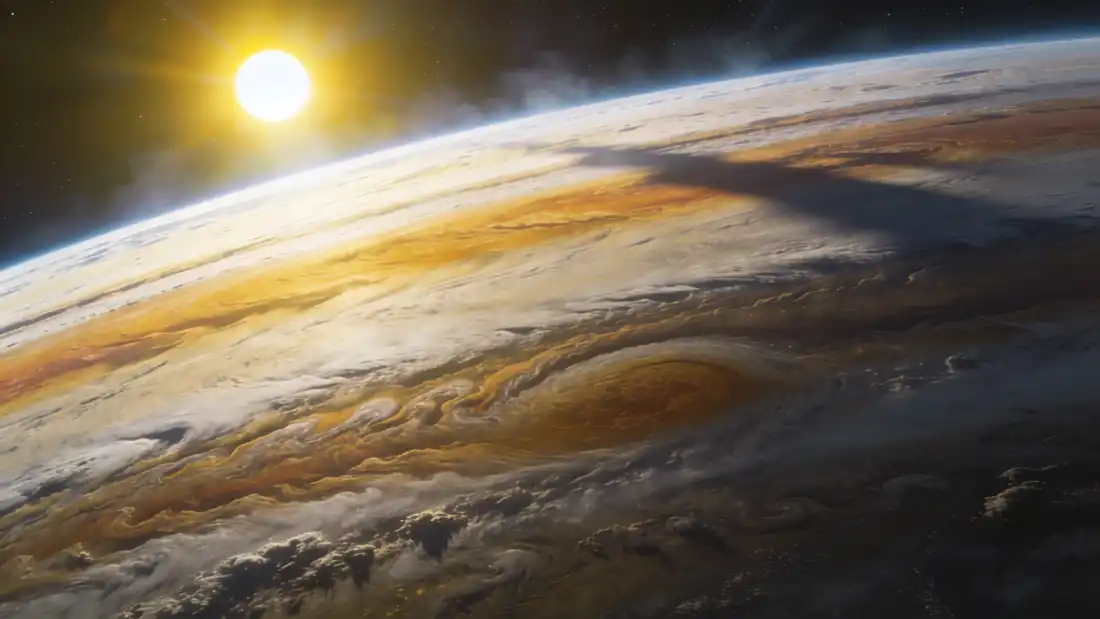
One hundred and fifty light-years from Earth, a star called HD 34445 hosts a whole family of six planets. Among them is a world called HD 34445 d, which gives scientists a useful window into how very different planetary systems can be. This system was fully announced in 2017, and researchers are still piecing together what it can teach us.
The Star at the Center
Every planetary system starts with its star, so it helps to know a little about HD 34445. A surface temperature is a measure of how hot the outer layer of a star is, given in units called Kelvin (K). HD 34445 has a surface temperature of 5,836 K. Our own Sun sits at around 5,778 K, which makes HD 34445 just a touch warmer. The two stars are quite similar in type.
Because HD 34445 is so Sun-like, scientists find it especially interesting. When a star resembles our Sun, it becomes easier to compare its planets to the ones we already know. It also raises careful questions about whether any of those six worlds could sit in conditions even loosely like those here at home — though that is a very long way from saying any of them do.
HD 34445 lies about 150 light-years away. A light-year is the distance light travels in one year — roughly 9.5 trillion kilometers. That is far too distant for any spacecraft we have today to visit, but it is close enough that telescopes can study the star’s motion in useful detail.
Six Worlds in One System
HD 34445 is home to at least six known planets. Having six planets around a single star is notable, though our own Solar System has eight, so it is not without comparison. What makes this family striking is how it is arranged and what kinds of worlds seem to be present.
When astronomers find multiple planets around one star, they can start to ask big questions. Do the planets orbit close together or spread far apart? Are they all rocky, all gassy, or a mix? Does the arrangement look anything like what we see in our Solar System, or is it something quite different? For HD 34445, the answers are still coming in. Scientists have measured some properties of these worlds, but others remain unknown for now.
You can explore the full layout of planetary systems, including ones like this, using our system explorer.
Meet HD 34445 d
Among the six planets, HD 34445 d is a particularly interesting one to look at closely, because we have some solid measurements for it.
HD 34445 d has a radius — that is, the distance from its center to its surface — of about 6.07 times Earth’s radius. It also has a mass of about 30.7 times Earth’s mass. Mass is a measure of how much matter a planet contains. Put those two numbers together, and you get a world that is noticeably larger and heavier than Earth, but probably not a giant gas planet in the same league as Jupiter.
Planets in this size and mass range are sometimes called sub-Neptunes or mini-Neptunes — worlds bigger than Earth but smaller than Neptune. Neptune, for comparison, is about 3.9 times Earth’s radius and about 17 times Earth’s mass. HD 34445 d is somewhat bigger and heavier than Neptune, so it sits near the boundary between that category and the next one up. Scientists think worlds in this range likely have thick envelopes of gas or fluid surrounding a denser core, though exactly what HD 34445 d looks like inside is not yet known.
One orbit around HD 34445 takes HD 34445 d about 118 Earth days. That means its year is roughly a third of ours. It moves around its star faster than Earth does, which suggests it orbits closer in — but scientists haven’t published a confirmed orbital distance for it yet.
How Scientists Found These Planets
The six planets of HD 34445 were confirmed using a technique called the radial velocity method. Here is how it works. A planet does not just orbit a star — the star also wobbles slightly because of the planet’s gravity pulling on it. When the star wobbles toward us, the light it sends our way gets slightly compressed, shifting toward the blue end of the color spectrum. When it wobbles away, the light stretches toward the red end. Scientists can measure these tiny shifts in color very precisely. By looking at the pattern of shifts over time, they can figure out that a planet is there, and estimate its mass and orbit.
The radial velocity method is especially good at finding more massive planets, because heavier worlds cause bigger wobbles. That is partly why planets like HD 34445 d — with its mass of 30.7 Earths — show up clearly in this kind of data. Smaller, lighter planets are much harder to detect this way.
The full set of six planets in this system was announced in 2017. Gathering enough data for six planets around one star takes many careful observations over a long period of time, which is why multi-planet systems like this one are so valuable — they represent years of patient work.
How This System Compares to Our Solar System
One of the most useful things scientists do with systems like HD 34445 is compare them to home. Our Solar System has eight planets spread across a wide range of distances from the Sun. The inner four — Mercury, Venus, Earth, and Mars — are rocky and relatively small. The outer four — Jupiter, Saturn, Uranus, and Neptune — are much larger and made mostly of gas or ice.
HD 34445 appears to work differently. The planets detected so far seem to include worlds in a mass range that does not have a clear twin in our Solar System. Earth and Mars are far lighter, while Jupiter and Saturn are far heavier. Planets like HD 34445 d fall in the middle ground, a category that turns out to be very common around other stars, even though our Solar System has none.
This is one of the bigger lessons from studying exoplanet — that is, planets outside our Solar System — families: our eight-planet home is not a standard template. The universe seems to enjoy building systems in all sorts of ways.
What We Still Don’t Know
For all that astronomers have measured, there is a great deal still open about the HD 34445 system. Scientists haven’t published confirmed sizes for all six planets, and the full orbital layout — how far each planet sits from the star — is not completely mapped yet. We don’t know whether any of these worlds sit in the habitable zone, the range of distances from a star where liquid water could in theory exist on a surface. We certainly have no evidence of water or life in this system.
Future telescopes and continued observation may help fill in these gaps. For now, the HD 34445 system is a good reminder that every new planetary family we find adds another piece to a very large puzzle — one that scientists are still carefully assembling, one patient observation at a time.