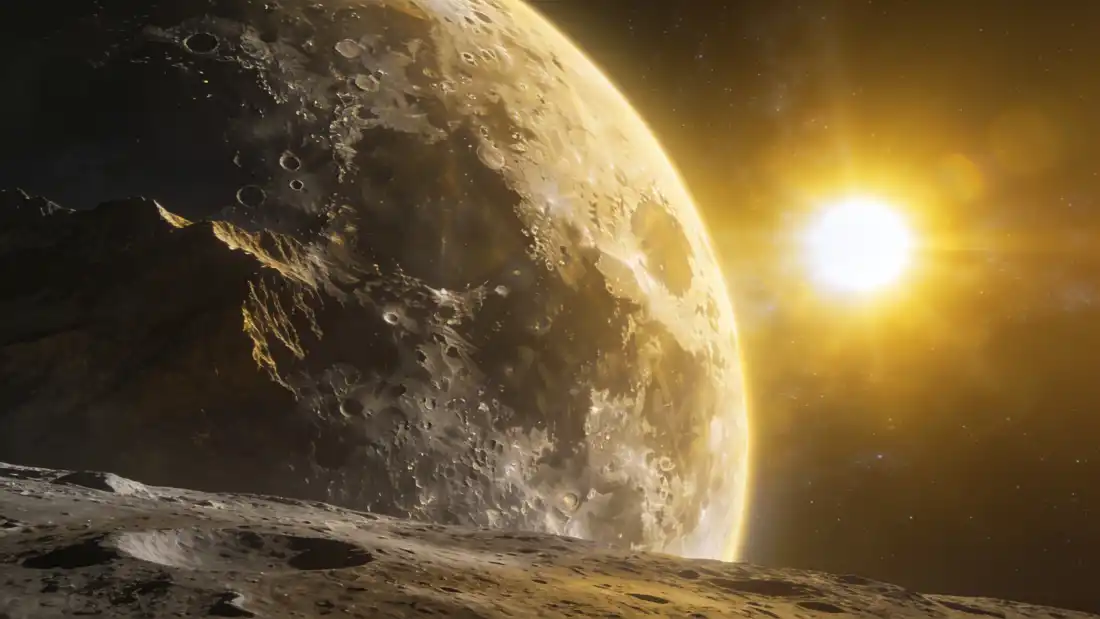
TOI-1839 c is a world quite unlike our own. It sits about 379 light-years away, and scientists only confirmed its existence in 2026. Even from that enormous distance, the clues it has already given us are fascinating.
Where in the Sky Does TOI-1839 c Live?
TOI-1839 c orbits a star called TOI-1839. That star lies 379 light-years from Earth. A light-year is the distance light travels in one year — about 9.5 trillion kilometers. So 379 light-years is an almost impossible distance for us to physically cross today, but telescopes can still study the light coming from that direction and learn a surprising amount.
TOI-1839, the host star, has a surface temperature of 5,316 K. Here, K stands for Kelvin, a scale scientists use to measure very hot things. For comparison, our own Sun has a surface temperature of around 5,778 K, so TOI-1839 is a little cooler and slightly dimmer than our Sun. That still makes it a warm, yellow-ish star, not the faint red kind called a red dwarf.
How Scientists Found It
TOI-1839 c was discovered in 2026 using a method called the transit method. When a planet passes in front of its star, it blocks a tiny fraction of the star’s light. From far away, we see the star get a little dimmer for a short time. Scientists watch for this pattern again and again. If the dimming happens on a regular schedule, they know a planet is likely orbiting there.
The transit method is brilliant in its simplicity, but it does have limits. It mainly tells us about a planet’s size — how wide it is — because a bigger planet blocks more light. To learn about mass — how much stuff is packed inside — scientists need to use other techniques as well. In the case of TOI-1839 c, both the radius and the mass have been measured, which gives us a much richer picture of this world.
What the Numbers Tell Us About Size and Mass

TOI-1839 c has a radius of 2.41 times Earth’s radius. That means if you lined up about two and a half Earths side by side, they would just about match the width of this planet. That puts it firmly in a category scientists call a mini-Neptune — a planet larger than Earth but smaller than the planet Neptune in our own solar system.
Its mass is 6.39 times Earth’s mass. Mass is simply how much matter a planet contains. When we compare a planet’s size and its mass together, we can work out something called density — density tells us how tightly packed the material inside is. A very dense planet is probably made mostly of rock and metal. A less dense planet likely contains a lot of lighter stuff, like water, ice, or gas.
TOI-1839 c’s density works out to be noticeably lower than a pure rocky planet of the same size would be. That tells scientists right away that rock alone cannot explain this world. Something lighter must be making up a big part of it. If you enjoy comparing planet sizes and masses visually, the mass-radius diagram is a great place to see how TOI-1839 c fits among thousands of other known worlds.
Inside a Mini-Neptune: Layers and Composition
So what is TOI-1839 c actually made of? Scientists think mini-Neptunes like this one probably have a rocky or metallic core at the center. Around that core, there may be a thick layer of water, ice, or other materials that are neither rock nor light gas — scientists sometimes call this a volatile layer, meaning it can flow or turn to gas under certain conditions. On top of all that, there is likely a deep, thick atmosphere made mostly of hydrogen and helium, the two lightest elements in the universe.
We should be honest here: scientists haven’t directly seen inside TOI-1839 c. These layers are educated guesses based on the planet’s size, mass, and density, combined with what we know about how planets form. Different models — different sets of assumptions — can give somewhat different answers. Some models might suggest more water, others more gas. As far as we know right now, the mini-Neptune category fits TOI-1839 c well, but the exact recipe inside remains uncertain.
What is clear is that this planet is not a small, dry, rocky world like Earth or Mars. It belongs to a class of planets that doesn’t even exist in our own solar system. Earth is rocky, and Neptune is a large ice giant. TOI-1839 c sits somewhere in between, in a size range that turns out to be very common across the galaxy.
A Scorching, Speedy Orbit
TOI-1839 c completes one full orbit around its star in just 4.02 Earth days. Our own year lasts 365 days, so TOI-1839 c’s year is extremely short. To move that quickly, the planet must be orbiting very close to its star.
Being so close to a star means the planet receives an intense flood of heat and radiation. Scientists call planets in this situation hot worlds, and TOI-1839 c almost certainly falls into that group. At this distance, the planet sits nowhere near the habitable zone — that is the region around a star where temperatures might allow liquid water to exist on a planet’s surface. TOI-1839 c is far too close, and far too hot, for that. We have no reason to think it has liquid water or anything like life as we know it.
TOI-1839 c and Its Planetary Neighbor
TOI-1839 c is not alone. Scientists have identified two planets in the TOI-1839 system so far. The other world is called TOI-1839 b. Having more than one planet in a system is quite common — our own solar system has eight — and multiple planets often help scientists understand how the whole system formed and evolved over time.
We don’t have detailed published data here about TOI-1839 b’s size, mass, or orbit, so we won’t guess at those numbers. What we can say is that studying two planets around the same star can sometimes help scientists refine their measurements of both, since the planets can tug on each other in tiny but detectable ways. You can also compare the sizes of planets in a system to get a feel for how they relate to each other.
What We Still Don’t Know
TOI-1839 c was only confirmed in 2026, which makes it a very recent discovery. There is a lot scientists haven’t measured yet — things like its exact atmospheric makeup, whether it has clouds, and precisely how its interior is structured. Future telescopes and observation campaigns may be able to look at the light passing through its atmosphere during transits. That kind of study, called transmission spectroscopy, can reveal which gases are present.
For now, TOI-1839 c stands as a good example of why mini-Neptunes are so interesting to study. They are the most common type of planet found so far beyond our solar system, yet we have nothing quite like them nearby to compare. Each new measurement brings us a little closer to understanding what these worlds are really like — and why they form so often across the galaxy.