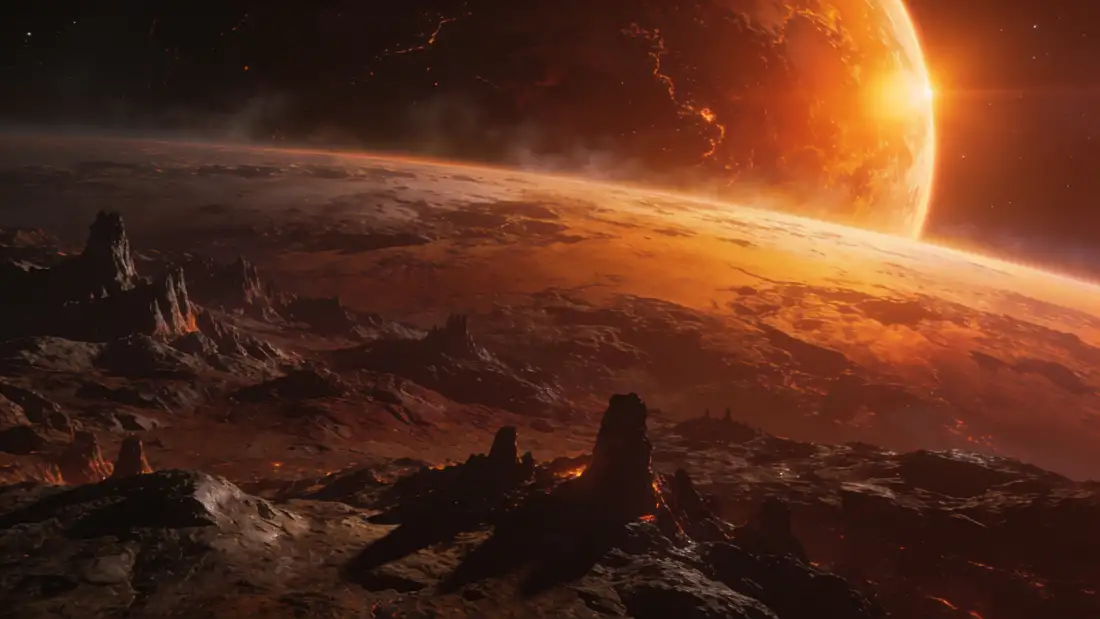
TOI-209 b is an exoplanet — a planet that orbits a star other than our Sun. It sits 370 light-years from Earth, which means no telescope can take a photo of it directly. Yet scientists know it is there, and they even know its size and mass. How? They used clever methods that turn small clues in starlight into real discoveries.
What Kind of World Is TOI-209 b?
TOI-209 b is larger than Earth but smaller than Neptune. Scientists call worlds in this size range sub-Neptunes or mini-Neptunes, depending on their exact measurements. With a radius of 2.39 times Earth’s and a mass of 6.32 times Earth’s, TOI-209 b is a good deal bigger and heavier than our home planet. But it is nowhere near the giant size of Jupiter or Saturn.
We do not know exactly what its surface or interior looks like. Scientists think a planet with this size and mass might have a thick atmosphere — the layer of gases around it — and possibly a rocky or watery interior underneath. But so far, no measurements have told us what that atmosphere is made of, if it has one at all.
What we do know is that TOI-209 b is not a place where life as we know it could survive. Its likely temperature is about 846 K, which works out to roughly 573 degrees Celsius. That is far hotter than any oven and much hotter than the surface of Venus. The planet sits well outside the habitable zone — the region around a star where temperatures could allow liquid water to exist on a planet’s surface.
How the Transit Method Revealed This Planet

TOI-209 b was discovered in 2026 using the transit method. A transit happens when a planet passes in front of its star, as seen from our point of view. When that happens, the planet blocks a tiny fraction of the star’s light. Telescopes watching the star measure a small, brief dip in brightness. That dip is a clue that something is crossing the star’s face.
Here is how the process works, step by step:
- A telescope watches a star and carefully measures how bright it is over many weeks or months.
- If a planet is orbiting that star and its orbit happens to line up with our view, the planet will pass in front of the star regularly.
- Each time it passes, the telescope records a slight drop in the star’s light — often less than one percent.
- Scientists look for this dip repeating at the same time interval. The time between dips tells them how long the planet takes to complete one orbit.
- The depth of the dip — how much light the planet blocks — tells them roughly how big the planet is compared to its star.
For TOI-209 b, that transit signal repeats every 4.38 Earth days. That is how we know its year is just over four Earth days long. If you want to explore how this works visually, the How We Find Them simulator lets you watch a planet transit a star and see the light curve change in real time.
The transit method is powerful, but it only works when a planet’s orbit is lined up just right with our line of sight. Many planets around other stars will never be seen this way simply because they orbit at a different angle. TOI-209 b is one of the lucky ones — from Earth’s perspective, its orbit is tilted so the planet crosses in front of its star.
The Wobble Method: A Second Way to Check

The transit method tells scientists a planet’s size, but not its mass. To find mass, researchers often use a different technique called the radial velocity method, sometimes nicknamed the wobble method.
Here is the idea. A planet does not just orbit its star — the planet and star actually tug on each other with gravity. The star pulls the planet into its orbit, but the planet also pulls back on the star. This makes the star wobble very slightly as the planet goes around it. The wobble is tiny, but it creates a detectable signal: as the star moves toward us, its light shifts slightly toward the blue end of the spectrum. As it moves away, the light shifts toward the red end. This shift is called the Doppler effect — the same reason an ambulance siren sounds higher as it approaches and lower as it drives away.
By measuring how strong this wobble is, scientists can estimate the planet’s mass. A heavier planet causes a bigger wobble. For TOI-209 b, measurements put its mass at 6.32 times Earth’s. Combining that mass with the radius from the transit gives scientists a good idea of how dense the planet is — and density helps them think about what the planet might be made of.
What We Know About TOI-209 b’s Size and Mass
With a radius 2.39 times Earth’s and a mass 6.32 times Earth’s, TOI-209 b is denser than a planet made purely of gas would be. This hints that it likely has a substantial rocky or dense component, though scientists think it probably also has a thick envelope of gas or fluid around that denser core. Planets in this size and mass range are among the most common found so far around other stars, yet they are also some of the least understood. We have no such world in our own solar system — Earth is smaller and Neptune is much larger — so TOI-209 b sits in a gap we are still working to understand.
A Scorching Orbit — and What That Means
A year on TOI-209 b lasts only 4.38 Earth days. That is an extraordinarily short orbit. For a planet to circle its star so quickly, it must be very close to it. Being that close is why TOI-209 b is so hot — estimated at around 573 degrees Celsius. Scientists haven’t measured the exact distance between the planet and its star with values listed in the current data, but the short orbit period makes clear that the planet is much closer to TOI-209 than Earth is to the Sun.
At such close range, the planet is likely tidally locked — meaning one side always faces the star, just as one side of our Moon always faces Earth. If that is the case, one hemisphere bakes in constant heat while the other sits in permanent darkness. Scientists are not certain about this, but it is a reasonable expectation for planets with orbits this short.
The Star Behind the Planet
TOI-209 b orbits a star called TOI-209. With a surface temperature of 4,807 K, this star is cooler than our Sun, which runs at about 5,778 K. A star this temperature typically glows with an orange tint rather than the yellow-white of our Sun. Stars in this temperature range are often called K-type stars — sometimes described as orange dwarfs. They are common in our galaxy and tend to be long-lived and stable.
So far, TOI-209 b is the only known planet in this system. That does not mean it is alone — other planets could be there but simply not yet detected, either because their orbits are not lined up for transits or because the wobble signal they create is too small to measure clearly.
TOI-209 b is a good reminder of how much we can learn about a distant world without ever seeing it directly. A careful watch on starlight, some patient mathematics, and two complementary methods together painted a picture of a hot, dense world circling an orange star 370 light-years away — all without a single direct photograph.