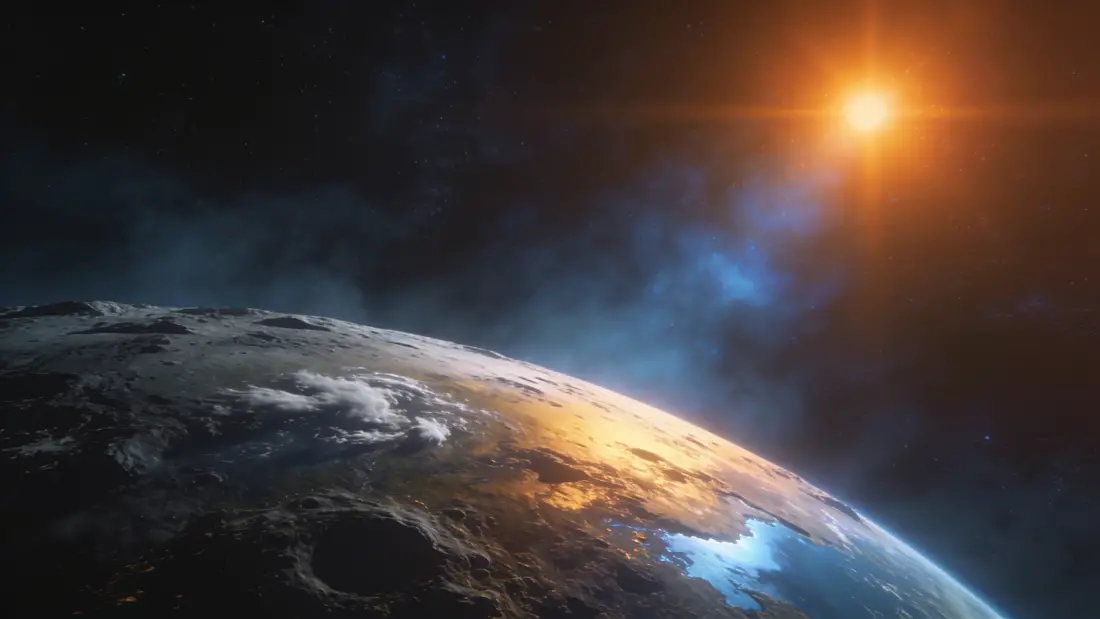
Kepler-1540 b is a world nearly 800 light-years away, and it has caught the attention of scientists wondering where life might exist beyond Earth. A light-year is the distance light travels in one year — an almost unimaginably large gap. What makes this planet interesting is where it sits in relation to its star, and what that might mean for liquid water.
Where in the Galaxy Is Kepler-1540 b?
Kepler-1540 b sits about 799 light-years from Earth. That is very far, but in galaxy terms it is actually a nearby neighbor. Our galaxy, the Milky Way, stretches roughly 100,000 light-years across, so this planet is well within our own small corner of it.
The planet was discovered in 2016. Scientists found it using the transit method — that is, they watched its star and noticed the starlight dimming slightly each time the planet passed in front of it. By measuring how much the light dipped and how often, they could figure out the planet’s size and how long it takes to orbit its star. This was done as part of NASA’s Kepler mission, which watched hundreds of thousands of stars at once looking for exactly these small dips.
So far, Kepler-1540 b is the only planet scientists have confirmed in this system. That does not mean it is alone — it just means no other planets have been detected yet.
What Kind of World Are We Looking At?

Kepler-1540 b is bigger than Earth, but not by a huge amount. Its radius — the distance from its center to its surface — is about 2.49 times Earth’s radius. Its mass, meaning how much matter it contains, is about 6.76 times Earth’s mass.
Those two numbers together tell scientists something useful. When a planet has a mass and radius in this range, it often falls into a category called a sub-Neptune or a super-Earth. A super-Earth is simply a rocky planet larger than Earth. A sub-Neptune tends to have a thick layer of gas or water around a rocky or icy core. Scientists are not yet certain which category Kepler-1540 b belongs to.
If it is more like a super-Earth — mostly rocky — its surface conditions might be something we could imagine, even if very different from home. If it has a thick, heavy atmosphere like Neptune’s, conditions at any solid surface below could be extreme. At this point, we honestly don’t know which picture is closer to the truth.
A Cool Star and a Long Year
The star Kepler-1540 has a surface temperature of about 4,540 K. (K stands for Kelvin, a scale scientists use to measure temperature — 4,540 K is quite warm to us, but for a star it is on the cooler end.) Our own Sun has a surface temperature of about 5,778 K, so Kepler-1540 is noticeably cooler and, as a result, dimmer and likely smaller. A star like this is sometimes called a K-type star or an orange dwarf.
One orbit of Kepler-1540 b around its star takes about 125 Earth days. That is one “year” on this world — roughly one-third of an Earth year. Because the star is cooler and dimmer than the Sun, a planet needs to orbit closer in to receive a similar amount of warmth. A shorter or similar orbit length in that context is actually consistent with a planet sitting in a moderate temperature range.
The Habitable Zone — What It Is and Where Kepler-1540 b Sits

The habitable zone is the band of distances around a star where conditions might allow liquid water to exist on a planet’s surface. It is sometimes called the “Goldilocks zone” because the temperature is not too hot and not too cold — just possibly right. Liquid water is important because, as far as scientists can tell, all life on Earth depends on it. If water boils away or freezes solid, life as we know it has a much harder time.
The habitable zone is different for every star. A hot, bright star has a wider and more distant zone. A cool, dim star has a zone that sits much closer in. Because Kepler-1540 is cooler than our Sun, its habitable zone is closer to the star than Earth is to the Sun.
Based on what scientists know about this system, Kepler-1540 b appears to orbit within or near its star’s habitable zone. If you want to explore how habitable zones work for different kinds of stars, you can take a look at our habitable zone explainer. Being in the zone does not mean the planet has water or life — it only means the distance is right for water to possibly exist in liquid form, if other conditions cooperate.
The Temperature Clue
Scientists have estimated an equilibrium temperature for Kepler-1540 b of about 266 K, which works out to roughly -7 degrees Celsius. Equilibrium temperature is the temperature a planet would reach based purely on how much starlight it receives, assuming it has no atmosphere. Think of it like guessing how warm a rock would get sitting in sunlight, before you account for any blanket of air around it.
A reading of -7 C is close to water’s freezing point. That is genuinely interesting. It means the planet is not roasting and not drifting in deep cold. An atmosphere — if one exists — could warm things up through the greenhouse effect, where certain gases trap heat. Earth’s own greenhouse effect raises our average temperature well above what our equilibrium temperature alone would suggest. So even a modest atmosphere on Kepler-1540 b could push temperatures above freezing. But scientists haven’t measured an atmosphere there yet, so this remains a careful “what if.”
What We Still Don’t Know
The list of unknowns is long, and that is normal for a world this far away. Scientists have not yet measured whether Kepler-1540 b has an atmosphere, and if so, what it is made of. They don’t know whether the planet is rocky or wrapped in gas and ice. They have not detected any moons. They do not know if it has a magnetic field, which on Earth helps protect life from harmful radiation.
Future telescopes may be able to study the light passing through or reflecting off distant atmospheres, giving us hints about their chemistry. Until then, Kepler-1540 b holds its secrets. You can compare it with other candidates on our most Earth-like worlds list to get a sense of where it stands.
What we can say is this: Kepler-1540 b is a world in a promising location, with a temperature estimate that does not rule anything out. That is worth paying attention to, even if it is nowhere near a final answer.