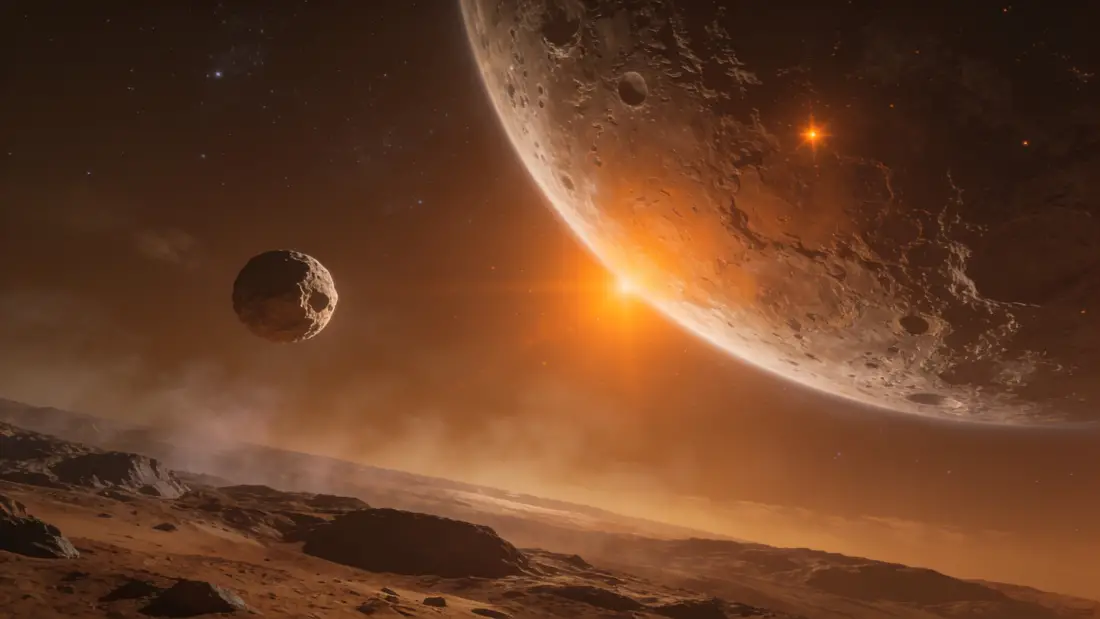
About 119 light-years from Earth, a star called Kepler-444 hosts a tight family of five planets. This system caught scientists’ attention not just because of its planets, but because of how old and unusual the whole setup is. One member of that family, Kepler-444 f, gives us a window into what distant worlds can be like.
A Very Old Star and Its Five Worlds
Kepler-444 is a star, much like our Sun but a little cooler. Its surface temperature is about 5,046 K — that K stands for Kelvin, a scientific way of measuring heat where 0 K is the coldest anything can ever be. Our Sun’s surface sits at roughly 5,778 K, so Kepler-444 runs a bit cooler and probably glows with a slightly more orange tint.
What really stands out about this star is its age. Scientists think Kepler-444 is around 11 billion years old. Our Solar System is only about 4.6 billion years old. That means this star, and the planets orbiting it, were already ancient long before Earth even formed. It tells us that planet formation — the process of dust and gas clumping together to build worlds — was happening in the universe much earlier than many researchers expected.
All five known planets in this system orbit very close to their star. Close means really close: every single one of them completes a full orbit in less than ten Earth days. Compare that to Mercury, our Solar System’s innermost planet, which takes 88 days to go around the Sun. The whole Kepler-444 family fits inside a space much smaller than Mercury’s orbit.
Kepler-444 f: The Outermost Known Planet

Of the five worlds in this system, Kepler-444 f is the farthest from the star — though “far” is relative here. It still whips around Kepler-444 in just 9.74 Earth days.
Kepler-444 f is smaller than Earth. Its radius — that is, the distance from its center to its surface — is 0.74 times Earth’s radius. Its mass, meaning how much matter it contains, is 0.33 times Earth’s mass. So it is a noticeably lighter, more compact world than our own.
It is also very hot. Scientists estimate its likely temperature at around 673 K, which works out to roughly 400 degrees Celsius. That is far hotter than any oven you would find in a kitchen, and well beyond what liquid water needs to survive. Kepler-444 f does not sit in the habitable zone — the region around a star where temperatures might allow liquid water to exist on a surface. No one expects this planet to be a friendly place for life as we know it.
Scientists haven’t measured everything about Kepler-444 f yet. Details like what its atmosphere might be like, if it even has one, are still unknown. At this point, the size, mass, and temperature figures give us a rough sketch of a small, scorching, rocky-feeling world — but much remains to be learned.
How Scientists Found This Family

The five planets of Kepler-444 were discovered in 2015 using the transit method. Here is how that works: when a planet passes in front of its star from our point of view, it blocks a tiny fraction of the star’s light. A telescope watching carefully can detect that dip in brightness. Do that repeatedly, and you can confirm a planet is there and measure its size.
The telescope responsible for finding this system was NASA’s Kepler space telescope, which is also where the star gets its name. Kepler spent years staring at hundreds of thousands of stars, hunting for those small, regular dips in starlight. It was very good at finding systems where multiple planets orbit the same star, because when several worlds line up to cross their star in turn, the light-curve — the record of how bright the star appears over time — shows a repeating pattern that is hard to miss.
Because the planets in this system orbit so quickly, Kepler could watch many orbits go by in a single observing season. That made it easier to confirm all five worlds. You can explore other systems found this way in our system explorer.
A Packed and Tidy Arrangement
One of the most interesting things about Kepler-444 is just how orderly it looks. Five planets, all huddled close to their star, all in orbits that take less than ten days. In our own Solar System, the planets are spread out across enormous distances. The gap between Earth and Mars alone is vastly larger than the entire width of the Kepler-444 system.
Systems like this one — compact, multi-planet, tightly packed — turn out to be surprisingly common in the galaxy. The Kepler telescope found many of them. Scientists think this kind of arrangement might form when planets migrate, meaning they slowly drift inward from where they first formed, settling into neat, close orbits around their star.
What is unusual here is the age. Most of the compact multi-planet systems we know about formed in a universe that already had several billion years behind it. Kepler-444 did the same thing when the universe was far younger and had fewer heavy elements — atoms like iron and silicon that help build rocky planets. That the system formed at all, with five planets, is a small puzzle that scientists are still thinking about.
The five planets are also quite similar in size to one another. They are all smaller than Earth, and none of them are gas giants — those are the large, fluffy planets made mostly of hydrogen and helium, like Jupiter or Saturn. Instead, the Kepler-444 family appears to be a set of small, compact worlds, possibly rocky, though scientists are still working to understand their exact makeup.
Why This System Matters
Kepler-444 and its planets, including Kepler-444 f, remind us that the universe started making planets a very long time ago. If planet formation was already underway 11 billion years ago, then there has been a lot of time — far more than Earth has existed — for other worlds to develop and change. That does not mean any of those worlds host life, but it does mean the conditions for complexity have been present in the cosmos for a long while.
Systems like this one also help scientists test ideas about how planets form and arrange themselves. Every family of worlds around a single star is a data point, a piece of a much larger picture we are slowly assembling. Kepler-444, ancient and compact and full of small, hot worlds, is one of the more thought-provoking pieces in that picture.