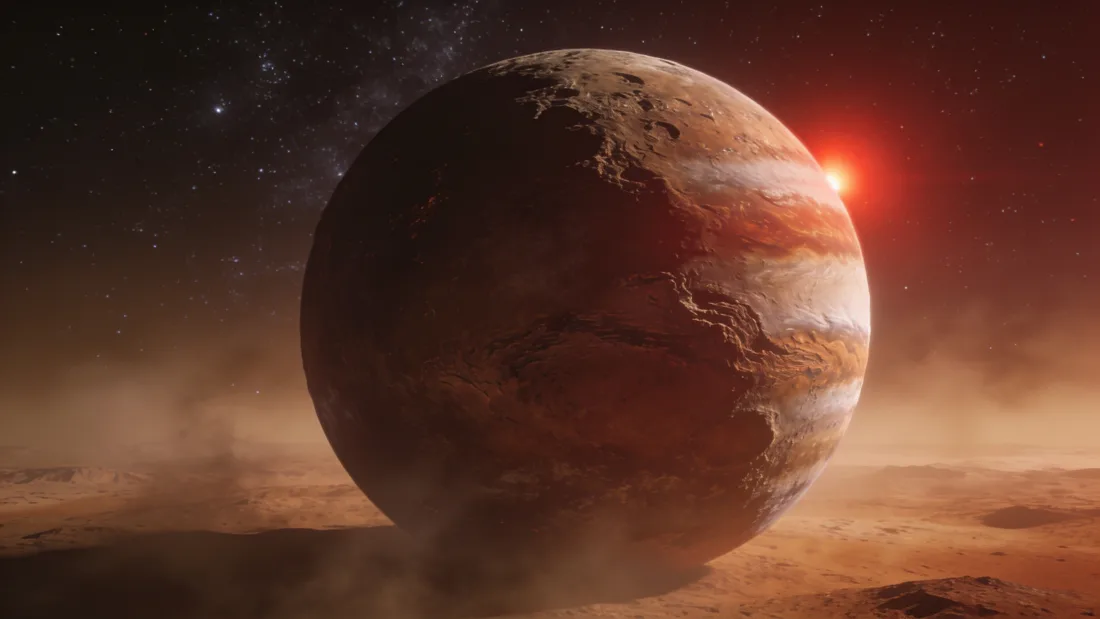
Astronomers have found thousands of planets orbiting distant stars, yet they have never seen most of them directly. Instead, they watch for clues hidden in starlight. LHS 1903 e is one of those hidden worlds — discovered in 2026, it sits 116 light-years from Earth, waiting to be understood.
A Star Called LHS 1903
Before we can understand the planet, we need to meet its star. LHS 1903 is what astronomers call a red dwarf — a star much smaller and cooler than our Sun. Its surface temperature is 3,664 K (K stands for kelvin, a unit scientists use to measure very high or very low temperatures — 3,664 K is roughly 3,391 degrees Celsius). Our Sun burns at about 5,778 K by comparison, so LHS 1903 is noticeably cooler and dimmer.
Red dwarfs are the most common type of star in our galaxy. Because they shine less brightly than the Sun, any planet catching enough warmth to have liquid water must orbit quite close in. LHS 1903 e does orbit close, completing one full trip around its star in just 29.3 Earth days. That is shorter than a single month here at home.
The whole system sits 116 light-years away. A light-year is the distance light travels in one year — about 9.5 trillion kilometres. So 116 light-years is an enormous distance. No spacecraft we have built today could reach LHS 1903 e in any reasonable time. Everything we learn about this world must come from the light that crosses that vast gulf and arrives at our telescopes.
The Transit Method — How a Tiny Shadow Reveals a World
The transit method is the main way LHS 1903 e was found. Here is how it works, step by step.
- Astronomers point a telescope at a star and watch its brightness very carefully over many weeks or months.
- If a planet is orbiting that star, and its orbit happens to line up just right with our line of sight, the planet will pass across the face of the star. This crossing is called a transit.
- During a transit, the planet blocks a tiny slice of the star’s light. The star looks ever so slightly dimmer for a short while — sometimes just a fraction of one percent.
- When the planet moves away, the brightness goes back to normal.
- If the same dip happens again and again at regular intervals, scientists know a planet is orbiting there.
Think of it like a moth flying slowly in front of a distant lamp. You might not see the moth itself, but you would notice the lamp flicker just a little. That flicker tells you something is there.
The transit method also gives scientists the planet’s radius — that is, how wide it is. A bigger planet blocks more light and causes a deeper dip. By measuring exactly how much the star dims, astronomers can calculate the planet’s size relative to the star. For LHS 1903 e, they found a radius of 1.73 times Earth’s. In other words, this world is nearly twice as wide as our planet.
If you want to explore how transits look in action, the how we find them simulator lets you watch a model star dim as a planet crosses it.
The Wobble Method — A Star That Moves

The transit method is powerful, but it mostly tells us about size. To find out how heavy a planet is, scientists use a second technique called the radial velocity method — often called the wobble method.
Here is the idea. A planet does not simply orbit a star; the two objects actually pull on each other with gravity. A massive planet tugs its star gently back and forth as it orbits. This causes the star to wobble — a tiny movement toward us and then away from us, over and over.
Scientists can detect this wobble by studying the star’s light very closely. When a star moves toward us, its light waves get slightly compressed, shifting toward the blue end of the colour spectrum. When it moves away, the light stretches toward the red end. This change is called a Doppler shift, and it happens with sound too — it is the same reason a siren sounds higher-pitched as it comes toward you and lower as it drives away.
By measuring how much and how fast the star wobbles, astronomers can estimate the planet’s mass. For LHS 1903 e, those measurements gave a mass of 5.79 times Earth’s mass. That is nearly six times heavier than our own planet.
What We Know About LHS 1903 e
Putting the transit and wobble results together gives us a surprisingly detailed picture for a world so far away.
- Radius: 1.73 times Earth’s
- Mass: 5.79 times Earth’s
- Estimated surface temperature: about 333 K, which is roughly 60 degrees Celsius
- Year length: 29.3 Earth days
60 degrees Celsius is hot — hotter than most places on Earth’s surface. But scientists have to be careful about what this temperature number really means. It is an estimated value based on the planet’s distance from its star. The actual temperature could be quite different depending on whether the planet has an atmosphere, how thick that atmosphere might be, and what it contains. We do not yet know if LHS 1903 e has an atmosphere at all.
The mass and radius together can hint at what a planet is made of. A planet that is nearly six times Earth’s mass but less than twice Earth’s radius is likely to be dense and rocky — or it might have a thick layer of water or gas around a rocky core. Scientists call worlds in this size range super-Earths. As far as we know, scientists haven’t yet measured enough to say for certain what LHS 1903 e is made of.
A Busy Neighbourhood
LHS 1903 e does not travel alone. Astronomers have found four planets in total orbiting LHS 1903. That makes this a busy little system around a single dim star. Having multiple planets in one system is actually quite common — our own solar system has eight, after all. Finding several planets at once around LHS 1903 helps scientists understand how planets form and arrange themselves around red dwarfs.
What LHS 1903 e Might Be Like — And What We Still Don’t Know
LHS 1903 e sits in a region where liquid water could exist on its surface — scientists sometimes call this the habitable zone, the range of distances from a star where temperatures might allow liquid water. But sitting in that zone is very different from actually having liquid water. Whether this world has oceans, a surface at all, or any kind of air is something we simply do not know yet.
What is remarkable is how much we can learn from a planet we cannot see directly — its width, its weight, roughly how warm it might be, and how long its year lasts. All of that knowledge comes from watching a star’s light change in the most subtle ways. LHS 1903 e is 116 light-years away, and yet it is already becoming knowable, one careful measurement at a time.