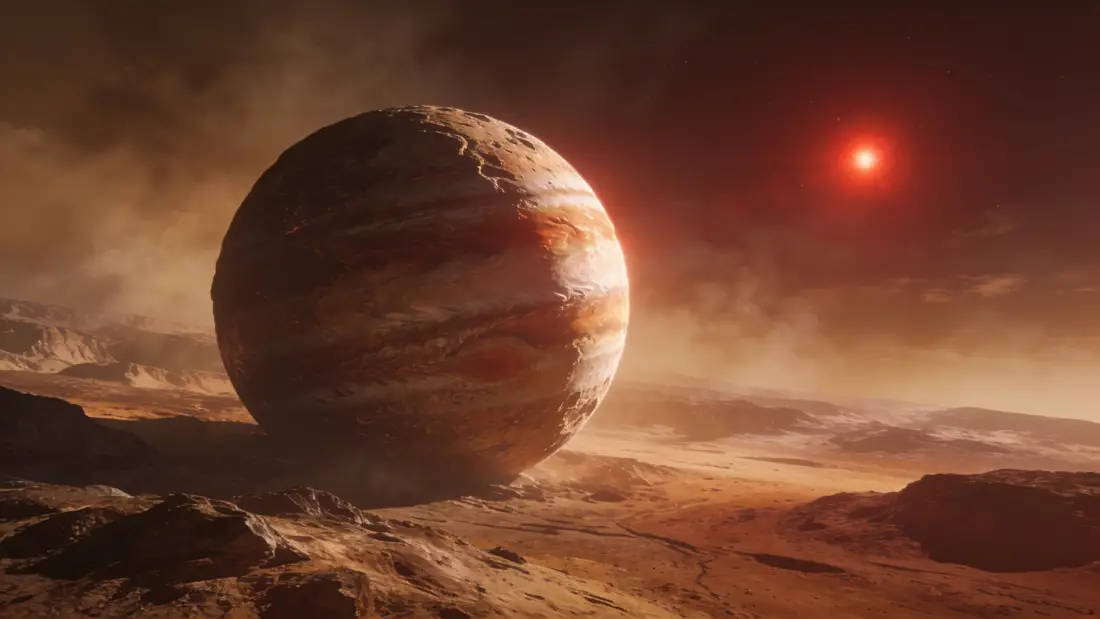
GJ 887 c is one of the closest known exoplanets — planets orbiting stars other than our Sun — to Earth. It circles a dim, nearby star just 10.7 light-years away. That sounds close in space terms, and by cosmic standards it truly is, but the real distance is still almost impossible to picture from where we stand.
How Far Is 10.7 Light-Years, Really?
A light-year is the distance light travels in one full year. Light moves at about 300,000 kilometres every second. In a year, it covers roughly 9.46 trillion kilometres. So 10.7 light-years is about 101 trillion kilometres. Writing that number out doesn’t really help most people feel it, so let’s try another way.
Our fastest spacecraft so far have travelled at tens of kilometres per second. At those kinds of speeds, reaching GJ 887 c would take far longer than all of recorded human history — we are talking tens of thousands of years, at minimum. Even a future spacecraft travelling at a small fraction of the speed of light would need many decades to arrive.
And yet, in the grand scheme of our galaxy, 10.7 light-years is practically our backyard. The Milky Way is about 100,000 light-years across. GJ 887 c’s star is among our nearest stellar neighbours. If you want to explore how travel times to worlds like this actually work out at different speeds, the Distance and Travel Time tool can walk you through the numbers.
The Star GJ 887 — A Quiet Red Dwarf Next Door
GJ 887 is what astronomers call a red dwarf — a star that is smaller, cooler, and much dimmer than our Sun. Its surface temperature is 3,688 K (the letter K stands for Kelvin, a temperature scale scientists use, where 0 K is the coldest anything can be). For comparison, our Sun’s surface is roughly 5,778 K, so GJ 887 runs noticeably cooler.
Because red dwarfs are so dim, their habitable zone — the band of distances around a star where liquid water could exist on a planet’s surface — sits much closer in than the habitable zone around our Sun. Planets have to orbit tightly to receive enough warmth.
One thing that makes GJ 887 interesting to researchers is that it appears to be a relatively calm star. Many red dwarfs are known for powerful flares — sudden blasts of energy and radiation. A calmer star might be gentler on any nearby planets. Scientists think GJ 887 shows fewer of these flares than many other red dwarfs of its type, though researchers continue to watch it carefully.
What We Know About GJ 887 c
GJ 887 c has a radius — that is, its distance from its centre to its surface — about 2.43 times that of Earth. Its mass, meaning how much matter it contains, comes in at about 6.5 times Earth’s mass. A planet in this size and mass range is often called a super-Earth or, depending on its makeup, a mini-Neptune. Scientists aren’t yet sure which of those two categories fits GJ 887 c best, because knowing a planet’s true nature requires understanding what it is made of on the inside — and we don’t have that information yet.
One orbit around GJ 887 takes just 21.8 Earth days. That means a year on GJ 887 c is shorter than most calendar months here at home. The planet sits close to its star to complete that quick orbit.
The estimated surface temperature for GJ 887 c is around 320 K, which works out to about 47 degrees Celsius. That is warmer than a hot summer day nearly anywhere on Earth. Whether any actual surface exists at that temperature — or whether the planet is wrapped in thick gas layers — scientists haven’t determined yet. The temperature figure is an estimate based on how much starlight the planet likely receives, and real conditions could be quite different depending on what kind of atmosphere, if any, the planet has.
A System of Four Worlds

GJ 887 c is not alone. Scientists have identified four planets in this system so far. Finding multiple planets around the same star is common — our own solar system is a good reminder that stars often hold several worlds at once. The other planets in the GJ 887 system have their own orbits and properties, though detailed measurements for them are still being gathered.
Having several planets packed around a small, cool star is a pattern scientists see often in red dwarf systems. Because the habitable zone lies so close to the star, some of these tightly spaced planets may receive very different amounts of energy depending on exactly where they sit in the lineup. You can get a feel for where GJ 887 fits among our closest stellar neighbours by exploring the Cosmic Map.
How Astronomers Found It — The Radial Velocity Method
GJ 887 c was discovered in 2020 using what’s called the radial velocity method. Here is how that works. When a planet orbits a star, it doesn’t just get pulled by the star’s gravity — it also tugs back on the star, just a little. That tiny tug makes the star wobble very slightly, moving toward us and then away from us in a slow, rhythmic pattern as the planet goes around.
When a star moves toward us, the light it sends reaches us slightly compressed — its colour shifts a little toward the blue end of the spectrum. When the star moves away, the light stretches and shifts slightly toward red. By measuring these colour shifts very precisely, scientists can detect the wobble and work backwards to learn about the planet’s mass and orbit.
The radial velocity method is one of the two main ways astronomers find exoplanets. It works especially well for heavier planets in tight orbits, which is exactly the situation with GJ 887 c.
Could This World Be a Place for Life?
This is the question many readers will want answered, and the honest answer is: we don’t know, and we can’t say much yet. At an estimated 47 degrees Celsius, the surface — if there is a solid surface — would be on the warm side for life as we know it, though some organisms on Earth do survive in similarly warm conditions. Whether GJ 887 c sits within the formal habitable zone of its star, and whether it holds an atmosphere suitable for life, are things scientists haven’t been able to confirm.
What makes GJ 887 c worth watching is its closeness. At just 10.7 light-years away, it is close enough that future telescopes — more powerful than anything currently operating — might one day be able to study its atmosphere directly, if it has one. For now, GJ 887 c stands as a genuine nearby world whose full story is still being written, one careful observation at a time.