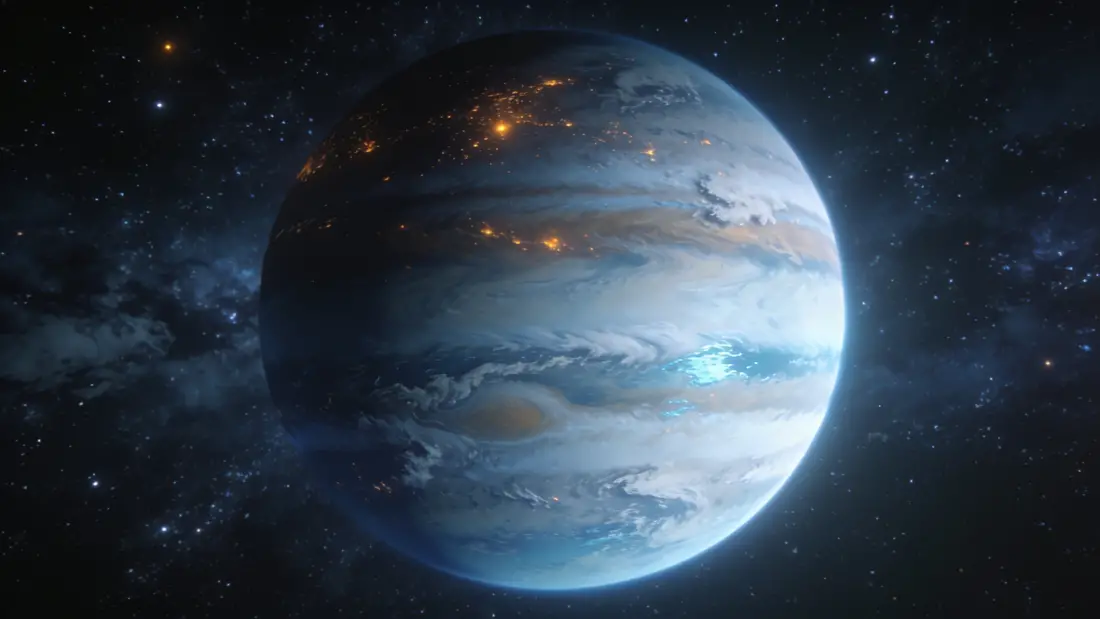
Kepler-967 c is a world far beyond our solar system, circling a star that looks a little like our own Sun. Scientists found it in 2016, and it sits in a region where liquid water — the kind that living things on Earth depend on — could potentially exist on its surface. That makes it a fascinating place to think about, even though we still have a lot to learn.
A World 1,854 Light-Years Away
Kepler-967 c lies about 1,854 light-years from Earth. A light-year is the distance light travels in one year — roughly 9.5 trillion kilometers. That means even travelling at the speed of light, you would need nearly two thousand years to reach this planet. It is extraordinarily far away, and no spacecraft we have today could get anywhere close to it in a human lifetime.
Scientists discovered Kepler-967 c using the transit method. This is a way of spotting planets by watching for tiny dips in a star’s brightness. When a planet passes in front of its star, it blocks a small amount of starlight. By measuring how often those dips happen, and how deep they are, astronomers can work out a planet’s size and how long its year is. The planet was confirmed in 2016, most likely using data from NASA’s Kepler space telescope, which spent years staring at hundreds of thousands of stars looking for exactly these kinds of signals.
Kepler-967 is a system with two known planets so far. Kepler-967 c is the second one out from the star.
A Bigger, Heavier World Than Earth
Kepler-967 c is noticeably larger and heavier than our planet. Its radius — the distance from the center to the surface — is about 3.65 times Earth’s radius. Its mass is around 12.9 times Earth’s mass. These are careful estimates based on the transit data and other measurements, and scientists treat them as their best current figures rather than exact certainties.
A planet with these proportions falls into a category researchers sometimes call a sub-Neptune or a super-Earth — worlds bigger than Earth but smaller than the ice giants Uranus and Neptune in our own solar system. Planets in this size range are actually very common across the galaxy, even though we don’t have one in our own solar system to study up close.
What is Kepler-967 c actually made of? Scientists haven’t worked that out with confidence yet. A planet of this size and mass could be a rocky world with a thick atmosphere, or it might be a world with a deep layer of water or ice beneath a gassy envelope. Both are real possibilities. Without more detailed observations — the kind that current telescopes struggle to make at this distance — we simply don’t know.
If you want to compare Kepler-967 c with other large rocky or ocean-type candidates, the Most Earth-Like Worlds list is a good place to see how scientists rank and group these kinds of planets.
The Star at the Center: Kepler-967
Every planet’s story starts with its star, and Kepler-967 is an interesting one. Its surface temperature is about 5,178 Kelvin. Kelvin is a temperature scale scientists use; to get a rough Celsius value, subtract 273. That puts Kepler-967’s surface at roughly 4,905 degrees Celsius. Our own Sun sits at about 5,778 Kelvin, so Kepler-967 is a bit cooler and likely a little smaller and dimmer than the Sun — though still a yellow or slightly orange star, broadly in the same family.
That matters a lot for the planet. A cooler star puts out less energy. So for a planet to receive a similar amount of warmth to what Earth gets, it needs to sit closer in. Kepler-967 c orbits at a distance that, given this star’s output, puts it inside what astronomers call the habitable zone — the band around a star where temperatures might allow liquid water on a planet’s surface. Scientists haven’t measured the exact orbital distance of Kepler-967 c yet, but the estimated temperature tells us roughly where it stands.
Temperature, Orbit, and the Habitable Zone
Kepler-967 c completes one full orbit around its star every 199 Earth days. That is its year — about six and a half months by our calendar. It moves faster around its star than Earth moves around the Sun, finishing each loop in well under one of our years.
The estimated surface temperature for Kepler-967 c is about 258 Kelvin, which works out to roughly minus 15 degrees Celsius. That is cold — well below the freezing point of pure water. But scientists use this figure as an equilibrium temperature, meaning it is a rough calculation of how warm the planet would be if it absorbed starlight like a bare rock with no atmosphere. A real planet with a thick atmosphere could be quite a bit warmer, because an atmosphere can trap heat the way a blanket does. This effect is called the greenhouse effect.
So while minus 15 degrees sounds icy, the real surface temperature depends heavily on whether Kepler-967 c has an atmosphere, what gases are in it, and how thick it is. Scientists haven’t measured any of that yet. It is entirely possible that the actual surface is warmer — perhaps warm enough for liquid water. It is also possible it is not. We genuinely don’t know.
To explore how the habitable zone works around different kinds of stars, you can visit the habitable zone explorer and see how the zone shifts depending on a star’s temperature and size.
Being in the Zone Is Not the Same as Having Life
It is worth pausing on what the habitable zone really means. It is not a guarantee of water, and it is certainly not a sign of life. It is simply the range of distances where, if a planet has the right kind of atmosphere and surface, liquid water could exist. Many things have to line up for that to happen. The planet needs an atmosphere thick enough to keep pressure on the surface. It needs the right mix of gases. It needs to be geologically active in ways that recycle materials, or maybe not — scientists still debate what conditions life truly needs.
Earth is in the habitable zone of the Sun, and it has liquid water and life. Mars is also roughly in or near the zone, and as far as we know it has neither, at least not on its surface today. Being in the right place is one piece of the puzzle, but only one.
What Scientists Still Need to Find Out
There is a long list of things we don’t yet know about Kepler-967 c. We don’t know its exact composition. We don’t know whether it has an atmosphere, and if so, what it contains. We don’t know its true surface temperature. We don’t know the precise distance between the planet and its star. These are not small gaps — they are the very details that would tell us whether this world is genuinely promising for liquid water, or whether it just happens to orbit in the right neighborhood.
Future telescopes with more powerful instruments may one day be able to study the atmospheres of planets at distances like this. For now, Kepler-967 c remains a careful estimate: a world of the right rough size, orbiting a star not too different from our Sun, sitting in a zone where water might — just might — be possible.