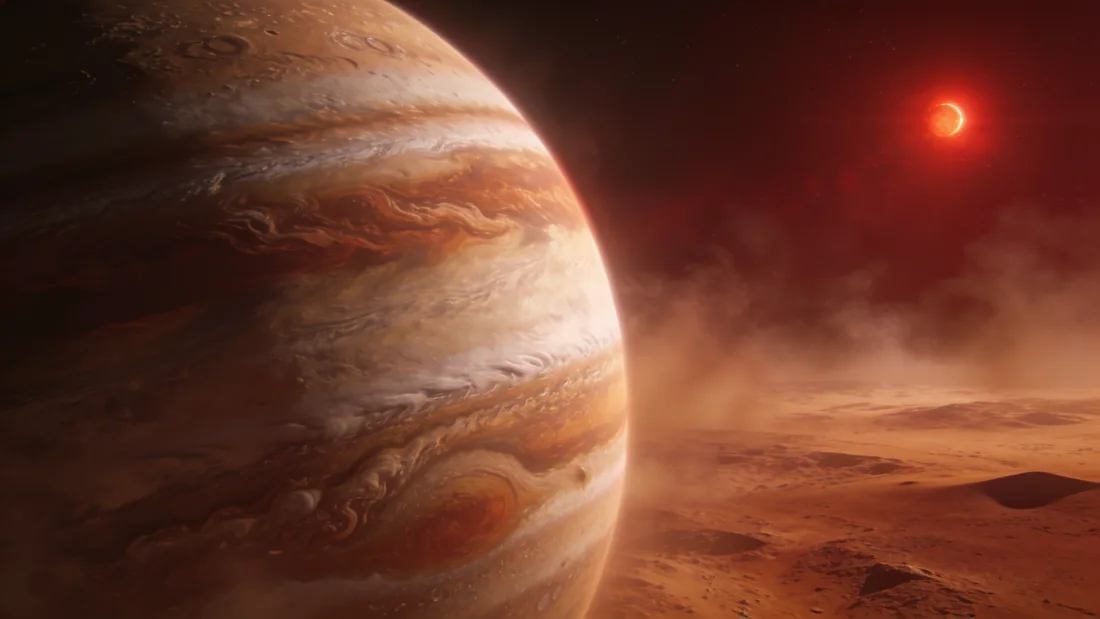
In 2026, astronomers added a new world to our growing list of known exoplanets — planets that orbit stars other than our Sun. That world is LHS 1903 d, a planet circling a dim star 116 light-years from Earth. The story of how scientists found it tells us a lot about one of the cleverest tricks in all of astronomy.
A Small Star 116 Light-Years Away
The star at the center of this story is called LHS 1903. It sits 116 light-years away from us. A light-year is the distance light travels in one year — about 9.5 trillion kilometers. So 116 light-years is an enormous distance, yet in the scale of our galaxy it is still a fairly close neighbor.
LHS 1903 is a red dwarf. Red dwarfs are stars that are much smaller and cooler than our Sun. Where the Sun’s surface reaches about 5,778 K (scientists measure star temperatures in units called Kelvin, where 0 K is the coldest anything can be), LHS 1903 has a surface temperature of just 3,664 K. That makes it noticeably cooler and redder than the Sun.
So far, astronomers have found four planets orbiting LHS 1903. LHS 1903 d is the third one out, as far as scientists can tell at this stage. Finding any planet around a star this far away is a real achievement, and it starts with watching very carefully for tiny changes in starlight.
How the Transit Method Works

Astronomers cannot take a normal photograph of LHS 1903 d. The planet is far too small and too close to its star for any telescope to see it as a separate dot of light. So instead, scientists watch the star itself and wait for something to happen.
When a planet’s orbit carries it between us and its star, the planet blocks a tiny fraction of the star’s light. This is called a transit — the planet is said to transit its star. From Earth, the star does not go dark. Instead, it dims just a little. The drop in brightness is very small, often less than one percent. But sensitive telescopes can measure it.
Here is how it works, step by step:
- Telescopes measure how bright the star looks over days, weeks, or months, recording each tiny change.
- Scientists look for a repeated pattern where the star dims by the same small amount, at regular intervals.
- If the dip happens again and again like clockwork, that is a strong sign that a planet is looping around the star on a steady orbit.
- Scientists then check whether other explanations — like a passing companion star — could cause the same pattern. If not, they grow confident a planet is there.
This is exactly how LHS 1903 d was discovered. You can explore how this kind of detection works with our interactive planet-finding simulator.
What the Dip in Light Tells Us

The transit is not just a detection tool. It also carries information hidden inside that tiny dip.
The depth of the dip — how much the star dims — tells astronomers how big the planet is compared to the star. A bigger planet blocks more light, so it creates a deeper dip. By working through the math, scientists figured out that LHS 1903 d has a radius (the distance from its center to its surface) about 2.5 times the radius of Earth. That makes it noticeably larger than our planet, though far smaller than a giant planet like Jupiter.
The timing between transits tells astronomers how long the planet takes to complete one orbit — its year. For LHS 1903 d, that year is just 12.6 Earth days. The planet races around its star in less than two Earth weeks. That is much faster than Earth’s 365-day year, but it makes sense: LHS 1903 d orbits much closer to its star than Earth orbits the Sun.
The Wobble Method: A Second Way to Check
The transit method is powerful, but astronomers like to confirm a discovery using a completely different approach. One of the best backup methods is called radial velocity, sometimes called the wobble method.
Here is the idea. A planet does not just orbit a star — both objects actually pull on each other with gravity. As the planet swings around, it tugs the star gently back and forth. The star moves only a tiny bit, but that tiny motion shifts the color of its light very slightly. When the star moves toward us, its light shifts toward the blue end of the color spectrum. When it moves away, the light shifts toward red. This is similar to the way a siren sounds higher as an ambulance approaches and lower as it drives away.
By measuring these color shifts with great care, astronomers can work out the mass of the planet. For LHS 1903 d, scientists measured a mass of about 5.96 times the mass of Earth. That is a solid, rocky-sounding world — though scientists are still working to understand exactly what kind of planet it is.
What We Know About LHS 1903 d
Putting the data together, here is what the evidence says about this planet, with honest notes about what we do and do not know.
- Size: 2.5 times Earth’s radius. It is definitely larger than Earth.
- Mass: About 5.96 times Earth’s mass. This puts it in a category scientists call a super-Earth or possibly a mini-Neptune — the boundary between those types is not always clear.
- Orbit length: 12.6 Earth days per trip around its star.
- Estimated temperature: About 442 K, which is roughly 169 degrees Celsius. That is hot — well above the boiling point of water. Scientists have not yet measured whether LHS 1903 d has an atmosphere, and without knowing that, the surface temperature is still an estimate.
- Habitability: At this temperature, liquid water on the surface seems very unlikely. Scientists have not found any sign of life, and the conditions as measured do not suggest it sits in the zone where liquid water could easily exist.
Many other details — like what the planet is made of, whether it has clouds, or exactly what its surface looks like — have not been measured yet.
Why Cool Red Stars Are Good Hunting Grounds
One reason LHS 1903 d could be found at all is that its host star is a red dwarf. Because red dwarfs are small and dim, a transiting planet blocks a larger fraction of their light than it would if it passed in front of a bigger, brighter star like the Sun. That deeper dip is easier to spot.
Red dwarfs also have smaller habitable zones — the range of distances where liquid water could exist on a planet’s surface — and planets in those zones have short orbital periods. Short periods mean more transits happen per year, giving astronomers more chances to catch the signal.
This is why so many recent planet discoveries, including the four worlds around LHS 1903, come from red dwarf stars. They are not easy targets, but the physics of their small size works in astronomers’ favor.
LHS 1903 d is one small piece of a much larger puzzle. Each planet found by the transit method adds to our understanding of how common planets are, what shapes and sizes they come in, and — someday — whether any of them might be places where life could take hold. That answer is still a long way off, but every careful measurement of a distant star’s flickering light brings us a little closer.