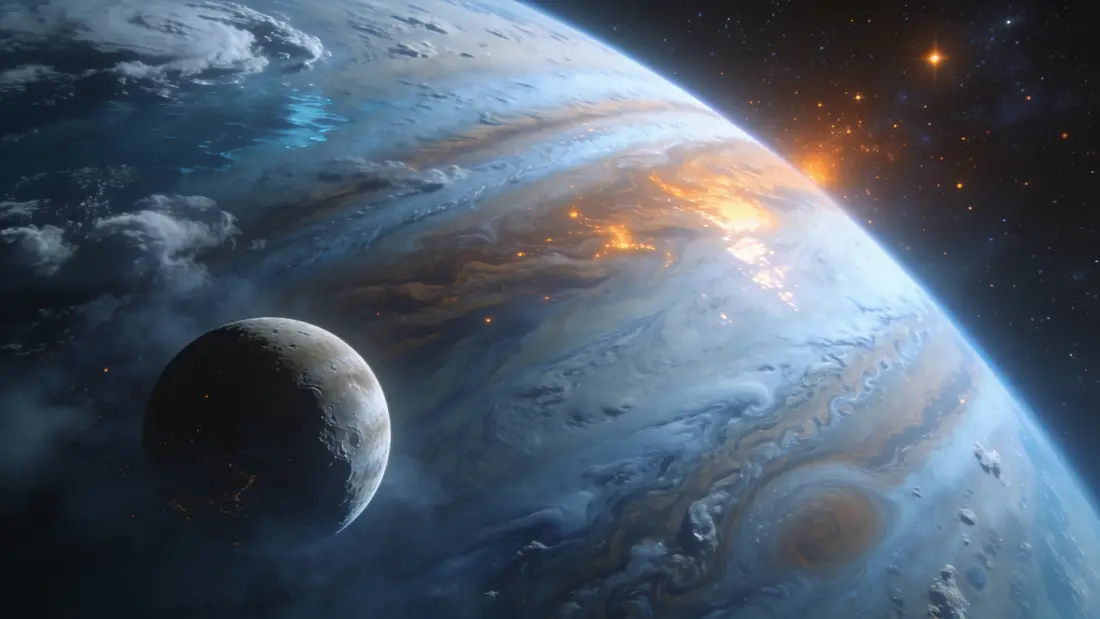
Kepler-553 c is a planet orbiting a star 2,376 light-years from Earth — so far away that light itself takes more than two thousand years to make the trip. Scientists spotted it in 2016, and it has quietly become one of the more curious entries on the long list of worlds found beyond our solar system. What makes it interesting is where it sits relative to its star, and what that might mean for water.
Finding Kepler-553 c
Astronomers discovered Kepler-553 c using the transit method. This means they watched the star and waited for the planet to pass in front of it. When that happens, the star’s light dips very slightly — like a lamp flickering when something small moves across it. By measuring how deep that dip is and how often it repeats, scientists can figure out the planet’s size and how long its year is.
Kepler-553 c takes 328 Earth days to complete one orbit around its star. That is very close to the length of an Earth year, which is 365 days. So while a year on this planet would feel roughly familiar in length, almost everything else about it is quite different from home.
The discovery came from the Kepler space telescope, which spent years staring at a patch of sky and recording the brightness of hundreds of thousands of stars at once. It gathered the data that led scientists to Kepler-553 c as part of a huge effort to find out how common planets are throughout our galaxy.
A Giant World

Kepler-553 c is enormous compared to Earth. Its radius — the distance from its center to its surface — is 11.6 times Earth’s radius. To picture that, imagine lining up nearly twelve Earths side by side across the middle of this planet.
Its mass is even more striking. Mass is the amount of matter packed into an object. Kepler-553 c has a mass of about 2,129 times Earth’s mass. That is in the range of a giant planet, more like Neptune or Jupiter in our own solar system than like a rocky world such as Earth or Mars.
A planet this large and massive almost certainly does not have a solid surface to stand on. Scientists think worlds in this size and mass range are made mostly of gas and liquid layers, with perhaps a dense core deep inside. If that is true for Kepler-553 c — and we cannot be completely certain yet — then “standing on the surface” would not really be possible in the way it is here on Earth.
That said, some scientists think that giant planets could have large moons. In our own solar system, some moons are bigger than the planet Mercury. A moon orbiting Kepler-553 c, if one exists, could be a very different kind of world. Scientists haven’t detected any moons here yet, and that is still well beyond what current telescopes can confirm.
The Star It Orbits

Kepler-553 c travels around a star called Kepler-553. The star’s surface temperature is 5,191 K — where K stands for Kelvin, a temperature scale scientists use that starts at absolute zero, the coldest anything can be. For comparison, our own Sun’s surface is about 5,778 K.
That means Kepler-553 is a little cooler than our Sun. A cooler star gives off slightly less energy and looks a little more orange than yellow. Stars like this are called K-type stars (sometimes called orange dwarfs), and they are considered quite stable. They burn through their fuel more slowly than hotter stars, which could be a good thing for any planet hoping to host life over a long stretch of time.
A calmer, longer-lived star means its planets have more time for things to develop — though of course, many other factors matter too.
Temperature and the Habitable Zone
The habitable zone is the band of space around a star where temperatures are just right for liquid water to exist on a planet’s surface — not so hot that water boils away, and not so cold that it freezes solid. It is sometimes called the “Goldilocks zone,” because conditions there are neither too hot nor too cold.
Kepler-553 c has an estimated temperature of 251 K, which works out to about -22 degrees Celsius. That is below the freezing point of pure water. So at first glance, it sounds too cold for liquid water. But that estimate is for the planet as a whole, based on how much light it receives from its star. The real temperature on or inside a planet depends on many other things — its atmosphere, its cloud cover, whether it generates internal heat, and more.
On Earth, for example, the greenhouse effect — where gases in the air trap heat — makes our planet significantly warmer than it would be otherwise. A thick atmosphere on Kepler-553 c could, in theory, raise temperatures. Scientists haven’t measured the atmosphere here, so we simply don’t know. What we can say is that the planet sits close enough to its star that liquid water is not ruled out by the numbers we have. You can explore how the habitable zone works for different kinds of stars with our habitable zone explorer.
Could This World Support Life?
This is where we have to be honest about what we don’t know. There is no evidence of life on Kepler-553 c. There is no confirmed evidence of liquid water, breathable air, or any of the other things life as we know it needs.
The planet’s enormous size and mass raise real questions. A world this massive would likely have very strong gravity. Its interior pressure would be extreme. These are not impossible conditions for life — we simply don’t know whether life could arise under them, because we have never encountered anything like it.
The more promising thought is about any hypothetical moons, but again, none have been found. For now, Kepler-553 c remains a place of genuine scientific curiosity rather than a strong candidate for life. If you want to see which planets scientists currently consider the most Earth-like, the most Earth-like worlds list is a good place to look.
Two Worlds, One System
Kepler-553 c is not alone. Scientists have found two planets in the Kepler-553 system so far. The other planet is called Kepler-553 b. Studying a whole planetary system helps scientists understand how planets form and how they influence each other over time through gravity.
Finding two planets around a single star also raises the chance that there may be more, smaller worlds hiding there that current instruments haven’t picked up yet. Planetary systems tend to come in groups, as we see in our own solar system with its eight planets.
Kepler-553 c may not be the friendliest-looking world at first glance, but it sits in a zone where the basic conditions for liquid water are not impossible — and that alone makes it worth watching as telescopes continue to improve.