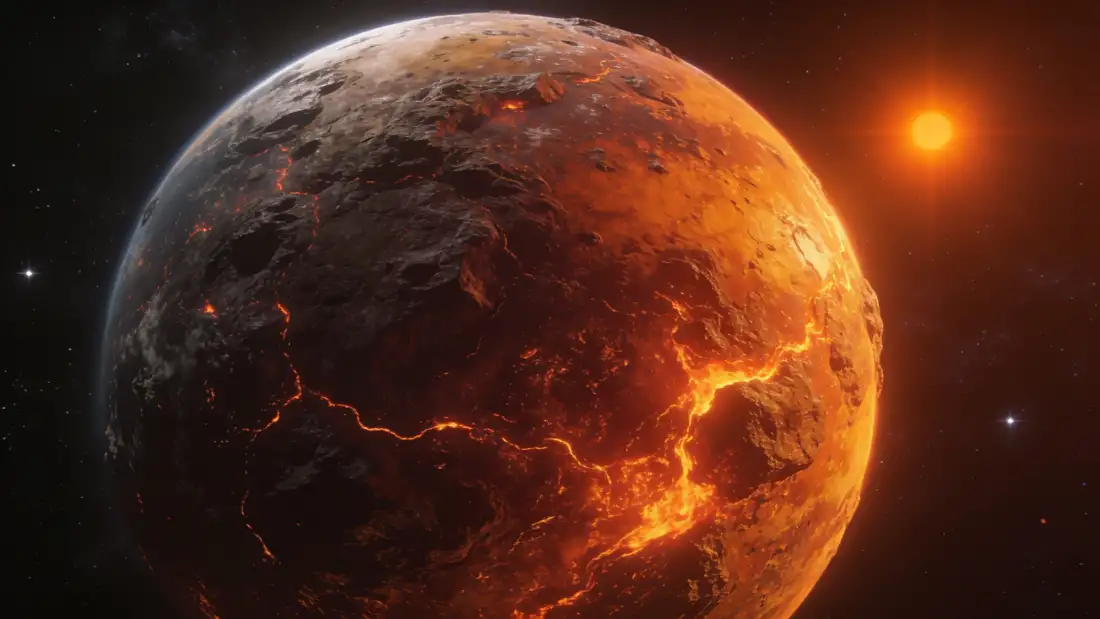
In 2026, astronomers added a new world to the growing list of known exoplanets — planets that orbit stars other than our Sun. That world is TOI-2431 b, a super-Earth sitting 118 light-years away. It is small enough to be called rocky, but it lives in one of the most extreme environments scientists have ever found.
The Star at the Center of It All
Every planet story starts with its star. TOI-2431 b orbits a star called TOI-2431. This star has a surface temperature of 4,109 K. To put that in plain terms, our own Sun burns at around 5,778 K, so TOI-2431 runs noticeably cooler. A star like this is classed as a K-type star — that just means it is smaller and dimmer than our Sun, but still hotter and brighter than the faintest stars in the galaxy.
K-type stars are quite common in the Milky Way. Scientists find them interesting because they tend to live for a very long time and are often a little calmer than our Sun when it comes to violent flares. Whether that matters for TOI-2431 b, though, depends on a lot more than the star alone.
How Astronomers Found It
TOI-2431 b was discovered using the transit method. Here is how that works. Imagine watching a tiny bug crawl across a lamp. The lamp dims ever so slightly while the bug is in the way. Scientists do something very similar with stars. When a planet passes in front of its star from our point of view, it blocks a small slice of starlight. Telescopes can detect that tiny dip. If the dip repeats in a regular pattern, that is a strong sign a planet is orbiting the star.
This method has been used to find hundreds of worlds, and you can explore many of them in the atlas of known exoplanets. The name “TOI” in this planet’s name stands for TESS Object of Interest, which tells us it was first flagged by the TESS space telescope — a mission built specifically to watch for these small drops in starlight.
A Super-Earth in Both Size and Mass
The term super-Earth simply means a planet that is bigger than Earth but smaller than the ice giants like Neptune. TOI-2431 b fits that description well. Its radius — the distance from its center to its surface — is 1.53 times Earth’s radius. So if you could hold the two planets side by side, TOI-2431 b would look noticeably wider, but not dramatically so.
Mass tells a deeper story. TOI-2431 b has a mass of 6.2 times Earth’s. That is a meaningful clue about what the planet might be made of. When scientists compare a planet’s size to its mass, they get a rough idea of its density. A planet that is not much wider than Earth but weighs more than six times as much is likely made of dense, rocky or metallic material — similar in some ways to Earth, but packed tighter or built from heavier stuff.
Scientists are careful here, though. Knowing size and mass does not tell them exactly what is inside. It narrows things down, but the true composition of TOI-2431 b is still a matter of careful study and, honestly, some guesswork.
An Orbit Faster Than a Long Weekend

One of the most striking things about TOI-2431 b is how quickly it completes one trip around its star. Its orbital period — the length of its year — is just 0.22 Earth days. That is a little over five hours. While you sleep a full night, this planet has already lapped its star more than once.
To orbit that fast, a planet has to be very close to its star. We are talking about a distance that would be deep inside the orbit of Mercury in our own solar system. Mercury is already the closest planet to our Sun, and its year takes about 88 Earth days. TOI-2431 b’s year is roughly 400 times shorter than that.
This kind of tight orbit is called an ultra-short period orbit. Planets like this are not rare — scientists have found quite a few of them, and you can see how they compare on the exoplanet discovery timeline. Still, each one raises fresh questions about how planets end up in such extreme positions.
What That Temperature Really Means
With a planet hugging its star so closely, heat is unavoidable. The estimated surface temperature of TOI-2431 b is around 2,063 K, which works out to about 1,790 degrees Celsius. That is far hotter than lava here on Earth. At those temperatures, rocks do not just melt — some of them turn to vapor.
Scientists think worlds this hot might have surfaces of flowing molten rock, or almost no solid surface at all. This also means TOI-2431 b sits nowhere near the habitable zone — the range of distances from a star where liquid water could exist on a planet’s surface. Life as we know it almost certainly could not survive here.
What We Still Need to Learn
For all that scientists have measured, there is a great deal they have not. Does TOI-2431 b have an atmosphere? So far, that has not been determined. What exactly is it made of? Scientists have reasonable ideas based on density, but no confirmed answer. Are there other planets in this system? As of now, TOI-2431 b is the only known world orbiting TOI-2431, but that could change as observations continue.
TOI-2431 b is a good reminder that every confirmed exoplanet is really just the beginning of a much longer set of questions. It is a real place, 118 light-years away, spinning in fierce heat around a calm orange star — and there is still so much to understand about it.