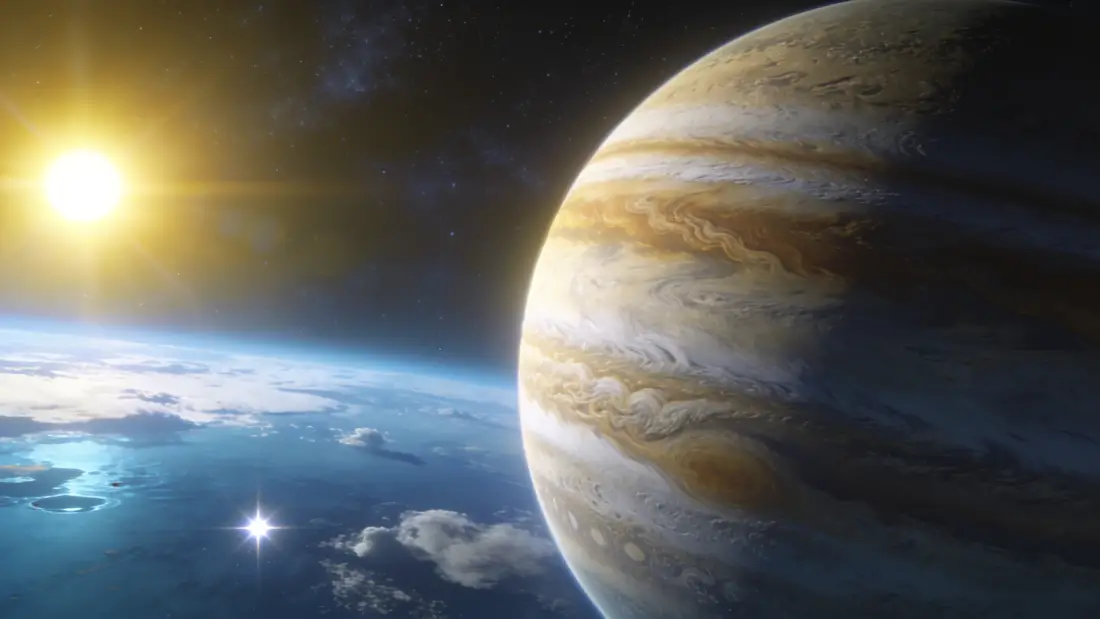
HD 109286 b is an exoplanet — a planet orbiting a star other than our Sun — that sits in a region where liquid water could, in theory, exist. It was discovered in 2021, and scientists are still piecing together what kind of world it really is. What we know so far raises some interesting questions about habitability, even if the answers are still far out of reach.
Where HD 109286 b Lives
HD 109286 b orbits a star called HD 109286, which sits about 181 light-years from Earth. A light-year is the distance light travels in one year — roughly 9.5 trillion kilometres. So 181 light-years is an enormous distance by everyday standards, though in the context of our galaxy, it is actually fairly close.
The planet takes 520 Earth days to complete one full orbit around its star. In other words, one year on HD 109286 b lasts just over one and a half Earth years. So far, scientists have found only one planet in this system — HD 109286 b itself. There could be others waiting to be found, but none have been confirmed yet.
A Giant World: Size and Mass
HD 109286 b is a very large planet. Its radius — the distance from its centre to its surface — is about 13.2 times the radius of Earth. That makes it much wider than our home planet, closer in size to the giant planets of our own solar system.
Its mass is even more striking. Mass is the amount of matter a planet contains. HD 109286 b has a mass of roughly 950 times that of Earth. To put that in perspective, Jupiter — the biggest planet in our solar system — is about 318 times Earth’s mass. So HD 109286 b is considerably heavier than even Jupiter.
With a size and mass like this, scientists think HD 109286 b is most likely a gas giant — a planet made mostly of thick layers of gas rather than solid rock. Planets like this probably do not have a firm surface to stand on. What we might think of as the “surface” would simply be clouds of gas getting denser and denser the deeper you go.
Because of its enormous size and gaseous nature, HD 109286 b itself is probably not the kind of place where life as we know it could thrive. But there is more to the story than just the planet alone.
Temperature and the Habitable Zone

One of the most interesting things about HD 109286 b is its estimated temperature. Scientists calculate that it sits at around 259 K, which is about -14 degrees Celsius. That is cold — well below the freezing point of water at normal pressure on Earth’s surface.
But temperature estimates for exoplanets are careful calculations, not direct measurements. They are based on how much energy the star sends out and how far away the planet orbits. The actual conditions on or inside the planet could be different. Scientists haven’t been able to measure the temperature directly yet.
Even so, that estimated temperature places HD 109286 b somewhere near what astronomers call the habitable zone — the band of distances around a star where liquid water could exist on a surface under the right conditions. You can explore what this means for different kinds of stars using our habitable zone interactive guide.
Being in or near the habitable zone does not mean a planet has water. It means the conditions might allow water to be liquid, rather than always frozen or always boiled away. Whether water actually exists on HD 109286 b — or anywhere nearby — is something scientists simply do not know yet.
How Scientists Found It

HD 109286 b was discovered in 2021 using a method called radial velocity. Here is how it works. When a planet orbits a star, its gravity gives the star a tiny tug. That tug makes the star wobble ever so slightly toward and away from us. When the star moves toward Earth, its light shifts to slightly bluer wavelengths. When it moves away, the light shifts to redder wavelengths. Scientists detect this colour shift and use it to work out that a planet must be pulling on the star.
The radial velocity method is very good at measuring a planet’s mass, because a heavier planet tugs harder on its star. That is why we have a solid mass measurement for HD 109286 b. However, this method does not directly tell us the planet’s radius. The radius measurement comes from other observations and careful modelling by scientists. For some details — like exactly what the planet’s atmosphere is made of, or whether it has moons — we simply do not have enough information yet.
What Kind of Star Does It Orbit?
The star HD 109286 has a surface temperature of 5,694 K — that is about 5,694 degrees above absolute zero, the coldest temperature possible. Our own Sun has a surface temperature of around 5,778 K, which is quite similar. This tells us that HD 109286 is a star broadly comparable to our Sun: not dramatically hotter, not dramatically cooler.
Stars similar to our Sun tend to emit a fairly stable amount of energy. They are not as prone to powerful flares — sudden bursts of radiation — as smaller, cooler stars called red dwarfs. This relative calm could be a good thing for any world sitting in the right zone around such a star, since violent flares can strip away a planet’s atmosphere over time.
That said, scientists have not fully studied the activity of HD 109286 specifically. These are general patterns, not guaranteed facts about this particular star.
Could This World Support Life?
Honestly, probably not on the planet itself — at least not life as we understand it. A gas giant with no solid surface and an estimated temperature well below freezing is not an obvious home for living things. But the question of habitability gets more interesting when we think more broadly.
Gas giants in our own solar system, like Jupiter and Saturn, have moons. Some of those moons — like Europa, which orbits Jupiter — are considered possible places where liquid water might exist beneath an icy crust. We do not know yet whether HD 109286 b has any moons. If it does, and if some of them orbit in a stable way, they could experience different conditions than the planet itself.
This is speculative — scientists are being careful not to claim more than the data shows. For now, HD 109286 b earns its place on any list worth watching, not because we know it hosts life, but because it sits in a region where the question of water is at least worth asking. You can compare it with other candidates on our most Earth-like worlds list to see how it stacks up.
The universe is full of planets we are only beginning to understand. HD 109286 b is one of them — a cold, enormous world 181 light-years away, quietly orbiting a Sun-like star, and keeping its secrets for now.