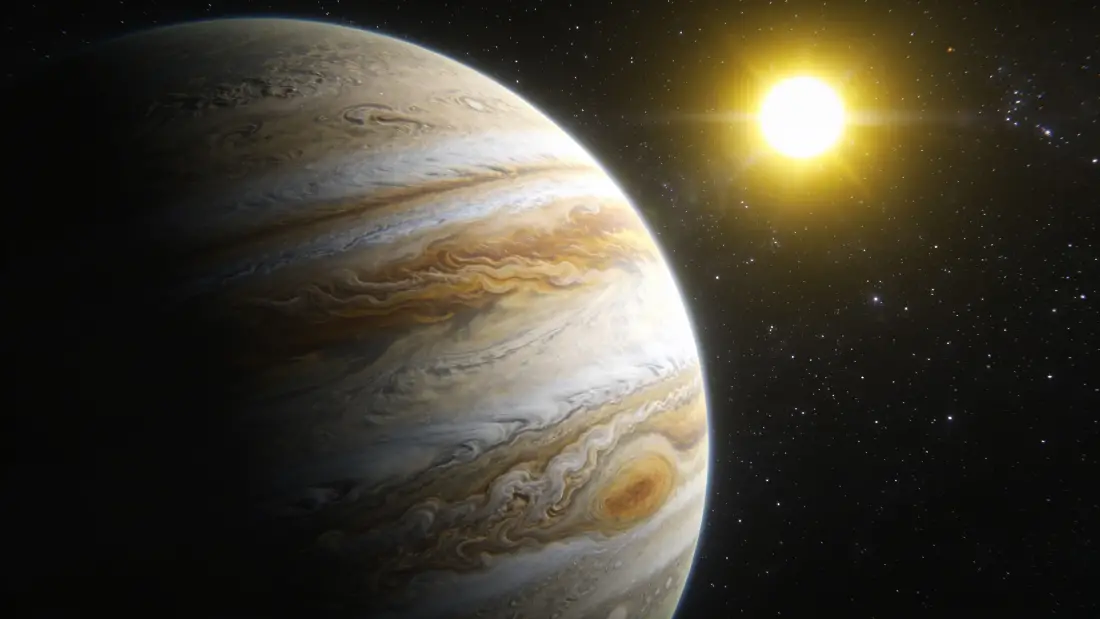
In 2026, astronomers added a fascinating new world to our growing list of known planets beyond our solar system. That world is HD 100508 b, a giant planet sitting 107 light-years from Earth. It is a place very different from anything in our own neighborhood, and it raises some interesting questions.
Where in the Sky Is HD 100508 b?
HD 100508 b lives 107 light-years away from us. A light-year is the distance light travels in one year — about 9.5 trillion kilometers. So 107 light-years is an almost impossible distance to picture, yet in the grand scale of our galaxy, it is actually fairly close. Our Milky Way galaxy is roughly 100,000 light-years across, so this planet is practically in our cosmic backyard.
The planet orbits a star called HD 100508. Right now, HD 100508 b is the only known planet in that system. Scientists may find more companions around that star someday, but as far as we know today, this giant world is alone out there.
You can explore many worlds like this one in the atlas of known exoplanets, where planets are mapped and compared side by side.
How Big and Heavy Is This Planet?
HD 100508 b is enormous. Its radius — that is, the distance from its center to its surface — is about 13.7 times the radius of Earth. To picture that, imagine lining up nearly 14 Earths in a row just to cross from one side of this planet to the other.
Its mass is even more striking. Mass is the amount of matter, or stuff, packed into an object. HD 100508 b has a mass of 381 times that of Earth. That puts it firmly in the category of a giant planet — a world made mostly of gas and liquid rather than solid rock, scientists think.
For comparison, Jupiter, the biggest planet in our own solar system, has a mass of about 318 times Earth’s mass. HD 100508 b is heavier than Jupiter. At this size and mass, it may sit near the boundary between what we call a giant planet and an object called a brown dwarf — which is like a star that never quite ignited. Scientists haven’t settled exactly where that boundary lies, but worlds this large and heavy are rare and worth studying carefully.
How Was HD 100508 b Discovered?
Astronomers found HD 100508 b using a technique called the radial velocity method. Here is how it works. A planet’s gravity gently tugs on its star as the planet moves around it. That tug makes the star wobble slightly — sometimes moving a tiny bit toward us, sometimes away. When the star moves toward Earth, its light shifts to slightly bluer colors. When it moves away, the light shifts to slightly redder colors. Scientists can measure these tiny color shifts very precisely. The pattern of shifts reveals that a planet is there, and how massive it likely is.
The radial velocity method is very good at finding massive planets, because heavier planets pull harder on their stars and cause bigger wobbles that are easier to detect. That is probably why HD 100508 b was found this way. It is heavy enough to leave a clear signal.
If you are curious about how the hunt for planets has grown over time, the discovery timeline shows just how many worlds have been found and when.
A Very Long Year

One orbit around HD 100508 — what we would call one year on this planet — takes about 5,681 Earth days. That is more than 15 and a half Earth years for a single trip around its star.
This tells us something important about where the planet sits. A long year almost always means a wide orbit — the planet travels a large path around its star, far from its center of warmth and light. By contrast, some giant planets discovered around other stars orbit so close to their stars that their years last just a few Earth days. HD 100508 b is nothing like those. It is a slow, distant giant, moving in a vast loop through cold space.
Scientists haven’t measured the exact distance between HD 100508 b and its star yet, so we cannot say precisely how far out it sits. But that long orbit is a strong clue that the planet lives far from the heat of its sun.
What Kind of Star Does It Orbit?
The star HD 100508 has a surface temperature of 5,419 Kelvin. Kelvin is a temperature scale scientists use, where zero is the coldest anything can ever be. A temperature of 5,419 K is slightly cooler than our own Sun, which sits at about 5,778 K. This makes HD 100508 what astronomers call a G-type star — a category our Sun also belongs to. So in some ways, HD 100508 is a solar neighbor in character, even if it is 107 light-years away in distance.
A cooler star puts out a little less light and heat than our Sun does. Combined with the planet’s likely wide orbit, HD 100508 b probably sits in a cold, dim region of its system.
What We Still Don’t Know
There is a lot scientists haven’t measured yet about HD 100508 b. We don’t know its exact distance from its star. We don’t know what its atmosphere is made of, or whether it has moons. We don’t know if any smaller, rocky planets share the same system. Because the planet was found through the radial velocity method rather than by watching it pass in front of its star, we also have less information about its interior and exact composition than we might otherwise hope for.
HD 100508 b is a reminder that every new discovery opens as many questions as it answers. This giant world is now on the map, and that is a fine place to start.