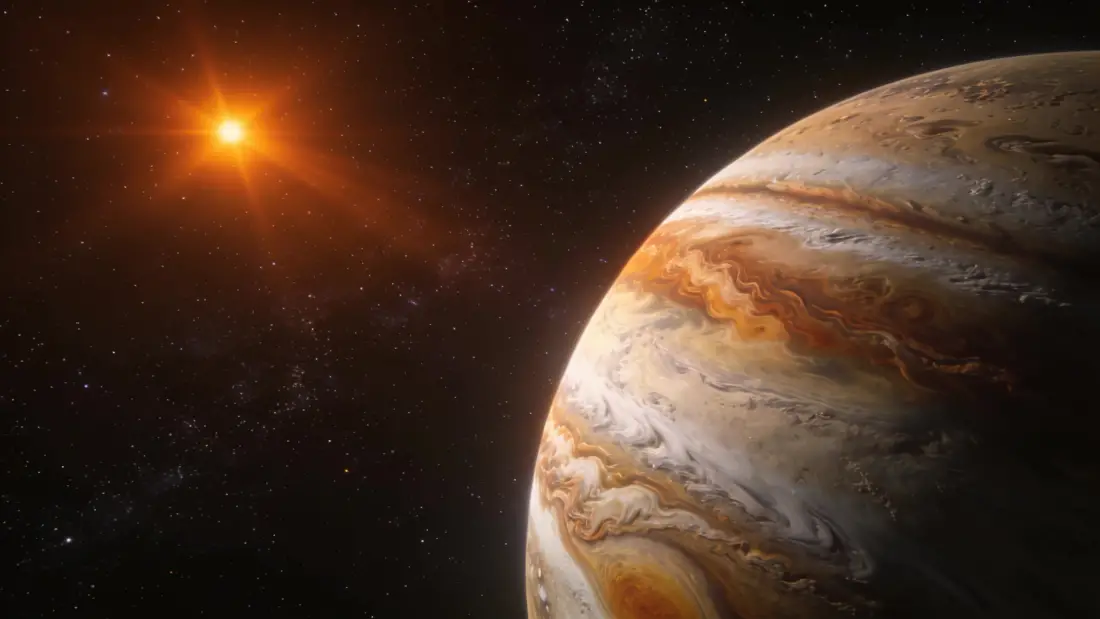
Epsilon Eridani b, or eps Eri b, is one of the closest known exoplanets — planets that orbit stars other than our Sun — to Earth. That makes it a favorite target for scientists who study nearby star systems. Even so, “close” in space means something very different from what the word means here on Earth.
Meet eps Eri and Its Planet
Eps Eri b orbits a star called Epsilon Eridani, often shortened to eps Eri. You can find that star in the constellation Eridanus, which is a long, winding pattern of stars visible from much of Earth. Eps Eri is just one of many stars in our cosmic neighborhood, but it stands out because it is relatively nearby and because scientists discovered a planet orbiting it back in 2000. So far, eps Eri b is the only known planet in that system.
Just How Far Is 10.5 Light-Years?
The distance from Earth to eps Eri b is 10.5 light-years. A light-year is the distance light travels in one full year. Light moves at about 300,000 kilometers every single second. In a year, that adds up to roughly 9.5 trillion kilometers. So 10.5 light-years is an almost impossible number to picture.
Here is one way to think about it. The distance from Earth to the Moon is about 384,000 kilometers. Light covers that gap in just over a second. Now stretch that journey out until it takes 10.5 years — that is the scale we are talking about when we say eps Eri b is 10.5 light-years away.
Another way to feel the distance: our Sun’s light takes about eight minutes to reach Earth. The light from eps Eri takes more than ten years to make the same kind of trip to us. When you look at eps Eri in the night sky, you are seeing it as it was over a decade ago.
10.5 light-years is genuinely close by the standards of the galaxy. Most stars are hundreds or thousands of light-years away. But it is still an enormous distance by any human measure. You can get a sense of how eps Eri fits among the stars near us by exploring the Cosmic Map.
How Long Would It Take to Travel There?

Our fastest spacecraft, the Voyager probes, travel at roughly 17 kilometers per second. That sounds fast, but in cosmic terms it is extremely slow. At that speed, reaching eps Eri b would take something in the range of 70,000 years. No human technology today could get us there in a reasonable time.
Scientists sometimes talk about what a journey would look like at higher speeds. Even at one tenth the speed of light — which is far beyond anything we can build today — the trip would still take over a hundred years. At the full speed of light, which is physically impossible for any object with mass, it would take 10.5 years one way. There would be no quick round trip.
This is one of the great challenges of studying nearby exoplanets. We can detect them, measure some of their properties, and learn a surprising amount from here on Earth. But visiting them remains far outside our reach. If you want to play with the numbers yourself, the Distance and Travel Time tool lets you explore just how long trips like this would take at different speeds.
What Kind of Star Is eps Eri?
Eps Eri is what astronomers call a K-type star. K-type stars are a little smaller and cooler than our Sun, which is a G-type star. The surface temperature of eps Eri is about 5,020 Kelvin. Kelvin is a temperature scale scientists use; 5,020 K is still extremely hot by everyday standards, but it is cooler than our Sun’s surface, which sits around 5,778 K.
Because it is a little cooler, eps Eri gives off slightly less light and energy than our Sun does. That warm orange glow makes K-type stars interesting to scientists who study habitability — the idea of whether conditions might allow life to exist somewhere. Scientists think K-type stars can be stable for a very long time, which is one reason eps Eri gets attention. That said, we should be careful not to jump to conclusions. Whether eps Eri b could support life is a completely separate and much harder question.
What We Know About eps Eri b Itself

Eps Eri b is a large world. Its radius — the distance from its center to its surface — is about 14.1 times the radius of Earth. Its mass is about 210 times the mass of Earth. Those numbers put it firmly in the category of a giant planet, more like Jupiter or Saturn in our own solar system than like Earth.
One year on eps Eri b — the time it takes to complete one orbit around its star — lasts about 2,671 Earth days. That is roughly seven and a third Earth years for a single eps Eri b year. This tells us the planet orbits quite far from its star, much like the outer planets in our solar system orbit far from our Sun.
Because of its large size and mass, scientists think eps Eri b is most likely a gas giant — a planet made mostly of gas, without a solid surface to stand on. What lies deep inside it, and what its atmosphere is like, scientists haven’t fully worked out yet. Many details about this world remain uncertain or simply unmeasured.
How eps Eri b Was Found
Eps Eri b was discovered in 2000 using a technique called the Radial Velocity method. This method works by measuring tiny wobbles in a star’s movement. When a planet orbits a star, its gravity tugs on the star ever so slightly. That tug causes the star to rock back and forth in a very small way. Scientists can detect this wobble by watching how the star’s light shifts slightly toward redder or bluer wavelengths over time.
The radial velocity method is especially good at finding large planets — ones with enough mass to produce a detectable wobble. Eps Eri b’s large mass made it a good candidate for this kind of detection. Even so, confirming the planet’s existence took careful work over several years, because other effects can sometimes mimic a planet’s signal.
Where eps Eri b Sits in the Bigger Picture
At 10.5 light-years away, eps Eri is one of the nearest star systems to Earth that we know hosts a planet. That makes eps Eri b a useful reference point when scientists think about how common planets are among the stars closest to us. Finding a giant planet this close suggests that planetary systems are not rare events in the universe.
At the same time, 10.5 light-years is a humbling reminder of the true scale of space. A world that is practically next door in galactic terms is still so far away that even a beam of light takes over a decade to cross the gap. Eps Eri b will likely remain a planet we study from a great distance for a long time to come — but every measurement we make from here tells us a little more about the universe we live in.