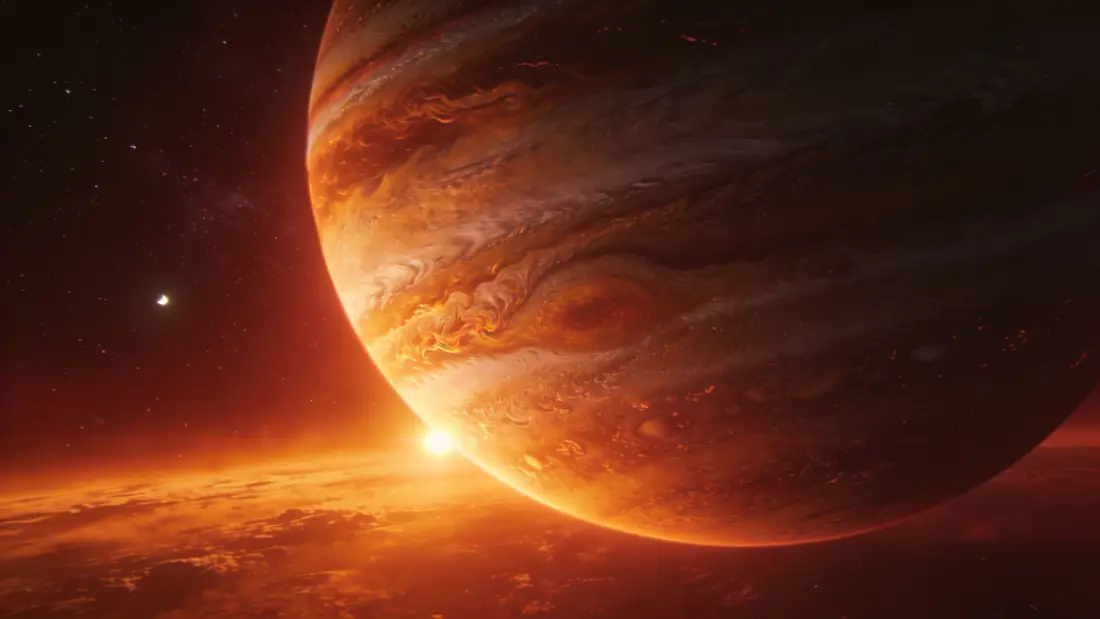
TOI-5938 b is a world quite unlike anything in our own solar system. It sits 372 light-years away — a light-year is the distance light travels in a whole year — and it belongs to a class of planet that turns out to be one of the most common in the galaxy. Scientists confirmed its discovery in 2026, and it is already teaching us about how planets form and what they are made of.
Finding TOI-5938 b
Astronomers spotted TOI-5938 b using the transit method. That means they watched the planet pass in front of its star and noticed the starlight dimming slightly, the way a small bug crossing a lamp makes it look a little less bright. By measuring how much the light dimmed, and how often, scientists could work out the planet’s size and how long its year lasts.
The signal came from a star called TOI-5938, sitting 372 light-years from Earth. That sounds impossibly far, but in galaxy terms it is actually one of our closer neighbors. Right now, TOI-5938 b is the only planet scientists have found in this system, though that does not mean it is alone — other worlds may simply be too small or too far from the star for current tools to pick up.
Size and Mass — What the Numbers Tell Us

TOI-5938 b has a radius of 3.82 times Earth’s and a mass of 14.0 times Earth’s. Those two numbers together are very useful. When scientists know both the size and the mass of a planet, they can work out its density — how tightly packed its material is. Density is one of the best clues we have about what a planet is made of.
A small, heavy world tends to be rocky, like Earth. A large, light world is usually mostly gas, like Jupiter. TOI-5938 b falls in between. It is nearly four times wider than Earth, but its mass is only 14 times ours. That means it is not as dense as a pure rock ball would be. Something lighter — probably a thick layer of gas or a deep layer of water-like fluids — must be puffing it up. You can explore how planets like this compare visually using the size comparison tool.
This puts TOI-5938 b firmly in the mini-Neptune category. Mini-Neptunes are planets bigger than Earth but smaller than Neptune. They are among the most common types of planet found so far, yet our solar system has none — which makes worlds like this one especially interesting to study.
Inside a Mini-Neptune
Scientists cannot see inside TOI-5938 b directly. But by combining its size and mass, they can make careful guesses about its structure. The mass-radius diagram is one of the tools researchers use to compare a planet’s measurements with models of different internal makeups.
A typical mini-Neptune probably has a rocky or iron core at the center. Around that core, there may be a layer of materials that are solid ice on Earth but exist as hot, pressurized fluids deep inside a planet — things like water, methane, or ammonia. Wrapped around all of that would be a thick atmosphere, which is the outer layer of gas that surrounds a planet. Scientists think that atmosphere is likely made mostly of hydrogen and helium, the two lightest elements in the universe.
None of this is certain. Different mixtures of rock, water-like material, and gas can produce similar size and mass readings. So while researchers have a good general picture, the exact recipe inside TOI-5938 b is still an open question. What we can say with confidence is that it is not a simple rock, and it is not a giant ball of gas — it is something in between.
A Scorching, Speedy Orbit
TOI-5938 b circles its star in just 2.26 Earth days. To put that in perspective, Mercury — the closest planet to our Sun — takes about 88 days to complete one orbit. TOI-5938 b is moving extraordinarily fast because it is orbiting extremely close to its star.
That closeness has a dramatic effect on temperature. Scientists estimate the planet’s equilibrium temperature — meaning how hot it gets from starlight alone — at 1,077 K, which is about 804 degrees Celsius. That is hot enough to melt many metals. Any gas in the outer atmosphere is being blasted with intense radiation every moment of every day.
At such temperatures and distances, TOI-5938 b sits nowhere near the habitable zone, which is the range of distances from a star where liquid water could exist on a planet’s surface. This world is far too hot for that. Scientists think the fierce heat may even be slowly stripping away the outer layers of its atmosphere over time, a process called atmospheric escape.
The Orange Star at the Center
The star TOI-5938 has a surface temperature of 4,650 K. Our own Sun sits at about 5,778 K, so TOI-5938 is cooler. That cooler temperature gives it an orange tint rather than the yellow-white color of the Sun. Stars like this are often called K-type stars or orange dwarfs.
K-type stars are considered fairly stable, which is good for planet study — they do not flare as violently as the smallest, coolest stars. Beyond its surface temperature and the fact that it hosts TOI-5938 b, scientists haven’t published other details about this star’s size or mass in the verified data available so far.
One World So Far — and Many Questions Left
As of now, TOI-5938 b is the only known planet in its system. Astronomers are cautious about reading too much into that. Finding planets takes time, and smaller or more distant worlds are much harder to detect. It is entirely possible that other planets orbit TOI-5938 and we simply haven’t spotted them yet.
For the planet itself, the biggest open questions involve its atmosphere. What gases are present? Is it losing its atmosphere over time because of its hot, close orbit? Future telescopes may be able to study starlight filtering through the planet’s atmosphere as it transits, giving researchers chemical clues about what is up there.
TOI-5938 b is a good example of how much a planet can tell us just from two careful measurements — its size and its mass. A world nearly four times wider than Earth, fourteen times heavier, and roasting at over 800 degrees Celsius, it is a reminder that most planets in the galaxy are nothing like the ones we grew up learning about. The universe, it turns out, has a lot of room for worlds that do not fit our familiar categories.