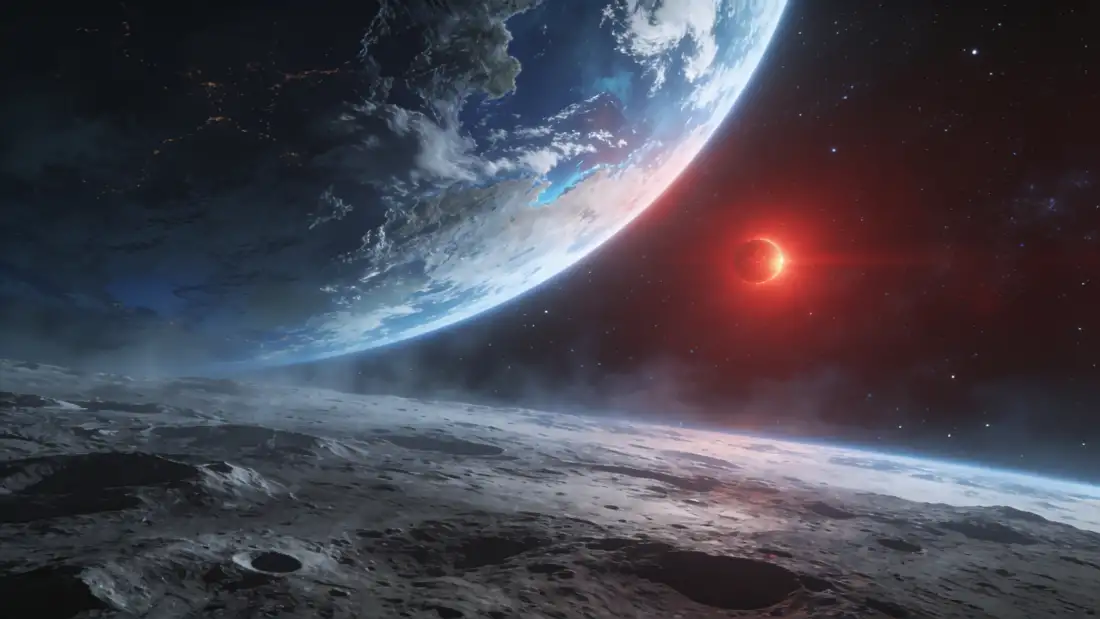
Teegarden’s Star b is one of the closest known Earth-sized worlds beyond our solar system. It sits just 12.5 light-years away, which sounds small on a cosmic scale — and in some ways it is. But closing that gap is a challenge that puts the true size of space into sharp focus.
Meet Teegarden’s Star b
Scientists discovered Teegarden’s Star b in 2019. They found it using the radial velocity method — a technique that watches a star for tiny wobbles. When a planet orbits a star, its gravity tugs the star gently back and forth. Those wobbles show up in the starlight, and from them scientists can work out that a planet is there.
The planet circles its host star, Teegarden’s Star, once every 4.91 Earth days. That is a very short year. In the time it takes you to finish a school week, this world has already lapped its star. The star itself is much cooler and dimmer than our Sun. Its surface temperature is 3,034 K (for comparison, our Sun’s surface is around 5,778 K). Stars like this are called red dwarfs — small, faint stars that burn slowly and can last for tens of billions of years.
Twelve and a Half Light-Years — What That Distance Really Means
Teegarden’s Star sits 12.5 light-years from Earth. A light-year is the distance light travels in one year — about 9.46 trillion kilometres. Multiply that by 12.5 and you get a number so large it is nearly impossible to picture.
Try this instead. Light is the fastest thing in the universe. It crosses the whole Earth in less than a tenth of a second. It reaches the Moon in about 1.3 seconds. It travels from the Sun to Earth in roughly 8 minutes. And yet, even at that incredible speed, a beam of light leaving Earth today would not reach Teegarden’s Star for 12.5 years.
In the larger story of the galaxy, 12.5 light-years is actually quite close. The Milky Way is roughly 100,000 light-years across. Teegarden’s Star is practically a neighbour — one of the nearest known stars to our Sun. But “practically a neighbour” in space still means an almost unimaginable distance by any human measure.
You can explore where Teegarden’s Star sits among the stars near us using the Cosmic Map, which puts these distances in a visual context.
Travel Times at Real Speeds
So how long would it actually take to get there? The answer depends on how fast you can go — and right now, humans cannot go very fast at all, compared to the size of space.
The fastest spacecraft ever launched from Earth is the Parker Solar Probe. At its peak, it travels at roughly 692,000 kilometres per hour. That is astonishing by everyday standards. But at that speed, a trip to Teegarden’s Star would take well over 20,000 years.
The Voyager 1 probe, which has now left our solar system, travels at around 61,000 kilometres per hour. At Voyager’s speed, the journey would take roughly 220,000 years.
What if we could travel at one percent of the speed of light? That is far beyond any current technology, but scientists sometimes use it as a thought experiment. At one percent of light speed, the trip would still take about 1,250 years — longer than the time since medieval Europe.
To reach Teegarden’s Star within a human lifetime, you would need to travel at a significant fraction of the speed of light. Some concepts, like laser-propelled lightsails, have been proposed as ways to reach perhaps 20 percent of light speed. At that pace, the journey would take around 60 to 65 years. No such technology exists yet, and building it would be one of the greatest engineering challenges in history.
If you want to see how travel time changes with speed, the Distance and Travel Time tool lets you experiment with different velocities for nearby stars.
Why the Journey Feels Even Longer Than the Numbers Suggest

The raw travel time is only part of the challenge. There are other things to think about that make the distance feel even harder to close.
- Communication delays: Any signal sent back to Earth — a radio message, a photo, a data reading — would travel at the speed of light. That means a message from Teegarden’s Star would take 12.5 years to arrive. If something went wrong, you could not ask for help and expect an answer for 25 years.
- Energy: Speeding up to even a small fraction of light speed would require an enormous amount of energy — far more than any rocket fuel we have today can provide.
- The human body: We do not fully understand what very long space journeys do to the human body. Radiation, weightlessness, and isolation are all serious concerns over timescales of decades or centuries.
For now, the most realistic way to study Teegarden’s Star b is with telescopes — especially space-based ones that can gather light across many years of patient observation.
A World Worth the Curiosity
Even from here, what scientists have measured is genuinely interesting. Teegarden’s Star b has a radius about 1.05 times that of Earth and a mass about 1.16 times Earth’s. Those numbers are remarkably close to our own planet’s. It is, as far as we can tell, a rocky world of similar size and weight to home.
Its estimated temperature is around 277 K, which is about 4 degrees Celsius. That is cool — think of a brisk autumn day — but it places the planet in the range where liquid water could exist on its surface, depending on whether it has an atmosphere. Scientists have not measured its atmosphere, and we do not know if it has one. Whether liquid water or life exist there is something we simply cannot say yet.
Three Planets, One Small Star
Teegarden’s Star b is not alone. Scientists currently know of three planets orbiting Teegarden’s Star. Each one was detected through the same radial velocity method. Beyond knowing that three worlds exist there, detailed information about the other two planets is still limited.
Red dwarfs like Teegarden’s Star are known to host planets quite often. Because they are so dim and cool, a planet can orbit very close to them and still sit in the zone where temperatures are not extreme. That is why Teegarden’s Star b can have an orbit of less than five days and yet sit at a potentially mild temperature.
Teegarden’s Star b reminds us that the universe is full of worlds we can barely reach even with our fastest machines, yet can still study, measure, and wonder about from right here on Earth. That mix of closeness and distance is one of the most thought-provoking things about our cosmic neighbourhood.