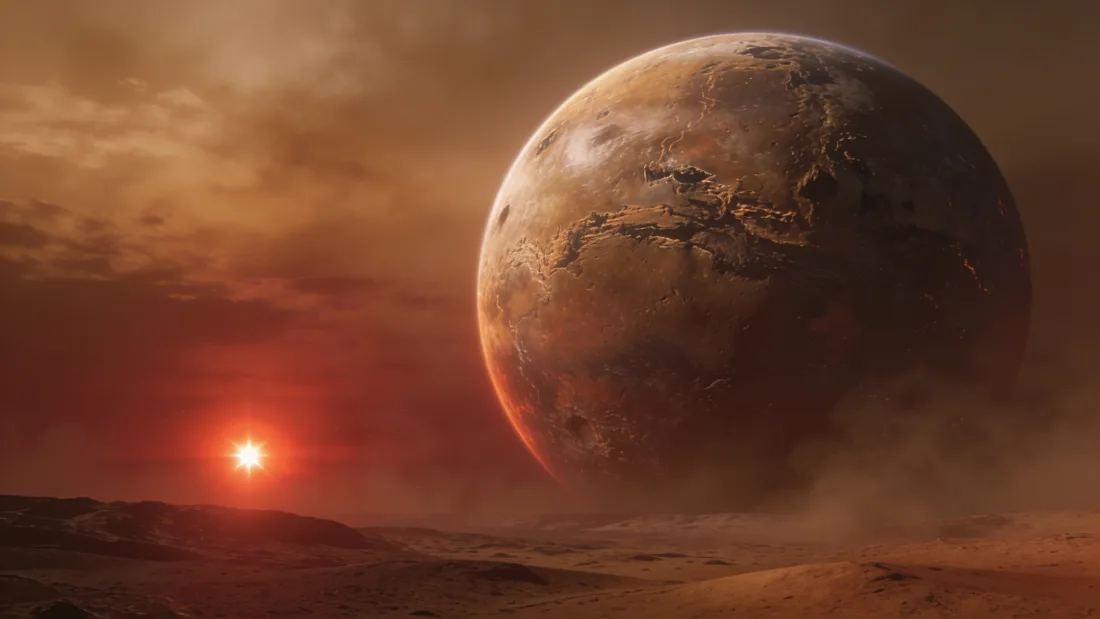
In 2026, astronomers confirmed a new world roughly 93 light-years away. It is called TOI-4529 b, and it belongs to a group of planets known as super-Earths — worlds bigger than our planet but smaller than the giant ice planets in our own solar system. There is a lot to learn from a world like this, even from so far away.
Where in the sky is TOI-4529 b?
TOI-4529 b sits about 92.6 light-years from Earth. A light-year is the distance light travels in one year — roughly 9.5 trillion kilometres. So 92.6 light-years is an enormous distance, but in the broader scale of our galaxy, it is actually a fairly close neighbour. Many confirmed exoplanets — planets orbiting stars other than our Sun — are hundreds or thousands of light-years away. You can explore how TOI-4529 b compares to other nearby worlds in our atlas of known exoplanets.
TOI-4529 b is the only planet scientists have found in this system so far. That does not mean it is alone. It simply means no other planets have been detected yet. Detecting planets is hard work, and smaller or more distant siblings could easily be hiding from our current instruments.
How scientists found it
TOI-4529 b was discovered using the transit method. This method works by watching a star very carefully and looking for tiny dips in its brightness. When a planet passes in front of its star — from our point of view — it blocks a small amount of starlight. That brief dimming is called a transit. By measuring how much the light dips and how often it happens, scientists can figure out the planet’s size and how long its year is.
The transit method is one of the most successful ways we have found planets beyond our solar system. If you are curious about how the field has grown over the years, the discovery timeline shows just how many worlds have been found and how our tools have improved.
The name TOI stands for TESS Object of Interest. TESS is a space telescope that watches large patches of the sky and flags stars that show these brightness dips. Scientists then follow up with more observations to confirm whether a real planet is responsible.
Size and mass: what kind of world is this?
TOI-4529 b has a radius 1.77 times that of Earth. In other words, if you could slice through it at its widest point, that circle would be nearly twice as wide as Earth’s. Its mass is 4.9 times Earth’s mass. That means the planet has almost five times as much material packed into it.
Knowing both the size and the mass of a planet is very useful. Scientists can use those two numbers together to work out the planet’s density — how tightly its material is packed. A planet with a lot of mass but a small size is probably made mostly of rock or metal. A planet with a large size but less mass might have thick layers of gas or water surrounding a smaller rocky core.
For TOI-4529 b, the numbers suggest it is denser than a purely rocky world like Earth, though scientists are still working to understand its exact make-up. It could be a rocky planet with a thin atmosphere, or it might have some other composition. We don’t know for certain yet.
A very fast year and a very hot surface

One of the most striking things about TOI-4529 b is how quickly it completes one orbit. Its year — the time it takes to travel all the way around its star — lasts just 5.88 Earth days. For comparison, Earth takes 365 days. So while you are reading this sentence, TOI-4529 b is rushing along its path at a remarkable pace.
That short orbit means the planet is very close to its star. Being so close has a big effect on temperature. Scientists estimate the planet’s surface temperature is around 511 Kelvin, which is about 238 degrees Celsius. That is far hotter than anything living things on Earth could survive. It is hotter than a kitchen oven set to its highest setting, and hot enough to melt some metals.
Because of this heat, TOI-4529 b does not sit in what scientists call the habitable zone — the range of distances from a star where liquid water might exist on a planet’s surface. This world is almost certainly too hot for liquid water as we know it.
The star it orbits
TOI-4529 b orbits a star called TOI-4529. This star has a surface temperature of about 3,697 Kelvin. Our own Sun’s surface sits at around 5,778 Kelvin, so TOI-4529 runs considerably cooler. Stars like this are known as red dwarf stars — they are smaller, cooler, and dimmer than the Sun, and they appear with an orange-red colour. Red dwarfs are actually the most common type of star in our galaxy.
Even though TOI-4529 is cooler than the Sun, its planet is still very hot because the planet orbits so incredibly close to it.
What we still don’t know
Scientists haven’t yet measured TOI-4529 b’s atmosphere, its exact composition, or whether it has any moons. The planet’s density hints at its interior, but a full picture would require more detailed observations. Questions like what gases might be in its sky, or whether it has a magnetic field, remain unanswered for now. That is completely normal. Most exoplanets are known only in broad strokes, and every new measurement adds a little more to the story.
TOI-4529 b is a reminder that even a world that is probably too hot for life tells us something valuable. Each confirmed planet helps scientists build a clearer picture of how planets form, how common different types of worlds are, and what makes a solar system like ours special — or perhaps not so special at all.