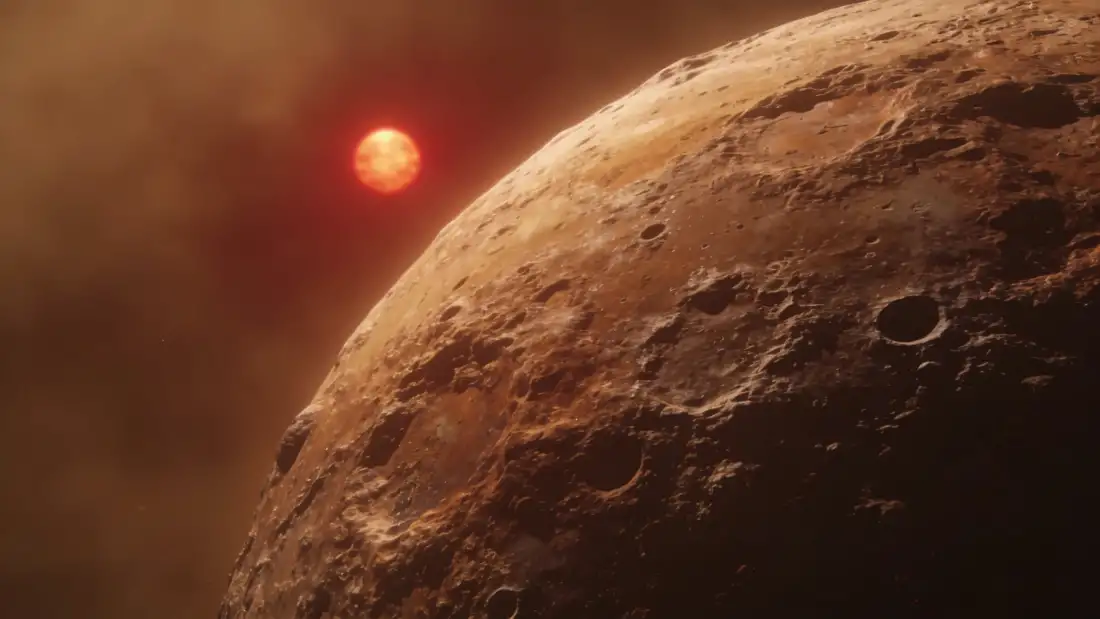
Barnard e is a small planet orbiting one of the closest stars to our own Sun. It was discovered in 2025, and scientists are still piecing together what kind of world it might be. One of the most interesting things about it is something very simple: it is extraordinarily close, on a cosmic scale.
Our Nearest Stellar Neighbor (Almost)
Barnard’s Star sits just 5.96 light-years from Earth. A light-year is the distance light travels in one full year — about 9.46 trillion kilometres. That number is so large it is almost impossible to picture.
In terms of cosmic distance, Barnard’s Star is the second-closest star system to our Sun. Only the Alpha Centauri system, which contains three stars, is closer. So when we talk about Barnard e, we are talking about a planet in what is essentially our own backyard — at least by the standards of the universe.
You can explore where Barnard’s Star sits relative to other nearby systems using our Cosmic Map.
What 5.96 Light-Years Actually Means
Numbers like “5.96 light-years” can slide past us without really landing. So let’s slow down and look at what that distance truly involves.
Light is the fastest thing we know of. It travels at about 300,000 kilometres every single second. Even at that speed, light leaving Barnard’s Star takes almost six years to reach your eyes. That means when you look at Barnard’s Star in the night sky, you are seeing it as it was nearly six years ago. The star’s light has been travelling across empty space this whole time, just to reach you.
Now think about radio signals. We use radio waves to communicate in space, and they travel at the same speed as light. If we sent a message to any civilization near Barnard’s Star today, they would not receive it for nearly six years. And their reply would take another six years to come back. A single conversation would take about twelve years.
Even so, in the grand sweep of our galaxy — which is about 100,000 light-years across — 5.96 light-years is an incredibly short hop. Barnard e is practically next door.
How Long Would a Trip Take?

No spacecraft we have ever built could come close to the speed of light. Our fastest probes, like the Voyager spacecraft, travel at roughly 17 kilometres per second. At that speed, reaching Barnard’s Star would take well over 70,000 years. That is longer than all of recorded human history, many times over.
Even if we imagine a future spacecraft moving at one percent of the speed of light — far faster than anything we can build today — the journey would still take nearly 600 years. A spacecraft at ten percent of the speed of light, which is purely theoretical right now, would need around 60 years.
These numbers show just how honest we have to be about interstellar travel. Even our nearest neighbours are, with today’s technology, completely unreachable within a human lifetime. If you want to play with these numbers yourself, try our distance and travel time tool to see how different speeds change the journey.
Barnard’s Star: The Host Star Up Close
Barnard’s Star is what astronomers call a red dwarf. A red dwarf is a star that is much smaller and cooler than our Sun. Its surface temperature is measured at 3,195 K — where K stands for Kelvin, a scale scientists use to measure heat. Our own Sun has a surface temperature of around 5,778 K, so Barnard’s Star is considerably cooler.
Because it is cooler, Barnard’s Star glows a deep reddish colour rather than the bright yellow-white of our Sun. It also puts out much less energy. This matters a great deal for any planets orbiting it, because those planets receive far less warmth and light.
Red dwarfs are the most common type of star in our galaxy. They tend to live for an extremely long time — potentially trillions of years, far longer than stars like our Sun. Barnard’s Star is actually quite old, and it is known to move across our sky faster than almost any other star, which is why astronomers have studied it carefully for over a century.
What We Know About Barnard e Itself

Barnard e is a small world. Its radius — the distance from its centre to its surface — is measured at 0.64 times that of Earth. Its mass, meaning how much matter it contains, is 0.19 times Earth’s mass. Both of these figures make it noticeably smaller and lighter than our own planet.
Its likely surface temperature is around 340 K, which works out to about 67 degrees Celsius. That is hotter than a very hot summer’s day, and well above the boiling point of water under some conditions. Scientists haven’t confirmed what, if anything, exists on its surface — no atmosphere has been detected, and scientists haven’t measured one yet.
One of the most striking things about Barnard e is how quickly it orbits its star. One full orbit takes just 6.74 Earth days. A year on Barnard e is less than a week on Earth. This is because the planet sits very close to Barnard’s Star. Close orbits mean short years.
Because it orbits so close to its star, and because the star is much cooler than our Sun, scientists are still working out whether that closeness makes the planet too warm, too cold, or somewhere in between for liquid water. Based on the temperature estimate, it seems quite warm — but so much depends on whether it has an atmosphere, and scientists haven’t confirmed that yet.
How Scientists Found It
Barnard e was discovered in 2025 using a method called the Radial Velocity method. This technique works by watching how a star’s light shifts slightly as an orbiting planet tugs on it with gravity. When a planet pulls a star just a little toward us, the star’s light shifts toward the blue end of the spectrum. When the planet pulls the star away, the light shifts toward the red. By measuring these tiny shifts very carefully, scientists can detect a planet they cannot even see directly.
This system now has four known planets in total, all found through the same method. Barnard’s Star has been watched and studied for many decades, so finding planets there has been a long-running effort in the astronomy community.
Where Barnard e Fits in the Bigger Picture
The fact that planets exist around one of our very closest stellar neighbours tells us something hopeful: planets seem to be common, even right next door. Barnard e is not alone in its system, and Barnard’s Star is not alone in hosting worlds. As telescopes improve, scientists expect to learn much more about this small, fast-orbiting planet — and what the neighbourhood just 5.96 light-years away is really like.