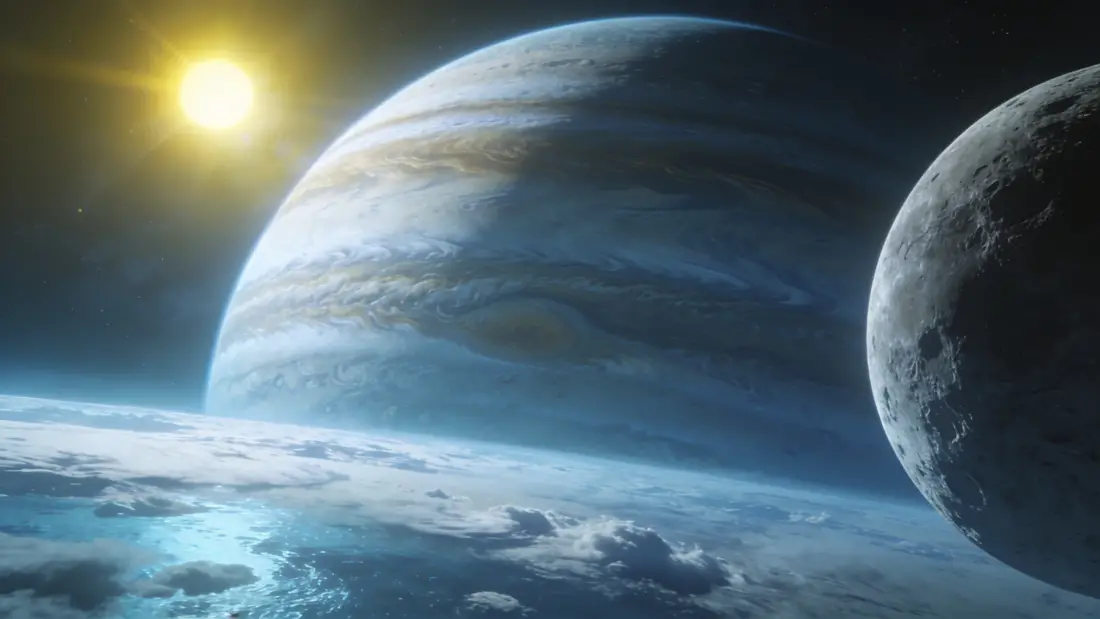
Kepler-539 c is a planet orbiting a star about 1,002 light-years from Earth. It was spotted in 2016, and it raises a natural question: could a world so far away, circling a distant star, ever support life? The short answer is almost certainly not — but the reasons why are worth exploring carefully.
A Giant World Unlike Anything in Our Solar System
The first thing to know about Kepler-539 c is its size. Its radius — that is, the distance from its center to its surface — is about 13.3 times Earth’s radius. That makes it far larger than our home planet. For comparison, even Jupiter, the biggest planet in our solar system, is only about 11 times Earth’s radius. So Kepler-539 c is a truly enormous world.
Its mass is even more striking. Mass is the amount of matter packed into an object. Kepler-539 c has a mass of about 763 times Earth’s mass. That is more than twice the mass of Jupiter. A planet this heavy is almost certainly a gas giant — a world made mostly of thick gases rather than solid rock or land.
Gas giants do not have a solid surface the way Earth does. There is no ground to stand on, no shoreline, no place where liquid water could pool and sit still. That alone makes the idea of life as we understand it very hard to imagine on a world like this.
How Scientists Found This Planet
Kepler-539 c was discovered in 2016 using a method called Transit Timing Variations, or TTV. To understand TTV, it helps to know about the transit method first. When a planet passes in front of its star, it blocks a tiny bit of starlight. Scientists on Earth can detect that small dip in brightness.
Now, if there is a second planet in the same system, its gravity gently tugs on the first planet. That tug makes the first planet arrive at its transit — its crossing in front of the star — slightly early or slightly late. By measuring how much those timings shift, scientists can figure out that a second planet must exist, even without ever seeing it cross the star directly. That second planet is Kepler-539 c.
This method is clever because it lets scientists find planets that are hard to detect any other way. It is also a reminder that much of what we know about Kepler-539 c comes from careful math and physics, not from a photograph of the planet itself.
The Star at the Center of This System
Every planet depends on its star for warmth and light. Kepler-539 is a star with a surface temperature of about 5,820 K. (K stands for Kelvin, a scale scientists use to measure temperature. 5,820 K is very hot — far hotter than any oven on Earth.) For comparison, our own Sun has a surface temperature of about 5,778 K. That means Kepler-539 is remarkably similar to the Sun in terms of heat output.
This is an interesting detail. Stars that are similar to the Sun are often the ones scientists find most promising when they think about habitability — the ability of a world to support life. A star that is too hot or too cool can make life much harder to imagine. Kepler-539 being close to solar in temperature is worth noting.
The Habitable Zone — and Where Kepler-539 c Sits
The habitable zone is the band of space around a star where conditions might allow liquid water to exist on a planet’s surface. It is sometimes called the “Goldilocks zone” — not too hot, not too cold. Liquid water is important because, as far as scientists know, all life needs it.
Being in the habitable zone does not mean a planet has water or life. It simply means the distance from the star is right so that liquid water could exist, given the right conditions. Many other things — like whether a planet has an atmosphere, and what that atmosphere is made of — also matter a great deal. You can explore how this works further with the habitable zone explainer on this site.
Kepler-539 c takes about 1,000 Earth days to complete one orbit around its star. That is a long year. Scientists have estimated its likely temperature at around 253 K, which is about -20 degrees Celsius. That is well below the freezing point of water. It sits on the cold edge of what might be considered habitable territory, though scientists haven’t confirmed its exact position in the habitable zone with certainty.
Why This World Is Almost Certainly Not Friendly to Life
Even setting aside the temperature, there are strong reasons to think Kepler-539 c could not support life as we know it. The biggest reason is its nature as a gas giant.
With a mass of 763 times Earth’s and a radius 13.3 times larger, this is not a rocky world with a surface. Scientists think it is made mostly of gas and, deeper inside, possibly compressed liquid or ice. There is no surface where oceans could form, no soil where anything could grow, and no stable ground of any kind.
The temperature of -20°C adds another challenge. Even if there were a surface, liquid water would be frozen at that temperature under Earth-like conditions. An atmosphere with certain gases can raise temperatures through the greenhouse effect — where gases trap heat close to a planet — but we have no data about Kepler-539 c’s atmosphere, and scientists haven’t been able to measure it yet.
Some scientists do think about the moons of gas giants as possible homes for life. Large planets sometimes have moons, and those moons can be rocky worlds in their own right. However, scientists haven’t detected any moons around Kepler-539 c, and we simply don’t have enough information to say whether any exist.
What Scientists Still Don’t Know
There is quite a lot we don’t yet know about this system. Scientists haven’t measured the full makeup of Kepler-539 c’s atmosphere, its exact position relative to the habitable zone, or whether it has moons. The system has two known planets, but there could be others that haven’t been found yet.
At 1,002 light-years away, getting detailed information about Kepler-539 c is genuinely difficult. A light-year is the distance light travels in one year — an almost unimaginable distance. Current telescopes can tell us a lot, but fine details about distant worlds like this one remain out of reach for now.
If you’re curious about worlds that scientists think are better candidates for life, the most Earth-like worlds list is a good place to look. Kepler-539 c, for all its fascinating qualities, is a reminder that “in an interesting orbit” and “friendly to life” are very different things — and that honest science means knowing the difference.