
In 2026, astronomers added a new world to our growing list of known planets beyond our solar system. That world is LHS 1903 b, a rocky planet a little larger than Earth, circling a dim star 116 light-years away. It is one of four planets found in the same system, and each one gives scientists a little more to think about.
Where in the Sky Is LHS 1903 b?
LHS 1903 b sits 116 light-years from Earth. A light-year is the distance light travels in one year — about 9.5 trillion kilometers. That sounds enormously far, and it is, but in cosmic terms it is still a fairly close neighbor. Many known exoplanets — planets outside our solar system — are hundreds or even thousands of light-years away. At 116 light-years, LHS 1903 b is in a part of the galaxy that astronomers can study in reasonable detail with modern telescopes.
You can explore how this planet fits into the broader map of known worlds in the Extremetica atlas.
What Kind of Star Does LHS 1903 b Orbit?
The planet orbits a star called LHS 1903. This star has a surface temperature of 3,664 K (K stands for Kelvin, a scale scientists use to measure very high or very low temperatures — 3,664 K is roughly 3,391 degrees Celsius). That is much cooler than our own Sun, which has a surface temperature of about 5,778 K.
A star that cool is called a red dwarf. Red dwarfs are the most common type of star in the Milky Way. They burn their fuel slowly and can live for tens of billions of years — far longer than stars like our Sun. They also shine with a reddish or orange glow rather than yellow-white. Because red dwarfs are smaller and dimmer, their habitable zones — the regions around a star where liquid water could exist on a planet’s surface — sit much closer in than ours does around the Sun.
Red dwarfs are popular targets for planet hunters. Their small size means a planet passing in front of them blocks a larger fraction of their light, which makes the planet easier to detect.
Size and Mass: What Makes LHS 1903 b a Super-Earth?
LHS 1903 b has a radius of 1.38 times Earth’s radius. That means if you set Earth and LHS 1903 b side by side, LHS 1903 b would be noticeably wider. Its mass is 3.28 times Earth’s mass, so it is also considerably heavier.
A planet like this — bigger and heavier than Earth but not nearly as large as Neptune — belongs to a category scientists call a super-Earth. The term does not mean the planet is similar to Earth in any other way. It simply describes a planet in that size and mass range. Many super-Earths are rocky worlds, while others may have thick layers of gas or liquid. Scientists can estimate the likely makeup of a planet by comparing its size to its mass. For LHS 1903 b, the numbers suggest it is probably a rocky world, though scientists haven’t confirmed its exact composition yet.
A Scorching World: Temperature and Orbit
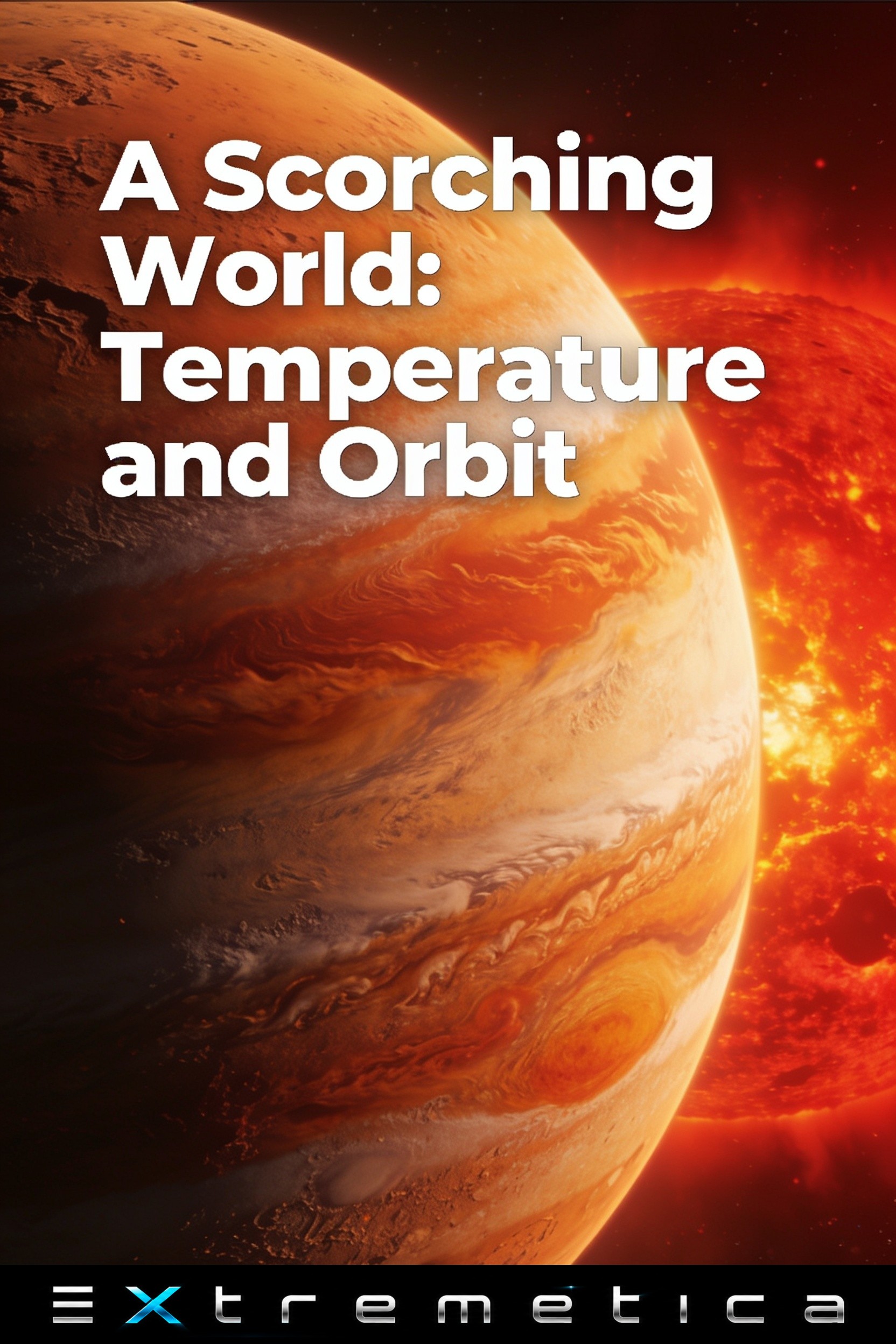
LHS 1903 b completes one full orbit around its star in just 2.16 Earth days. Our own year lasts 365 days, so this planet moves incredibly fast by comparison. To finish an orbit that quickly, it must be orbiting very close to its star.
That closeness comes with a cost. The estimated surface temperature of LHS 1903 b is about 796 K, which works out to roughly 523 degrees Celsius. That is far hotter than any oven or even most industrial furnaces. At that temperature, liquid water is not possible on the surface. This planet does not sit in what scientists call the habitable zone — the region where conditions might allow liquid water to exist. As far as we know, it is a hot, dry, and likely airless or thin-atmosphered world, though scientists haven’t studied its atmosphere yet.
Three Neighbors: The Rest of the System
LHS 1903 b is not alone. Astronomers have found three other planets in the same system, bringing the total to four known worlds orbiting LHS 1903. Details about those other planets — their sizes, masses, temperatures, and orbits — haven’t all been fully measured and published yet, so we will not guess at them here. What we do know is that multi-planet systems like this one are especially useful. When scientists can compare several planets around the same star, it helps them understand how planets form and change over time. Finding four planets around one small, cool star is a meaningful result.
How Scientists Found It
LHS 1903 b was discovered using the transit method. This technique works by watching a star very carefully over time. When a planet passes directly between us and the star, it blocks a tiny fraction of the star’s light. The star appears to dim slightly, then brighten again. That small dip — repeated on a regular schedule — tells astronomers a planet is there. The transit method also reveals the planet’s size, because a larger planet blocks more light. Paired with other measurements, it can help scientists figure out a planet’s mass as well.
You can follow the long history of exoplanet discoveries, from the earliest confirmed worlds to finds like LHS 1903 b, on our discovery timeline.
LHS 1903 b is one data point among thousands, but each new world helps scientists build a clearer picture of how common planets are, what shapes and sizes they come in, and what conditions exist elsewhere in the galaxy. For now, this particular super-Earth is a hot, fast-moving rock around a quiet red star — and that, on its own, is genuinely interesting.