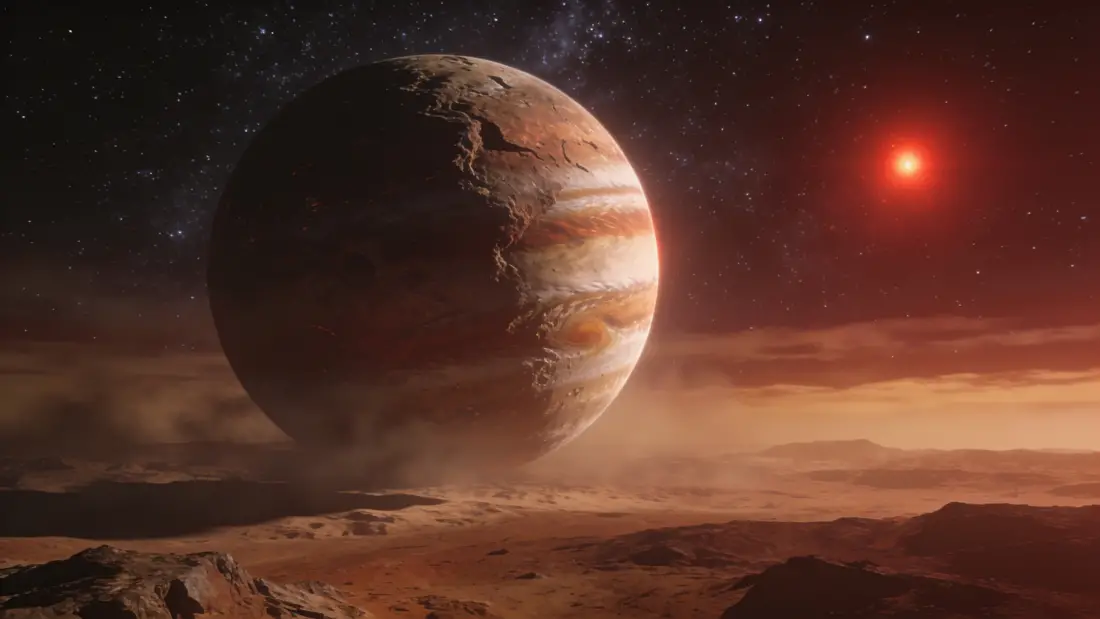
About 116 light-years away, a small star hosts a busy little family of worlds — and one of them, LHS 1903 c, is a fascinating example of a type of planet our own solar system simply does not have. It sits in a gap between Earth and the giant planets, and studying it helps scientists understand how planets form and what they are made of.
Where in the Sky Is LHS 1903?
The star LHS 1903 sits 116 light-years from Earth. A light-year is the distance light travels in one year — about 9.5 trillion kilometres. So 116 light-years is an enormous distance, far beyond anything humans have ever visited. Even so, by the scale of our galaxy, it is a close neighbour.
LHS 1903 is a red dwarf — a type of star that is much smaller, cooler, and dimmer than our Sun. Its surface temperature is 3,664 K (kelvin is the unit scientists use to measure very high temperatures). For comparison, our Sun’s surface is about 5,778 K, so LHS 1903 runs noticeably cooler. Red dwarfs are the most common type of star in the Milky Way, and many of them turn out to host planets.
At least four planets are known to orbit LHS 1903. LHS 1903 c is the second one out from the star.
How Did Scientists Find LHS 1903 c?
LHS 1903 c was discovered in 2026 using the transit method. Here is how that works: when a planet passes in front of its star, it blocks a tiny fraction of the star’s light. Telescopes watching the star notice this small dip in brightness. If the dip happens on a regular schedule, scientists can tell a planet is orbiting there.
The transit method is a bit like watching a fly walk across a lamp. You cannot see the fly clearly, but you notice the light gets a little dimmer for a moment. From that, you can figure out the fly’s size — and with careful maths, a great deal more.
Once scientists spotted the transits of LHS 1903 c, they could calculate how big the planet is and how long it takes to complete one orbit. Other measurements helped pin down the planet’s mass. Together, size and mass are the two most important clues to what a planet is made of.
Size and Mass: What the Numbers Tell Us
LHS 1903 c has a radius about 2.05 times Earth’s and a mass about 4.55 times Earth’s. Those might sound like small differences, but they carry a lot of meaning.
If you know a planet’s size and mass, you can work out its density — how tightly matter is packed inside it. A planet made mostly of rock is dense. A planet wrapped in thick gas or a deep layer of water is less dense, because those materials are lighter for their volume.
LHS 1903 c is about twice as wide as Earth, but its mass is only about four and a half times Earth’s. That combination suggests it is not a pure rock ball — if it were, scientists would expect it to be heavier for its size. Instead, the planet likely has a thick envelope of lighter material around a rocky or icy core. You can explore how radius and mass relate to planet type using our mass-radius diagram.
Inside a Mini-Neptune
Based on its size and mass, LHS 1903 c most likely belongs to a category called a mini-Neptune. A mini-Neptune is a world larger than Earth but smaller than the ice giants in our solar system — Uranus and Neptune. These planets probably have a solid or slushy core surrounded by a thick layer of water, ice, or gas. Scientists are not yet certain of the exact mix inside LHS 1903 c, but the density hints strongly at this kind of layered structure.
Mini-Neptunes are interesting because they are the most common type of planet found around other stars, yet we have none in our own solar system. Our planets jump straight from the rocky worlds — Mercury, Venus, Earth, Mars — to the much larger gas giants like Jupiter and Saturn. That gap in our solar system is actually unusual. Most star systems seem to fill it with planets just like LHS 1903 c.
One open question is whether LHS 1903 c has a proper atmosphere — a layer of gas around it. Scientists think mini-Neptunes often do, but the composition and thickness can vary a lot. For this planet, we do not yet have enough data to say what that atmosphere might be made of, if it exists at all.
If you want to get a feel for just how much larger 2.05 Earth radii really looks, the size comparison tool lets you put planets side by side.
How Hot Is LHS 1903 c, and Why?
The estimated temperature of LHS 1903 c is about 559 K, which works out to roughly 286 degrees Celsius. That is hot enough to melt lead, and far above what life as we know it could survive. This is not a world in the habitable zone — the region around a star where temperatures might allow liquid water to exist on a planet’s surface.
The main reason LHS 1903 c is so warm is its orbit. It circles its star in just 6.23 Earth days. That is less than one Earth week for a full year. Such a short orbit means the planet is very close to LHS 1903, and even though that star is cool and dim, the planet sits near enough to receive a strong dose of heat and radiation. The temperature figure of 559 K is a scientific estimate based on how much energy the star sends out and how close the planet sits — scientists call this the equilibrium temperature. The real surface temperature could differ depending on whether the planet has an atmosphere that traps or reflects heat.
The Rest of the System
LHS 1903 c shares its star with at least three other planets, making LHS 1903 a multi-planet system. Finding four planets around a small red dwarf is not unusual — red dwarfs often host compact families of worlds, many of them packed into short orbits. Scientists haven’t published full details on all four planets in this system yet, so we don’t have verified sizes or masses for the others to share here.
What we do know is that each world in a system like this formed from the same original cloud of gas and dust, yet they can turn out remarkably different from one another. Studying all four planets together, when more data arrives, will help scientists piece together the history of this little corner of the galaxy.
LHS 1903 c is a good reminder that the universe is full of planet types we cannot find at home. Every new world measured adds another data point to a growing picture of just how varied — and how surprising — planets can be.