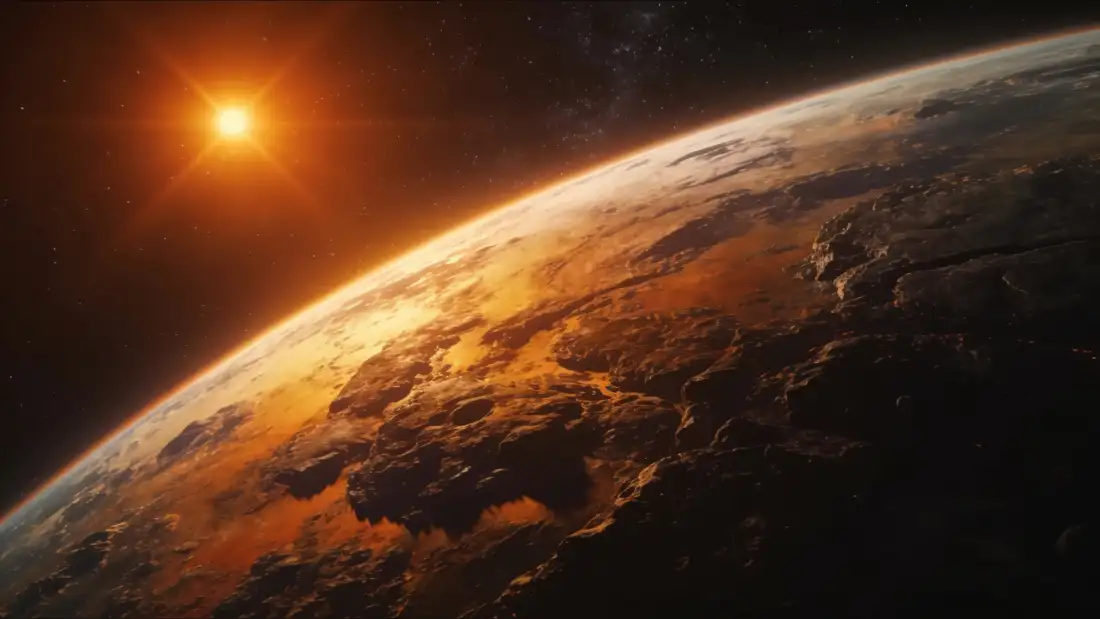
Ninety-three light-years away, a planet about twice the size of Earth zips around an orange star in under ten days. That planet is GJ 1137 c, and it belongs to a class of worlds we have no example of in our own solar system. Getting to know it helps us understand just how many different kinds of planets the universe can make.
Where GJ 1137 c Lives
GJ 1137 c orbits a star called HD 93083. Despite the planet’s name starting with “GJ,” the host star is also catalogued as HD 93083 — stars often carry more than one name from different sky surveys over the years.
HD 93083 is what astronomers call a K-type star, sometimes nicknamed an orange dwarf. That means it is a little cooler and a little smaller than our own Sun. Its surface temperature is about 5,034 Kelvin. Kelvin is a unit scientists use to measure very high temperatures — 0 Kelvin is the coldest anything can ever get, and our Sun’s surface sits near 5,778 Kelvin. So HD 93083 runs somewhat cooler than the Sun, glowing with a warm, orange-yellow light.
The whole system sits 93.0 light-years from Earth. A light-year is the distance light travels in one year — roughly 9.5 trillion kilometres. That is far beyond any spacecraft we have today, but close enough that telescopes can study the star’s light in good detail.
Size and Mass — What the Numbers Tell Us
GJ 1137 c has a radius of 2.11 times Earth’s radius. Picture Earth as a golf ball. GJ 1137 c would be a little bigger than a ping-pong ball beside it. That puts it comfortably in the category scientists call a mini-Neptune — a planet larger than Earth but smaller than Neptune.
Its mass is 5.12 times Earth’s mass. Mass is simply how much stuff — or matter — a planet contains. Knowing both the size and the mass lets scientists work out a planet’s density. Density tells you how tightly packed the matter inside is. A planet made mostly of iron would be very dense. One made mostly of gas and water would be much lighter for its size.
For GJ 1137 c, the combination of a moderate radius and a modest mass suggests it is not a dense, purely rocky world. Scientists think it likely holds a mix of materials — possibly a rocky or iron core surrounded by layers of water, ice, or lighter gases. You can explore how size and mass relate to each other for many exoplanets using the mass-radius diagram.
Inside a Mini-Neptune — Layers of Rock, Ice, and Gas
Because we cannot visit GJ 1137 c or send a probe, everything about its interior is a careful estimate. Still, its size and mass give scientists real clues.
Mini-Neptunes are thought to have several layers. At the center there is likely a core of rock and possibly iron. Above that, many models suggest a thick layer of water or ices — and here “ice” does not mean frozen the way we think of it. Deep inside a planet, water can exist in very exotic states under enormous pressure, neither quite liquid nor solid in the everyday sense.
On top of that, a mini-Neptune probably carries a hydrogen and helium envelope — a deep, thick blanket of lightweight gas. This gas layer would make the planet puff up larger than a purely rocky world of the same mass. That matches what we see with GJ 1137 c: it is a bit bigger than we might expect for just over five Earth masses of material, which hints that some lighter material is inflating its outer layers.
Scientists have not measured GJ 1137 c’s atmosphere directly. We do not yet know for certain what gases surround it, or how thick that atmosphere might be. Those answers may come from future observations.
A Very Fast Year

One of the most striking things about GJ 1137 c is how quickly it completes one orbit. Its year lasts just 9.64 Earth days. That means it circles its star roughly 38 times in the same period Earth goes around the Sun once.
Such a short orbit places the planet very close to HD 93083. Being that close to a star usually means a planet receives a great deal of heat and radiation. The planet almost certainly does not experience anything like comfortable seasons. Scientists have not published a measured surface temperature for GJ 1137 c yet, but a world sitting that close to its star is generally expected to be quite warm.
If you are curious how GJ 1137 c compares in size to planets in our solar system, the size comparison tool lets you put worlds side by side.
How Scientists Found It — the Radial Velocity Method
GJ 1137 c was discovered in 2026 using a technique called the radial velocity method. Here is how that works. A planet does not just orbit its star — the star also wobbles slightly because of the planet’s gravity pulling on it. When the star wobbles toward us, its light shifts very slightly toward the blue end of the spectrum. When it wobbles away, the light shifts toward the red end. Scientists measure these tiny shifts precisely to figure out that a planet must be there.
The radial velocity method is very good at measuring a planet’s mass. Combined with a radius measurement from another method — such as watching the planet cross in front of the star — scientists can work out density. For GJ 1137 c, we have both a radius and a mass from the archive data, which is why scientists can already begin building models of what is inside.
A Two-Planet System
So far, astronomers have found two known planets in the HD 93083 system. GJ 1137 c is one of them. The other planet in the system has not been the focus of this article, and detailed verified data on it is limited, but its presence tells us that planet formation around this orange star was active enough to build more than one world.
Multi-planet systems are common in our galaxy. Many of the thousands of exoplanets — planets outside our solar system — found so far belong to families of two, three, or even more worlds sharing the same star. HD 93083 fits that pattern.
Could Anything Live There?
The short answer is: we do not know, and scientists are careful not to guess. GJ 1137 c orbits very close to its star, which likely makes it quite hot. It also seems to be a mini-Neptune, and planets of that type may not have a solid surface to stand on at all. The habitable zone — the region around a star where liquid water could exist on a surface — is a concept that applies most easily to rocky worlds. For a planet wrapped in thick gas, the question of habitability becomes much harder to answer.
None of this makes GJ 1137 c less interesting. Every world we study teaches us something new about how planets form, what they are made of, and how common or rare different types of worlds might be. GJ 1137 c is a good example of the most abundant kind of planet we have found beyond our solar system — and yet it has no twin here at home. That alone makes it worth knowing.