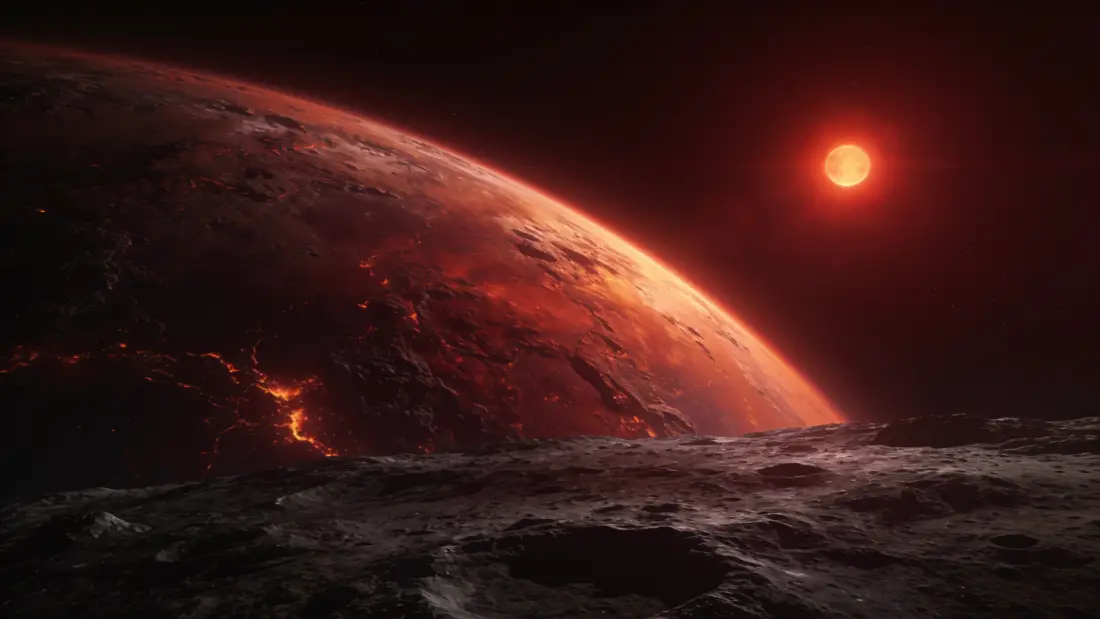
In 2026, astronomers added a new world to our growing list of known exoplanets — planets that orbit stars beyond our own Sun. That world is TIC 231949697 b, a rocky planet sitting 164 light-years from Earth. Its discovery is a good example of how scientists find planets they can never see directly, using only careful measurements of starlight.
Meet TIC 231949697 b
A light-year is the distance light travels in one year — about 9.5 trillion kilometres. At 164 light-years away, TIC 231949697 b is far too distant for any telescope to photograph as a separate dot. Even our most powerful instruments cannot pick it out from the glare of its host star, TIC 231949697.
So how do we know it is there at all? The answer lies in a clever trick. When a planet moves across the face of its star, it blocks a tiny fraction of the star’s light. From Earth, that shows up as a small, regular dip in the star’s brightness. Scientists spotted exactly that pattern coming from TIC 231949697, and that is how this planet was confirmed.
The Transit Method, Step by Step
The transit method works because planets travel in orbits — paths they repeat again and again around their star. When a planet’s orbit is lined up just right, it passes in front of the star from our point of view. That moment is called a transit.
Here is what astronomers do:
- They point a telescope at a star and measure its brightness very precisely, thousands of times over many days or months.
- If a planet is present and its orbit is tilted toward us, the star will dim slightly each time the planet passes in front.
- The dip in brightness is tiny — often less than one percent — but modern instruments can detect it.
- If the same dip happens again and again at a steady interval, that is strong evidence of a planet in orbit.
The time between one dip and the next tells scientists how long the planet’s year is — in other words, how long it takes to complete one trip around its star. You can explore how this works yourself with our interactive planet-finding simulator.
Reading the Light Curve
When scientists plot a star’s brightness against time, the result is called a light curve. Think of it as a graph that shows how the light rises and falls. A transit looks like a smooth, U-shaped dip on that graph.
The depth of the dip — how much the light drops — is related to the size of the planet compared to the star. A larger planet blocks more light, so it makes a deeper dip. A smaller planet makes a shallower one.
The width of the dip — how long it lasts — depends on how fast the planet moves across the star’s face. Planets with very short orbits zip across quickly. Planets on wider, slower orbits take longer to cross.
Scientists measure these shapes carefully to estimate a planet’s size. That is how they worked out that TIC 231949697 b has a radius about 1.53 times that of Earth — meaning it is noticeably wider than our planet, though not enormous.
The Wobble Method — A Second Way to Check
Finding a dip in a star’s light is a strong clue, but scientists like to confirm their findings. One important tool for this is the radial velocity method, sometimes called the wobble method.
Here is the idea. A planet does not simply orbit a star while the star sits perfectly still. Both the planet and the star tug on each other through gravity. As the planet moves around, it pulls the star in a very small circle. That causes the star to wobble slightly — moving a tiny bit toward us and then away from us as it goes around.
When the star moves toward us, its light gets squished to slightly shorter wavelengths. When it moves away, the light stretches to slightly longer wavelengths. This is called the Doppler effect, and astronomers can measure it with a spectrograph — an instrument that splits starlight into its colours, the way a prism does.
By measuring how much the star wobbles, scientists can estimate the planet’s mass. That is how we know TIC 231949697 b has a mass about 2.95 times that of Earth. Together, the radius from the transit method and the mass from the wobble method help scientists work out what a planet might be made of.
What TIC 231949697 b Is Like
With a radius of 1.53 Earths and a mass of 2.95 Earths, TIC 231949697 b is classed as a super-Earth — a planet bigger and heavier than ours, but likely still rocky in nature. Scientists use the combination of size and mass to estimate how dense a planet is, and this one appears to be a solid world rather than a gassy one.
Its year is extremely short. One full orbit around its star takes just 0.91 Earth days — less than a single day on our planet. That means it is orbiting incredibly close to its star.
Being that close has a dramatic consequence. The planet’s likely temperature is around 983 K, which is about 710 degrees Celsius. That is far hotter than any oven, and hotter than the melting point of many rocks. Any liquid water would be impossible under those conditions, and life as we know it could not survive there. TIC 231949697 b sits well outside what scientists call the habitable zone — the range of distances from a star where liquid water could exist on a planet’s surface.
The Star Behind the Planet
TIC 231949697 is what astronomers call a red dwarf — a type of star that is smaller, cooler, and dimmer than our Sun. Its surface temperature is 3,451 K. Our Sun, by comparison, burns at around 5,778 K. Red dwarfs are the most common type of star in our galaxy, and they are a rich hunting ground for planet hunters because their small size makes transits easier to detect.
So far, TIC 231949697 b is the only planet confirmed in this system. Scientists haven’t measured whether there are others waiting to be found — that could change as more observations are made.
TIC 231949697 b is a scorching, fast-moving world, and it is unlikely to be a place where anything lives. But its discovery still matters. Every planet we find teaches us more about how planetary systems form, and each new detection sharpens the tools and methods astronomers will use to find the worlds they are really hoping for — ones that might, just possibly, be a little more like home.