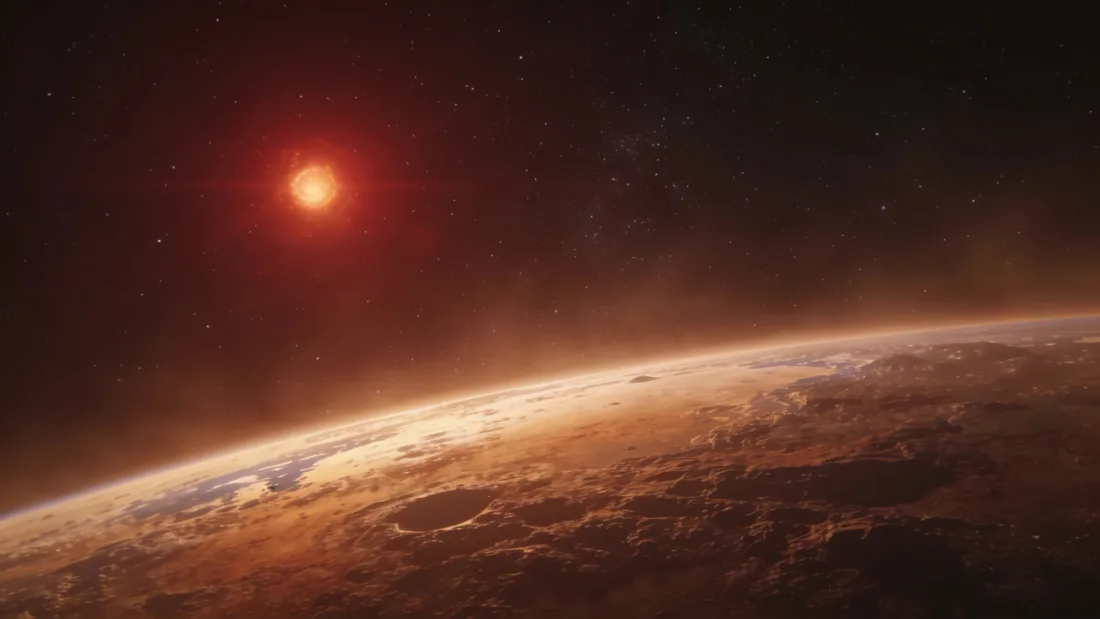
Ross 128 b is one of the closest known exoplanets — planets orbiting stars other than our Sun — to Earth. It sits just 11.0 light-years away, making it one of our nearest neighbors in the galaxy. That sounds close, but as you are about to find out, even “next door” in space is almost impossible to imagine.
A Star Next Door
Ross 128 is the name of the star that Ross 128 b orbits. It sits in the constellation Virgo, a pattern of stars you can find in the night sky. In the big picture of our galaxy, the Milky Way, 11.0 light-years is a tiny gap. Our galaxy is roughly 100,000 light-years across. So Ross 128 is an extremely close neighbor on that scale — like living on the same street.
Only a handful of star systems are closer to us than Ross 128. The Alpha Centauri system is the nearest of all, at just over 4 light-years. Ross 128 sits a little farther out, but it is still among the nearest few dozen stars to our Sun. If you could see all the stars within 12 light-years of Earth plotted on a map, Ross 128 would be right there in the cluster closest to home. You can explore that neighborhood yourself using the Cosmic Map.
What 11 Light-Years Actually Means

A light-year is the distance light travels in one year. Light is the fastest thing in the universe. It moves at about 300,000 kilometers every single second. In one year, light covers roughly 9.46 trillion kilometers — that is a 9 followed by 12 zeros.
Multiply that by 11.0, and you get the distance to Ross 128. The number is so large that it stops feeling real. Here is one way to think about it. The Sun’s light takes about 8 minutes to reach Earth. The light you would see from Ross 128 tonight left that star 11 years ago. When that light set off on its journey, it was 2014 here on Earth.
Space probes are the fastest human-made objects we have ever launched. The Voyager 1 probe, which has been traveling since 1977, moves at roughly 17 kilometers per second. At that speed, it would take Voyager 1 around 75,000 years to cover one light-year. Ross 128 is 11.0 light-years away. The numbers get very large very fast.
How Long Would a Trip Take?
There is no spacecraft today that could make the journey to Ross 128 in any reasonable time. At Voyager 1’s speed, a trip there would take hundreds of thousands of years. Even if engineers could build a ship that traveled at one percent of the speed of light — far beyond anything we can do now — the journey would still take over 1,100 years.
Scientists and dreamers have proposed ideas for faster travel, such as using powerful lasers to push a tiny sail-like probe. Some concepts suggest that a very small probe might one day reach a few percent of the speed of light. But nothing like that has been built yet, and many huge problems remain unsolved. For now, Ross 128 b is a world we can only study from here, using telescopes and the light that arrives on our doorstep after an 11-year trip.
If you want to see just how these distances and travel times compare for different worlds, the Distance and Travel Time tool lets you explore the numbers yourself.
How Scientists Found Ross 128 b
Astronomers announced the discovery of Ross 128 b in 2017. They used a method called the Radial Velocity method — sometimes nicknamed the “wobble” method. Here is how it works. A planet’s gravity pulls on its star as it orbits. That tiny pull makes the star wobble slightly toward us and then away from us. When the star moves toward Earth, its light shifts a little toward the blue end of the spectrum. When it moves away, the light shifts toward the red. Scientists measure these tiny shifts very carefully. Over time, the pattern of shifts tells them that a planet is there, and gives clues about the planet’s mass and orbit.
The Radial Velocity method does not let scientists see a planet directly. Ross 128 b has never been photographed. Everything we know about it comes from the careful study of starlight and the math behind it.
What We Know About the Planet
For a world we cannot photograph, we actually know a reasonable amount about Ross 128 b. Scientists estimate its radius at about 1.11 times Earth’s — so it is slightly larger than our planet, but not by much. Its mass is estimated at about 1.4 times Earth’s mass. Together, those figures suggest Ross 128 b is probably a rocky world, though scientists cannot be certain of that yet.
One orbit around Ross 128 takes just 9.87 Earth days. That is a very short year. The planet is much closer to its star than Earth is to the Sun. Its estimated surface temperature is around 301 K, which works out to about 28 degrees Celsius. That is a warm but not scorching temperature. Importantly, scientists haven’t yet measured its atmosphere — if it has one — so that temperature is an estimate based on its distance from the star, not a confirmed reading from the surface.
The Star: A Cool, Quiet Red Dwarf
Ross 128 is what astronomers call a red dwarf — a star that is smaller and cooler than our Sun. Its surface temperature is 3,192 K. Our Sun’s surface is about 5,778 K, so Ross 128 is significantly cooler. It glows with a reddish light rather than the yellow-white we see from our own star.
Red dwarfs are the most common type of star in the Milky Way. One thing that makes Ross 128 stand out among red dwarfs is that it is considered relatively quiet. Some red dwarfs send out powerful bursts of energy called flares, which could strip away a nearby planet’s atmosphere. Ross 128 produces fewer of these violent outbursts than many of its siblings, which scientists see as a hopeful sign for any planet in its orbit.
Could Ross 128 b Be Habitable?
Ross 128 b sits in what scientists call the habitable zone — the range of distances from a star where liquid water could exist on a planet’s surface, given the right conditions. That is an interesting place to be. But “could exist” carries a lot of uncertainty.
We do not know whether Ross 128 b has an atmosphere. Without an atmosphere, liquid water cannot exist on a surface at all. We do not know its surface conditions, its geology, or whether it has a magnetic field to protect it. Scientists think it is a promising candidate for further study, but no one is claiming it is a living world. It is simply a nearby planet, in the right zone, that deserves a closer look — which is exactly the kind of target future telescopes are being designed to examine.
Ross 128 b reminds us how much we have already learned about worlds we cannot visit, and how much is still waiting to be discovered across those 11.0 quiet light-years of space.