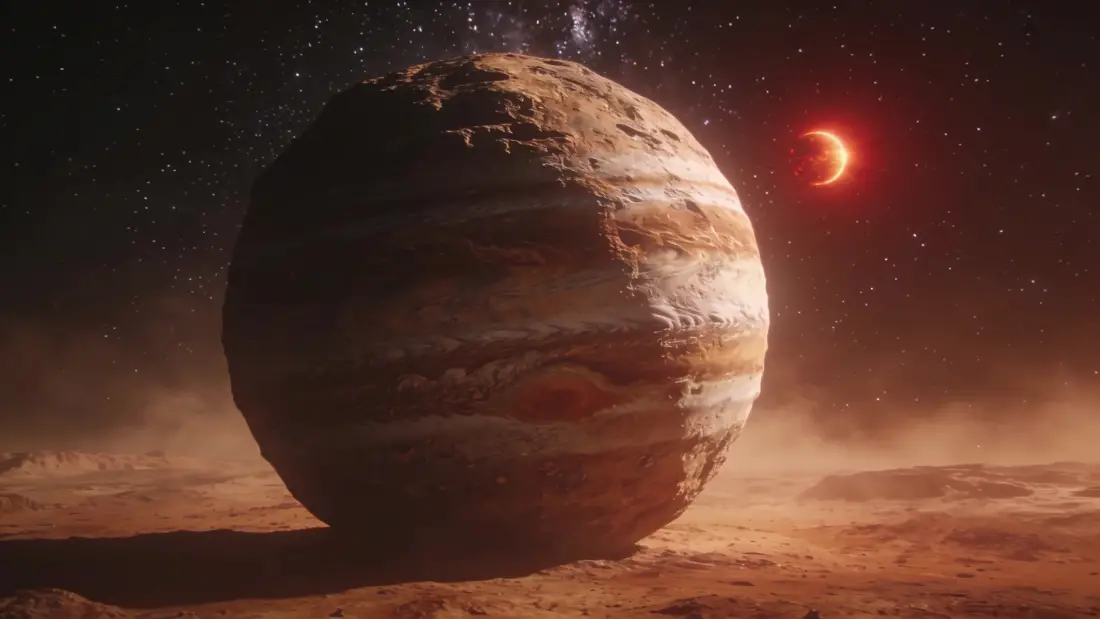
TOI-1243 b is a planet about 141 light-years from Earth, confirmed in 2026. It belongs to a group called mini-Neptunes — worlds bigger than Earth but smaller than the giant ice planet Neptune in our own solar system. Scientists are still piecing together what this world is really like, and the picture so far is fascinating.
What Kind of Star Does TOI-1243 b Orbit?
Every planet story starts with its star. TOI-1243 b circles a star called TOI-1243. Based on its surface temperature of 3,515 K (about 3,240 degrees Celsius), this star is quite cool compared to our own Sun, which runs at roughly 5,778 K. A star that cool is known as a red dwarf — a small, dim star that burns far less brightly than the Sun.
Red dwarfs are the most common type of star in our galaxy. They live for an incredibly long time — far longer than stars like the Sun. That gives any planets around them a huge amount of time to develop. But red dwarfs can also be moody. They sometimes send out bursts of energy called flares, which are sudden flashes of radiation. Whether TOI-1243 b feels the effects of such flares is something scientists are still working to understand.
How Scientists Found TOI-1243 b
TOI-1243 b was discovered using something called the transit method. Here is how it works. When a planet passes in front of its star, it blocks a tiny bit of starlight. A telescope watching the star notices the light dimming slightly, then brightening again as the planet moves on. By measuring how much the light dims and how often it happens, scientists can figure out the planet’s size and how long its orbit takes.
The name “TOI” stands for TESS Object of Interest. TESS is a space telescope designed specifically to hunt for these little dips in starlight. It watches large patches of the sky at once and flags anything that looks like a planet passing by. Once TESS spots a candidate, scientists use other telescopes to confirm the find. TOI-1243 b earned its confirmed status in 2026. You can explore other confirmed worlds in our atlas of known exoplanets.
Size, Mass, and What Those Numbers Tell Us
TOI-1243 b has a radius — that means its width from center to edge — of about 2.33 times Earth’s. Its mass, which is how much matter it contains, comes in at 7.7 times Earth’s. Both of those measurements put it comfortably in the mini-Neptune category.
When scientists compare a planet’s size to its mass, they get a sense of what it might be made of. A planet that is very large but not very heavy is probably full of gas or ice. A planet that is small but very heavy is likely made mostly of rock and metal. TOI-1243 b sits somewhere in the middle. Scientists think it probably has a rocky or icy core surrounded by a thick atmosphere of gas — but they have not measured that atmosphere directly yet, so this is an educated guess rather than a confirmed fact.
This size range — roughly two to four times Earth’s radius — is actually very interesting to astronomers. In our own solar system, we have rocky planets like Earth and Mars, and we have gas giants like Jupiter and Saturn. There is nothing in between. But out in the wider galaxy, worlds like TOI-1243 b seem to be quite common. Studying them helps scientists understand how planets form and grow.
A Very Short Year and a Very Hot Day

One orbit around TOI-1243 takes just 4.66 Earth days. That means one year on TOI-1243 b is less than five of our days. The planet sits very close to its star to move that quickly.
Being so close to the star means the planet receives a lot of energy. Scientists estimate its temperature at around 450 K, which works out to about 177 degrees Celsius. That is hotter than a kitchen oven at full blast. Keep in mind, this is an estimate of the planet’s average temperature based on how much starlight it receives — the actual surface or atmospheric temperature could be different depending on factors scientists have not yet measured, such as whether it has clouds or how thick its atmosphere is.
Could This World Support Life?
Honestly, TOI-1243 b does not look like a great candidate for life as we know it. The temperature is far too high for liquid water on any rocky surface, and the planet is almost certainly not a solid, rocky world in the first place. The habitable zone — the range of distances from a star where liquid water could exist on a planet’s surface — is much farther out than where TOI-1243 b orbits. As far as we can tell, this planet sits well outside that zone.
That does not make it uninteresting. Quite the opposite. Understanding hot, gassy worlds like this one helps scientists figure out what makes a planet suitable for life in the first place.
What Scientists Hope to Learn Next
TOI-1243 b is currently the only known planet in its system, though scientists have not ruled out the possibility of others waiting to be found. Future observations could reveal whether this world has an atmosphere, and if so, what it is made of. Telescopes powerful enough to read the chemistry of a planet’s air are now operating, and mini-Neptunes are high on the list of worlds worth examining closely.
TOI-1243 b is a small dot of light, 141 light-years away, that we are only just beginning to understand. As tools improve and data comes in, our picture of this planet will sharpen. You can follow new finds like this one on our discovery timeline as the list of known worlds keeps growing.