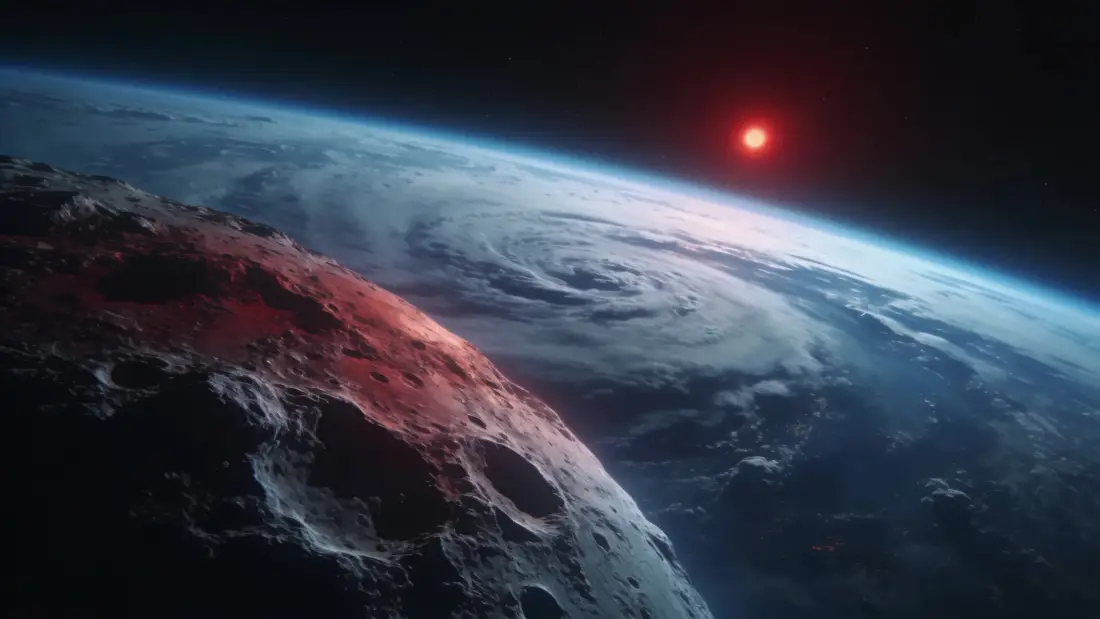
Kapteyn c is a planet circling one of the nearest stars to our Sun. It sits close enough that astronomers can study it in some detail, yet so far away that reaching it is far beyond anything we can do today. Thinking about that distance — really thinking about it — teaches us something deep about how vast space truly is.
Meet Kapteyn’s Star and Its World
Kapteyn c orbits a star called Kapteyn’s Star. The star is named after Jacobus Kapteyn, a Dutch astronomer who studied it closely more than a century ago. It is what scientists call a red dwarf — a star that is smaller, cooler, and dimmer than our Sun. Its surface temperature is 3,550 K. (K stands for kelvin, a scale scientists use to measure heat. For comparison, our Sun’s surface is about 5,778 K, so Kapteyn’s Star is noticeably cooler.)
The planet was discovered in 2014, using something called the radial velocity method. This is a clever technique. As a planet orbits a star, its gravity pulls the star very slightly back and forth. That tiny wobble changes the color of the starlight reaching us just a little. By measuring those changes carefully, scientists can figure out that a planet is there — even without seeing it directly.
So far, astronomers have confirmed one planet in this system. There could be more, but none have been confirmed yet.
What 12.8 Light-Years Actually Means
Kapteyn’s Star is 12.8 light-years away. A light-year is the distance light travels in one full year. Light moves at about 300,000 kilometers every second. In a year, it covers roughly 9.46 trillion kilometers. That is a 9 followed by twelve zeros.
So 12.8 light-years is about 121 trillion kilometers from Earth. Writing that number out does not really help the brain understand it. Let’s try a different way.
The Moon is about 384,000 kilometers away. The fastest spacecraft ever launched by humans, NASA’s New Horizons probe, traveled fast enough to reach the Moon in roughly nine hours. That sounds quick. But New Horizons moves at around 58,000 kilometers per hour. At that speed, reaching Kapteyn’s Star would take about 236,000 years. That is longer than modern humans have existed on Earth.
Even a signal sent by radio — traveling at the speed of light — takes 12.8 years one way to reach the star. If someone there replied immediately, we would wait nearly 26 years for the answer to come back. That is a long conversation.
You can explore distances like this yourself using our Distance and Travel Time tool, which shows how long different spacecraft speeds would take to reach various stars.
How Long Would Real Spacecraft Take?
Let’s look at some different travel scenarios, using what we actually know about spacecraft speeds and some ideas scientists have discussed for the future.
- New Horizons speed (about 58,000 km/h): Roughly 236,000 years.
- Parker Solar Probe (the fastest spacecraft ever, at its closest to the Sun — about 692,000 km/h): Still around 20,000 years.
- A future ion drive or nuclear rocket (a concept scientists have studied, perhaps reaching 1% of the speed of light): Around 1,280 years.
- A laser-pushed light sail (like those imagined in the Breakthrough Starshot project, aiming for 20% of light speed): About 64 years — still a human lifetime, and that is for a tiny probe, not a crewed ship.
None of these options, except perhaps the last, exist yet in working form for interstellar travel. And even 64 years is a very long journey. A crewed mission to Kapteyn c — with life support, fuel, food, and a way to slow down at the other end — is far beyond anything we know how to build today.
Slowing down is often forgotten in these conversations. Arriving at 20% of the speed of light and not being able to stop means flying straight past. Any real mission would need as much energy to brake as it does to accelerate, roughly doubling the challenge.
What Kind of World Is Kapteyn c?
Even if we could get there, what would we find? Scientists have measured a few things about Kapteyn c, though many details remain unknown.
The planet has a radius about 2.54 times that of Earth and a mass about 7 times Earth’s mass. Planets in this size and mass range are sometimes called super-Earths — worlds larger and heavier than our own, but probably still rocky rather than made mostly of gas. However, scientists haven’t measured exactly what Kapteyn c is made of, so we can’t be certain.
One orbit around its star takes 122 Earth days. That is its year — shorter than ours because it sits in a different orbit around a very different star.
Kapteyn c orbits farther out from its star than Kapteyn b (the planet that was once thought to be in the system alongside it — though scientists have debated whether Kapteyn b is a real planet or a measurement artifact). Because red dwarf stars are so dim, a planet needs to be quite close to receive enough warmth. Scientists think Kapteyn c may sit in a region that is too cold for liquid water on its surface, but we do not have enough data to say that with confidence. Its surface temperature has not been measured directly.
There is much we simply do not know yet. Its atmosphere, if it has one, is unknown. Whether it has moons, magnetic fields, or anything like geology — all unknown. Future telescopes may help answer some of these questions without us ever going there.
A Star That Has Seen a Lot
Kapteyn’s Star has an interesting story of its own, and it changes how we think about the journey. The star is very old — thought by many astronomers to be one of the oldest stars near our Sun, possibly more than 11 billion years old, though exact age estimates can vary. Our Sun is about 4.6 billion years old. If Kapteyn’s Star really is that ancient, then Kapteyn c has been orbiting it for an enormous stretch of time.
The star is also moving across our sky fairly quickly compared to most stars. It is what astronomers call a high proper-motion star, meaning it has a noticeable drift across the sky as seen from Earth over many years. Kapteyn himself discovered this movement. Over tens of thousands of years, the star was much closer to our solar system than it is today, and it will drift farther away again in the future. So even the distance of 12.8 light-years is not a fixed number across deep time — it is just where the star happens to be right now.
Kapteyn c reminds us that space is not a static picture. Stars move, distances change, and our cosmic neighborhood is always slowly reshuffling. You can see how nearby stars and exoplanets relate to each other on the Cosmic Map. For now, 12.8 light-years is close in astronomical terms, and yet completely unreachable by any technology we possess. That gap between “close” and “reachable” is one of the most humbling things about exploring the universe from where we stand.