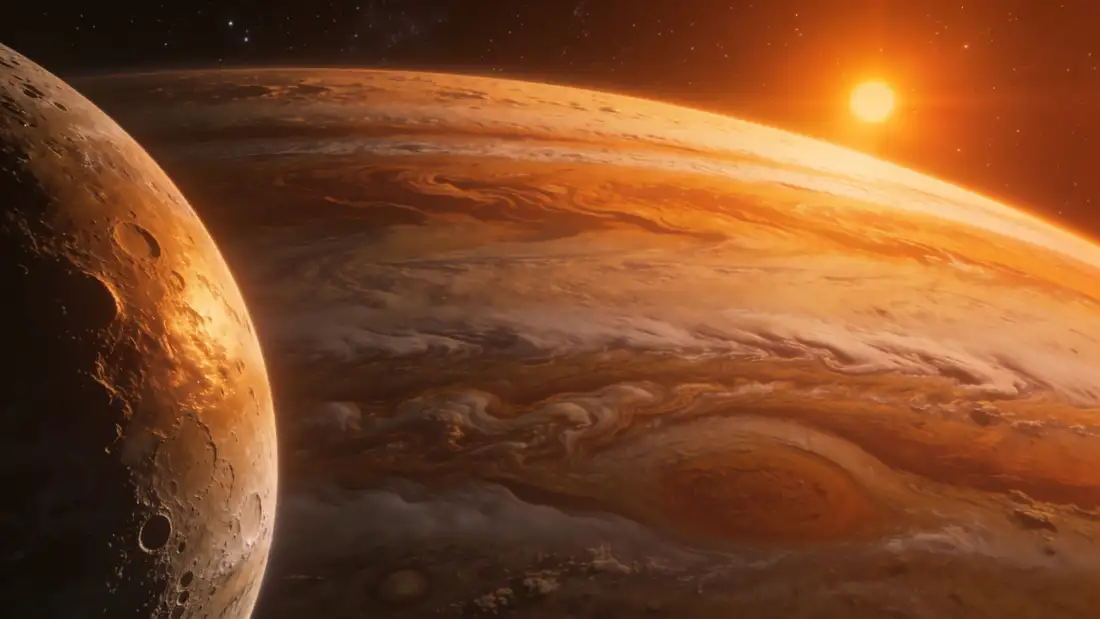
About 109 light-years away, a giant planet drifts slowly around a star that looks a little like our own Sun. That planet is HD 68475 b, and it was only confirmed in 2026. Scientists are still working out its story, but what they have found so far gives us a lot to think about.
The Star at the Center
HD 68475 b orbits a star called HD 68475. A star’s surface temperature tells us a lot about its color and energy. Our Sun has a surface temperature of about 5,778 K — K stands for Kelvin, which is a unit scientists use to measure very high temperatures. HD 68475 comes in at 5,022 K, so it is a little cooler and a little dimmer than the Sun, but still in the same broad family of stars.
The whole system sits 109 light-years from Earth. A light-year is the distance light travels in one year — about 9.5 trillion kilometers. At that distance, even our fastest spacecraft would take many thousands of years to arrive. For now, we study HD 68475 b purely through the signals it sends across space to our telescopes.
So far, astronomers have found only one planet in this system. That does not mean HD 68475 is alone — it just means we haven’t spotted any companions yet. Detecting planets is hard work, and smaller or differently placed worlds can easily escape notice.
A World of Enormous Size and Mass
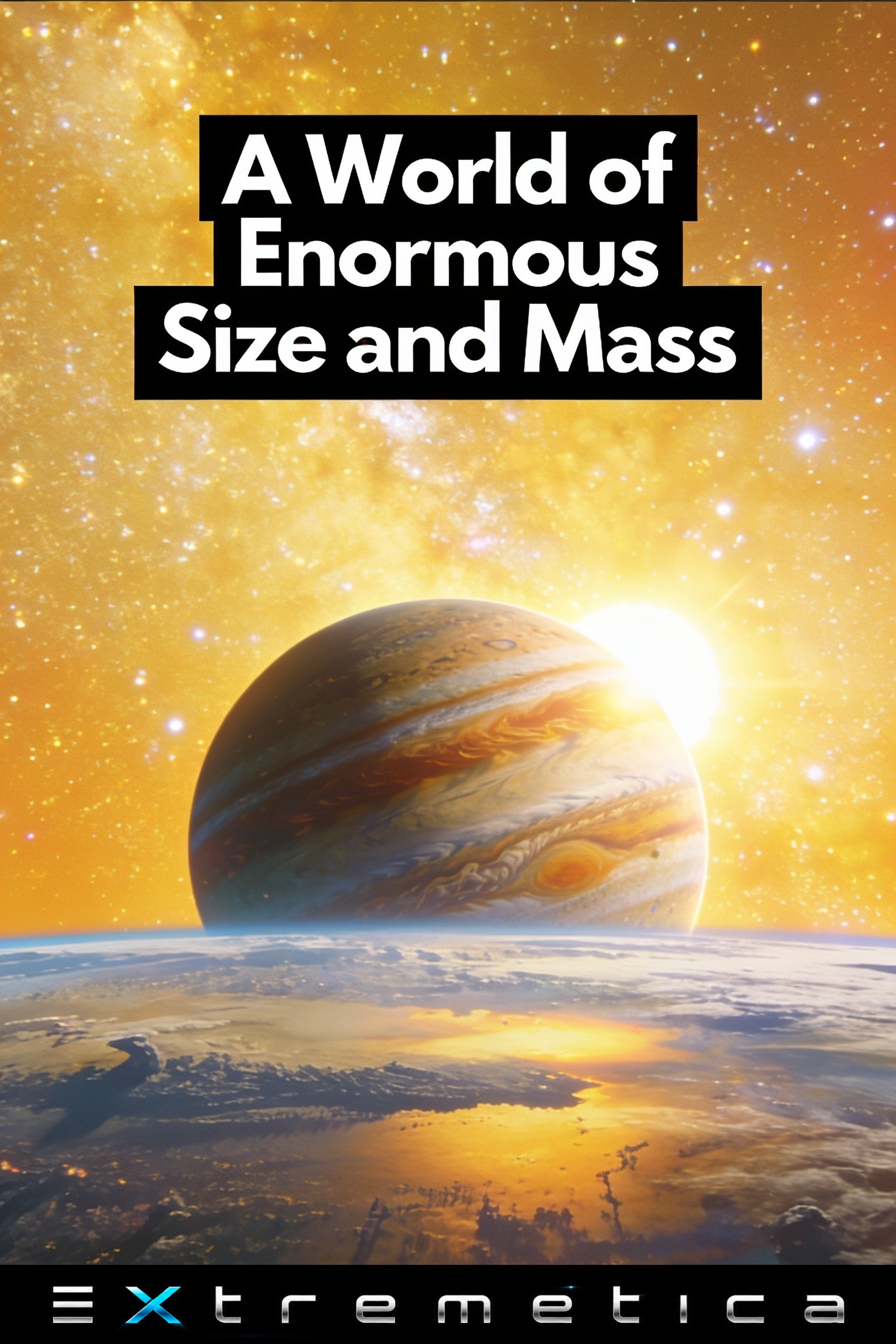
HD 68475 b is a giant by any measure. Its radius — meaning how wide it is from center to surface — is about 12.8 times the radius of Earth. To picture that, imagine lining up nearly 13 Earths side by side: that stretch would just about match the width of this planet. If you want a visual sense of how such sizes stack up, the size comparison tool on this site can help you see the difference in a clear, easy way.
Its mass is even more striking. Mass is how much matter something contains. HD 68475 b has a mass of 1,640 times the mass of Earth. That is an enormous amount of material packed into one world. For comparison, Jupiter — the largest planet in our own solar system — has a mass of about 318 times Earth’s mass. HD 68475 b is therefore roughly five times more massive than Jupiter.
Worlds this large and this massive push right up against a fuzzy border. Scientists sometimes call objects with very high mass “super-Jupiters.” Above a certain mass, objects start to fuse a type of heavy hydrogen in their cores, and we begin calling them brown dwarfs — a kind of failed star that never quite ignited. HD 68475 b sits in a range where it could be described as a super-Jupiter or possibly a brown dwarf companion. Scientists haven’t firmly settled the label yet.
What Might Be Inside

We can learn a lot about a planet’s interior by combining its size and its mass. Scientists calculate something called density, which tells you how tightly matter is packed. A small, heavy world is dense — think of a rock. A large, light world has low density — think of a balloon.
HD 68475 b has a radius about 12.8 times Earth’s but a mass about 1,640 times Earth’s. Working through those numbers, the planet comes out with a fairly high density for an object this size. That suggests it is not mostly made of light gases spread thinly through a huge volume. Instead, it is likely packed with a large amount of material — possibly a very deep atmosphere of hydrogen and helium surrounding a dense core, or it could be even more compressed than a typical gas giant. The mass-radius diagram is a great place to explore how HD 68475 b compares with other known worlds of different compositions.
Planets like this are sometimes called gas giants or ice giants depending on what fills their interiors. Gas giants, like Jupiter and Saturn, are dominated by hydrogen and helium. Ice giants, like Uranus and Neptune, contain more water, methane, and ammonia in a slushy high-pressure state — scientists call these materials “ices” even though they are nothing like the ice in your freezer. At the mass and size of HD 68475 b, gas giant chemistry seems the most likely fit, but scientists haven’t measured its atmosphere directly yet, so we can’t be certain.
One Very Long Year
A planet’s “year” is the time it takes to complete one full orbit around its star. On Earth, that takes 365 days. For HD 68475 b, one orbit takes 7,832 Earth days. That is more than 21 Earth years for a single trip around its star.
This tells us HD 68475 b is orbiting very far from HD 68475 — much the way distant planets in our own solar system, like Saturn or Uranus, take many years to complete their orbits. Planets that orbit far from their star receive less warmth. Scientists haven’t measured HD 68475 b’s temperature directly yet, so we don’t know exactly how cold or warm it might be. What we can say is that its distant orbit places it well outside the zone where liquid water could exist on any surface — but for a gas giant without a solid surface, that question takes on a different meaning anyway.
How HD 68475 b Was Found
HD 68475 b was confirmed in 2026 using a technique called the radial velocity method. Here is the basic idea: a planet’s gravity gently tugs on its star as it orbits. That tug makes the star wobble — very slightly moving toward us and then away from us. When a star moves toward us, the light it sends us gets squeezed to a slightly bluer color. When it moves away, the light stretches to a slightly redder color. Scientists can measure these tiny color shifts precisely. Over time, a repeating pattern of shifts reveals a planet pulling on the star.
Because HD 68475 b is very massive and its year is very long, scientists had to watch HD 68475 for a long time before they could be confident the signal was real. Detecting a planet with a 7,832-day orbit means you need observations spanning many years.
Questions Still Waiting for Answers
Even with the numbers we have, HD 68475 b is still a world of open questions. Scientists haven’t measured its temperature. We don’t know the details of its atmosphere or its exact chemical makeup. We don’t know whether other planets share this system. We also don’t yet know the precise distance of HD 68475 b from its star — that measurement hasn’t been published in the data available so far.
These gaps are normal. Exoplanet science — the study of planets around other stars — is a young field, and most worlds are known only in outline. HD 68475 b is a reminder that discovery is rarely a single moment. It is a slow process of gathering clues, asking better questions, and building a clearer picture one careful measurement at a time.