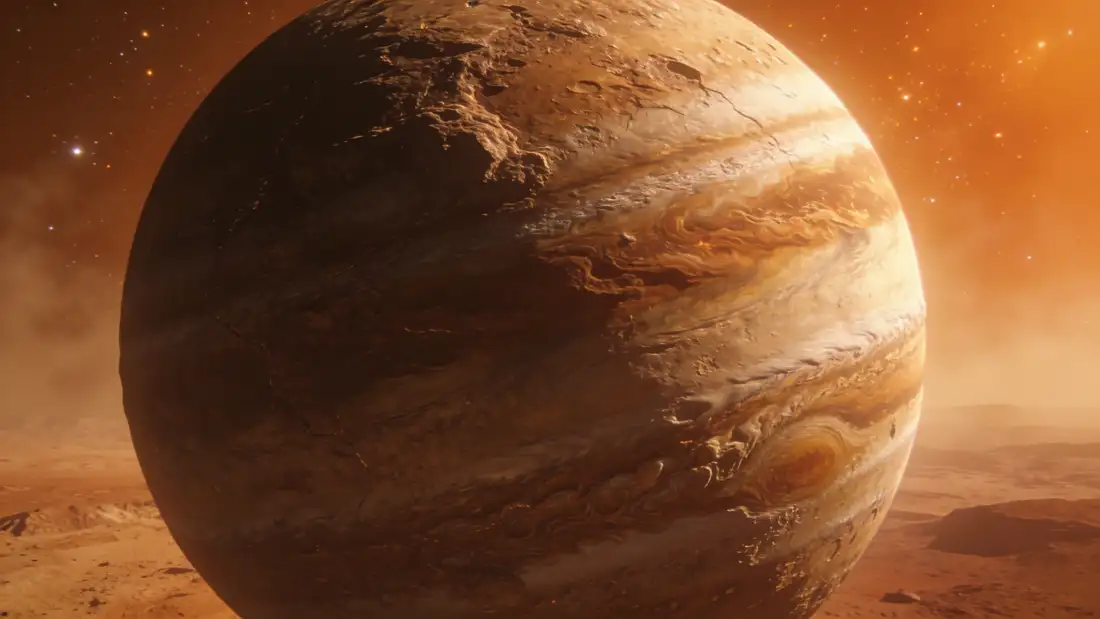
In 2026, astronomers added a new world to the growing list of known exoplanets — planets that orbit stars other than our Sun. That world is TOI-5734 b, and it sits about 106 light-years from Earth. A light-year is the distance light travels in one whole year, so 106 light-years is an enormous stretch of space. Here is how scientists found it.
A World 106 Light-Years Away
TOI-5734 b orbits a star called TOI-5734. The star has a surface temperature of 4,750 K — where K stands for Kelvin, a scale scientists use to measure very high or very low temperatures. Our own Sun has a surface temperature of around 5,778 K, so TOI-5734 runs a little cooler. That makes it what astronomers call an orange dwarf, a type of star slightly smaller and dimmer than the Sun.
At 106 light-years away, TOI-5734 is far too distant for any spacecraft to visit in our lifetimes. We cannot point a camera at it and snap a photo of its planet either. So how do scientists know TOI-5734 b is there at all? The answer comes down to two clever methods that look for tiny, careful signals instead of pictures.
The Transit Method: Catching a Planet’s Shadow
The transit method is how TOI-5734 b was discovered. A transit happens when a planet passes in front of its star from our point of view, a little like watching a bug crawl across a lamp. When that happens, the planet blocks a tiny bit of the star’s light from reaching us.
Scientists measure a star’s brightness very carefully over time. If the brightness dips by a small, regular amount and then comes back, that is a clue. If the dip repeats on a steady schedule, it starts to look like a planet making laps around its star. Each lap, the planet crosses in front again, and the light dips again.
The dip is very small. For a planet about twice the size of Earth, it might block less than one percent of the star’s light. You could not see that change with your eyes, but a space telescope can measure it with great care. Scientists then check the timing, the depth of the dip, and the shape of the curve to work out roughly how big the planet is and how long its year takes.
If you want to see how this works in a hands-on way, try the planet-finding simulator here on Extremetica — it lets you watch the light curve change as a planet crosses its star.
The transit method works best when a planet’s orbit happens to line up just right so the planet passes in front of the star as seen from Earth. Many planets orbit at an angle that means we never see that crossing, so we miss them entirely. The ones we do find this way are a lucky sample of what is out there.
The Wobble Method: How a Planet Tugs Its Star

The second big method is called the radial velocity method, or sometimes just the wobble method. It uses a different idea: gravity. A planet does not just orbit a star — the planet and star actually pull on each other. As a planet goes around, it tugs the star in a tiny circle too.
That tiny movement changes the light reaching us very slightly. When the star moves toward us, its light is squished to shorter wavelengths — scientists call this a blueshift. When the star moves away, its light is stretched to longer wavelengths — a redshift. By watching these shifts very carefully, scientists can measure the star’s wobble.
A bigger or heavier planet causes a stronger wobble, which is easier to spot. A smaller planet causes only a faint wobble, which needs very precise equipment to catch. The wobble method is especially useful for measuring a planet’s mass — how much matter is packed into it. Transits alone tell us a planet’s size, but not its weight. Wobble measurements fill in that gap.
Together, the transit method and the wobble method form a powerful team. One tells us the planet’s size. The other tells us its mass. With both numbers, scientists can estimate what the planet might be made of — whether it is mostly rock, mostly gas, or something in between.
What We Know About TOI-5734 b
Using these two methods together, scientists have worked out several things about TOI-5734 b. Its radius is about 2.1 times Earth’s radius, meaning it is noticeably larger than our planet but still in the range scientists call a super-Earth or possibly a mini-Neptune — worlds bigger than Earth but smaller than the ice giants in our Solar System.
Its mass is about 9.1 times Earth’s mass. That is a lot of material packed into a world only a little more than twice Earth’s width. When scientists compare the mass and the size, they can start to think about density — how tightly packed the planet is. At those values, TOI-5734 b could be a rocky world with a thick atmosphere, or it might have a significant layer of water or gas. Scientists haven’t settled on a final answer yet, and more study would be needed to know for sure.
A Very Short Year and a Very Hot Day
One of the most striking things about TOI-5734 b is how fast it orbits. It completes one full trip around its star in just 6.18 Earth days. A year there lasts less than one week here. That means the planet is very close to its star — much closer than Mercury is to our Sun.
Being that close comes with a cost. Scientists estimate the planet’s temperature at around 688 K, which is roughly 415 degrees Celsius. That is hot enough to melt many metals. At that temperature, liquid water on the surface seems very unlikely. TOI-5734 b sits well inside the habitable zone — the range of distances where liquid water could possibly exist on a surface — meaning it is far too close and far too warm to be in that zone.
One Planet So Far — But Is There More?
Right now, TOI-5734 b is the only confirmed planet known in this system. That does not mean it is the only one. Many star systems turn out to hold several planets, and astronomers often find additional worlds after looking more carefully or using more powerful instruments. Scientists simply haven’t confirmed any others around TOI-5734 yet.
TOI-5734 b is a good reminder of how much the universe holds. A world twice Earth’s size, blazing hot, racing around its star in less than a week — and we found it from 106 light-years away, by watching a star’s light flicker just a little. That careful, patient science is one of the most remarkable things our species has learned to do.