
One hundred and five light-years away, a star called HD 110067 holds six worlds in its steady grip. Scientists announced this remarkable family of planets in 2023, and it has been teaching us a great deal about how planets form and arrange themselves. The innermost member of that family, HD 110067 b, is a fascinating place to start.
A Star with Six Worlds
HD 110067 is a star in the northern constellation Coma Berenices. Its surface temperature is 5,266 K — that stands for Kelvin, a scale scientists use to measure very high temperatures. For comparison, our own Sun runs at about 5,778 K, so HD 110067 is just a little cooler and slightly smaller than the Sun. It is not wildly different from the star we know best.
What makes this system special is not the star itself but what orbits around it. Six planets travel around HD 110067 in neat, predictable paths. Having six confirmed planets around one star is already unusual. What makes this family even more interesting is the careful, almost musical pattern those planets follow — but more on that in a moment.
At 105 light-years from Earth, HD 110067 is close enough that our telescopes can study it in some detail, yet still so far away that no spacecraft could ever reach it in a human lifetime. A light-year is the distance light travels in one year — about 9.5 trillion kilometres. So 105 light-years is a very large number of kilometres indeed.
Meet HD 110067 b
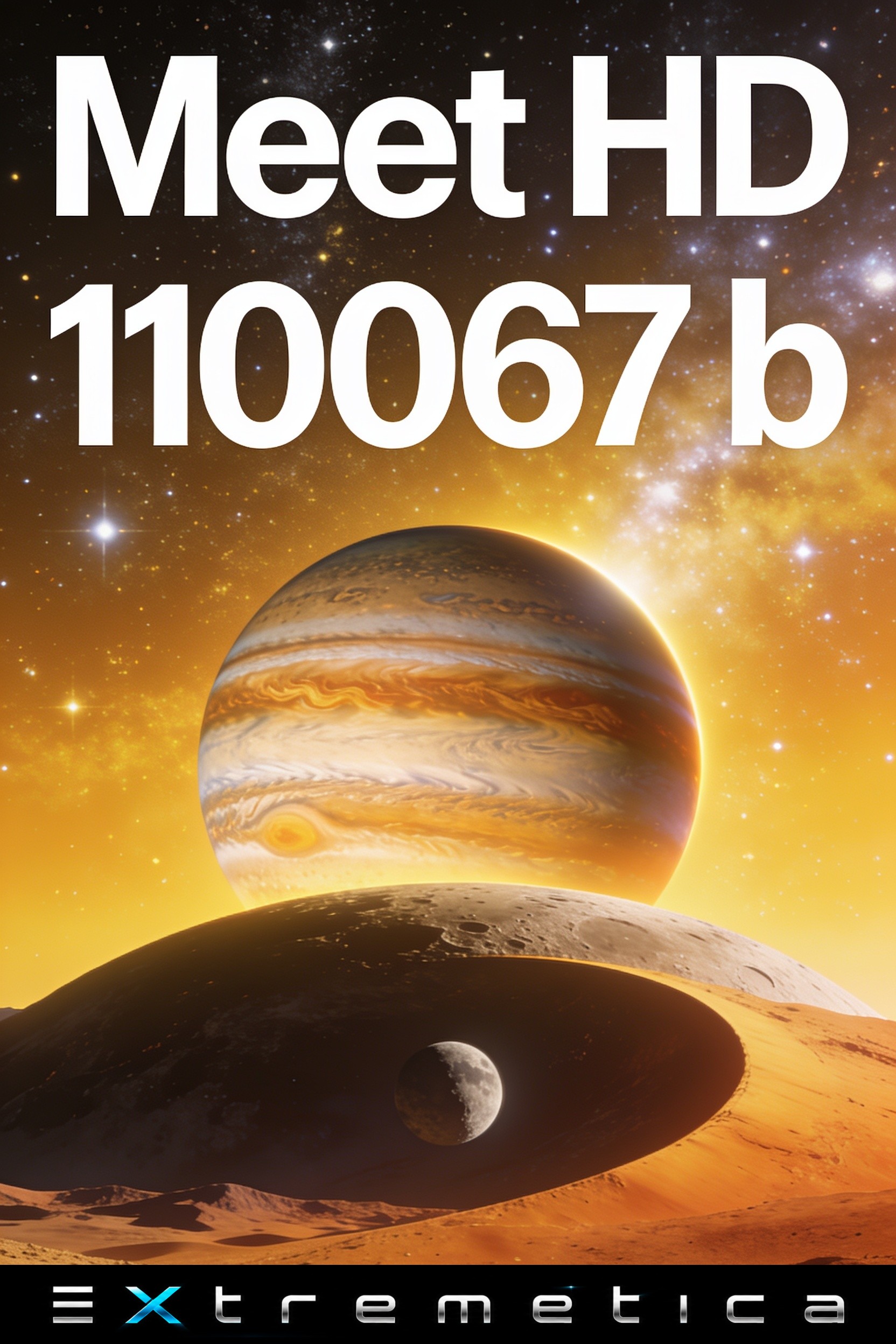
HD 110067 b is the planet sitting closest to the star. Scientists have measured several of its key properties, and the numbers paint an interesting picture.
- Size: HD 110067 b has a radius about 2.2 times that of Earth. It is noticeably larger than our planet, though much smaller than a giant like Neptune.
- Mass: It weighs about 5.69 times as much as Earth. That is a meaningful number, because combined with its size, it tells scientists something about what the planet is made of.
- Year length: One orbit around HD 110067 takes just 9.11 Earth days. This planet moves very quickly, hugging close to its star.
- Temperature: Scientists estimate its temperature at around 800 K, which is roughly 527 degrees Celsius. That is extremely hot — far hotter than any oven, and hot enough to melt many metals.
These measurements come from the transit method, which we will explain shortly. Scientists are careful to say these are estimates based on careful observation and modelling, not direct measurements taken on the ground.
What Kind of World Is HD 110067 b?
When scientists know both a planet’s size and its mass, they can work out its density — how tightly packed its material is. Density is like comparing a bag of feathers and a bag of rocks that are the same size: the rocks bag is much denser.
For HD 110067 b, the combination of a radius 2.2 times Earth’s and a mass about 5.69 times Earth’s suggests that this planet is not a dense, rocky world like our own. It likely has a thick layer of gas or fluids surrounding a rocky or icy core. Scientists sometimes call planets in this size range sub-Neptunes or mini-Neptunes — worlds bigger than Earth but smaller than the ice giant Neptune in our Solar System.
With a temperature near 527 degrees Celsius, HD 110067 b is nowhere near the habitable zone — that is the range of distances from a star where temperatures could allow liquid water to exist on a planet’s surface. HD 110067 b orbits far too close to its star for that. Any water there would be vapour, and the heat and radiation from the nearby star would make the environment very harsh. Scientists are not suggesting this planet could host life as we know it.
There is still much we do not know. Scientists haven’t measured HD 110067 b’s atmosphere in detail, so exactly what gases surround it remains an open question.
The Rhythm of Six Orbits
One of the most remarkable things about the HD 110067 system is how its six planets move. They appear to be arranged in what scientists call an orbital resonance — a pattern where the planets’ orbit times form simple, whole-number ratios with each other. Think of it like a musical rhythm: some beats fall at regular, predictable intervals, and the whole pattern repeats.
In many planetary systems, gravitational nudges from neighbouring planets, passing stars, or other disturbances gradually pull worlds out of these neat patterns over billions of years. When a system keeps its resonance, it is often a sign that the planets have not been knocked around too much since they formed. It suggests the system has been relatively calm and stable.
This makes HD 110067 especially valuable to scientists. A preserved resonance chain can act like a fossil record of how the system formed. By studying the pattern today, researchers can work backwards and build models of how those six worlds settled into their current arrangement long ago.
How Astronomers Found This Family
The planets of HD 110067 were discovered in 2023 using the transit method. Here is how it works: when a planet passes in front of its star from our point of view, it blocks a tiny fraction of the star’s light. A sensitive space telescope watching the star sees the light dip a little, then return to normal. By measuring how often these dips happen and how long they last, scientists can figure out the planet’s size and the length of its year.
The transit method is very good at finding planets with short orbits — ones that pass in front of their star frequently. That is partly why HD 110067 b, with its 9.11-day orbit, was detectable. Planets farther out in a system take longer to orbit and so transit less often, making them harder to spot.
Finding all six planets required patient observation and careful analysis. Scientists have to rule out other explanations for light dips — such as a second star nearby — before they can be confident a planet is really there.
What HD 110067 Tells Us About Planetary Systems
Before missions like Kepler and TESS began searching the sky in earnest, we only knew of planets in our own Solar System. Now we know of thousands of worlds around other stars, and systems like HD 110067 show us how varied planetary families can be. Six planets, a resonance chain, and a star slightly cooler than our Sun — none of that matches our own neighbourhood exactly.
Sub-Neptunes like HD 110067 b are actually among the most common planet types found so far around other stars, yet we have none in our Solar System. Studying them helps scientists ask why. Did our Solar System miss out on forming them, or did early conditions sweep them away? HD 110067 offers one more data point in that ongoing puzzle.
If you enjoy exploring multi-planet systems and comparing their layouts, you can browse many known systems in the System Explorer. HD 110067 is a good reminder that the universe is full of planetary families unlike our own, quietly orbiting their stars, waiting to be understood a little better each year.