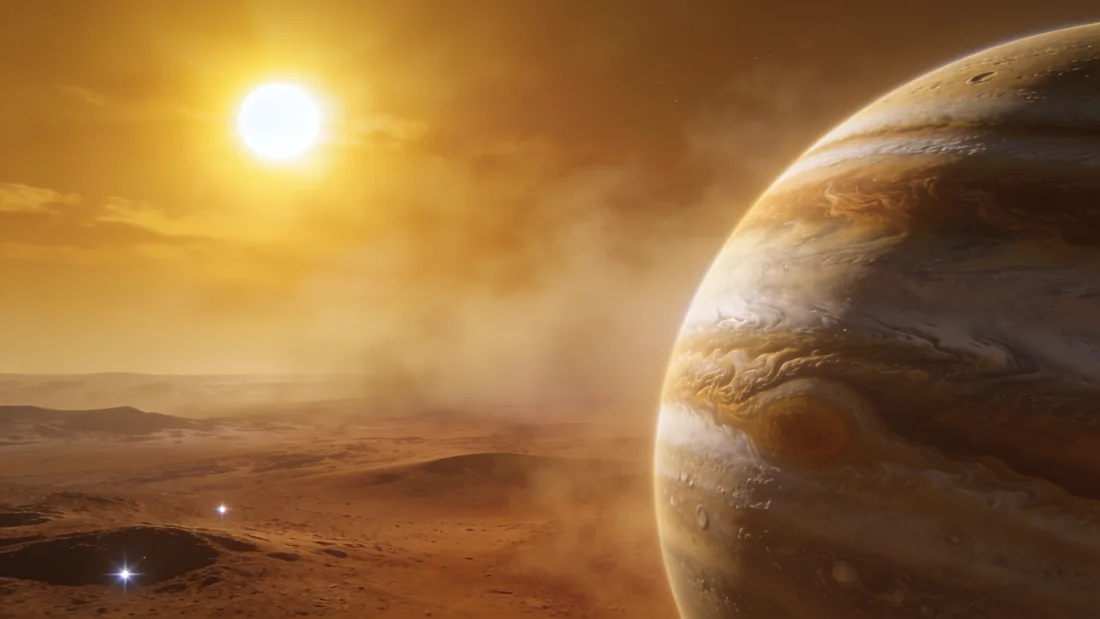
About 175 light-years away — that is about 1,000 trillion kilometres — a quiet star hosts at least six planets. Scientists discovered this busy family in 2020, and one member in particular, HD 191939 c, gives us a nice close look at a type of world that does not even exist in our own Solar System.
A Star Worth Knowing
The star at the centre of this system is called HD 191939. It sits in our own galaxy, the Milky Way, at a distance of 175 light-years from Earth. A light-year is the distance light travels in one year — about 9.5 trillion kilometres. So even at the speed of light, you would need 175 years to reach this star. In everyday terms, it is extremely far away, yet in the scale of the galaxy it is actually one of our closer neighbours.
HD 191939 is a Sun-like star, meaning it belongs to the same broad family as our own Sun. Its surface temperature is 5,348 K (K stands for Kelvin, a unit scientists use to measure very high temperatures — 0 K is the coldest anything can be, and room temperature is about 294 K). Our Sun’s surface is about 5,778 K, so HD 191939 runs a little cooler and is probably a bit smaller and dimmer than the Sun. It still gives its planets a steady supply of light and warmth.
Meet HD 191939 c
HD 191939 c is one of six known planets in this system, and it is the one we have the most solid numbers for. Here is what the data tells us.
- Size: HD 191939 c has a radius 3.2 times that of Earth. Imagine stacking three-and-a-bit Earths side by side across its middle.
- Mass: It weighs about 8 times as much as Earth. That is a lot of material packed together.
- Year length: One full trip around its star takes just 28.6 Earth days — less than one of our months.
- Likely temperature: Scientists estimate the surface or cloud-top temperature is around 600 K, which is about 327 degrees Celsius. That is far too hot for liquid water as we know it.
Those numbers were gathered using the transit method — more on that in a moment — along with careful follow-up measurements from ground-based telescopes.
What Kind of World Is HD 191939 c?
With a radius of 3.2 Earths and a mass of 8 Earths, HD 191939 c falls into a category scientists call a sub-Neptune. A sub-Neptune is a planet bigger than Earth but smaller than Neptune. Neptune, the outermost planet in our Solar System, has a radius about 3.9 times Earth’s, so HD 191939 c is not far off that size — though it is considerably less massive than Neptune, which is about 17 Earth masses.
What is the inside of this planet like? Scientists think that sub-Neptunes often have a rocky or icy core surrounded by a thick atmosphere of hydrogen and helium gas, or possibly a deep layer of water or other volatile materials — volatiles are substances that turn to gas fairly easily. We are not sure exactly what HD 191939 c is made of. Its density (how tightly its mass is packed into its size) is somewhere between a pure rock world and a pure gas world, which suggests a mix of both — but the exact recipe is still an open question.
What we can say with more confidence is that the planet is not a comfortable place. At around 327 degrees Celsius, it sits far outside the habitable zone — that is the range of distances from a star where temperatures might allow liquid water on a planet’s surface. HD 191939 c orbits far too close and runs far too hot for that.
Six Worlds, One Star
HD 191939 c is not alone. As of the time of writing, scientists have confirmed at least six planets orbiting HD 191939. That makes it one of the more populated planetary systems found so far.
We do not have the same level of detail for all six planets as we do for HD 191939 c. Scientists haven’t fully measured the sizes or masses of every member of the family yet. What we do know is that the system contains a range of worlds, and several of them are also in the sub-Neptune size range. This kind of pattern — multiple medium-sized planets packed around one star — turns out to be surprisingly common among the planetary systems astronomers have studied closely. Some of the planets in this system orbit closer to the star than HD 191939 c does, and at least one orbits farther out, though precise details for those worlds are still being pinned down.
You can browse all the confirmed planets in this and many other systems using our interactive System Explorer.
How We Found Them: The Transit Method
The whole HD 191939 family was discovered in 2020 using the transit method. Here is the idea: when a planet passes in front of its star from our point of view, it blocks a tiny fraction of the star’s light. A telescope watching the star sees the light dip just a little. If that dip repeats at regular intervals, it is very likely a planet in orbit.
The transit method is powerful because it works even when planets are too small and too far away to photograph directly. It tells scientists how big a planet is (by how much light it blocks) and how long its year is (by how often the dip repeats). To find the planet’s mass, scientists usually need a second technique called radial velocity — this measures tiny wobbles in the star caused by the planet’s gravity pulling on it. Together, radius and mass let scientists estimate density and start guessing at a planet’s composition.
How This System Compares to Ours
Our Solar System has eight planets. The inner ones — Mercury, Venus, Earth, Mars — are rocky and relatively small. The outer ones — Jupiter, Saturn, Uranus, Neptune — are much bigger and gassy. There is a clear gap in the middle: we have nothing between the size of Earth and the size of Neptune.
HD 191939 is different. It seems to be packed with planets in exactly that in-between size range — the sub-Neptunes that our Solar System is missing. This is actually very common across the galaxy. Studies of many planetary systems suggest that sub-Neptunes may be the most frequent type of planet out there. Our own Solar System, with its gap between small rocky worlds and large gas giants, might be the unusual one.
HD 191939 and its six known worlds remind us that planetary families come in many shapes. The more systems scientists study, the clearer it becomes that there is no single template for how planets arrange themselves around a star — and that is one of the most interesting things about exploring the galaxy.