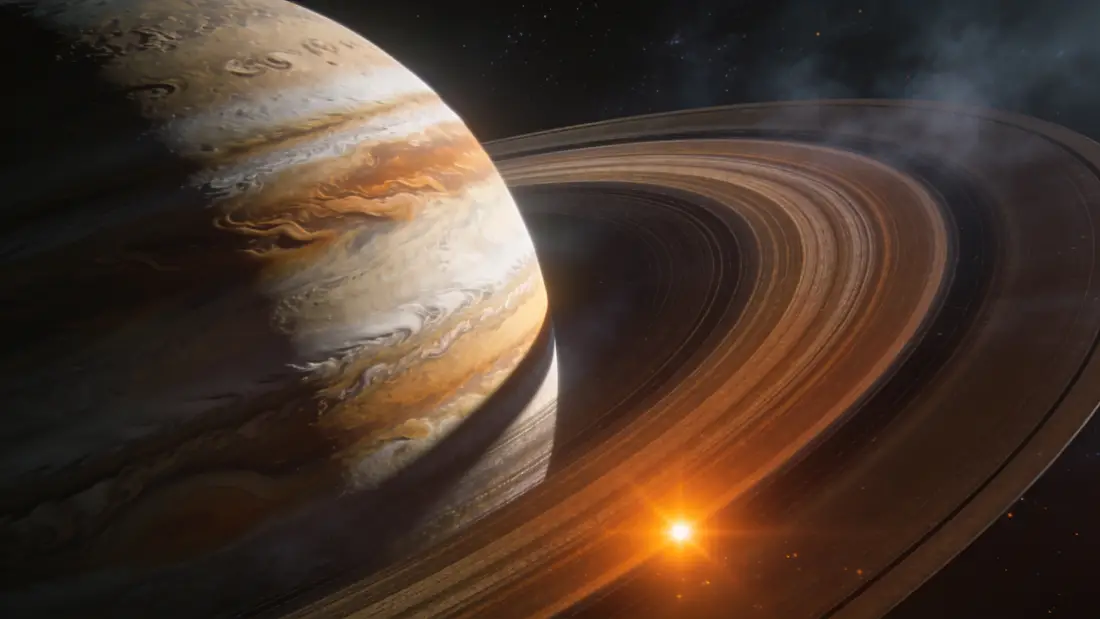
HD 164604 c is a planet that no telescope has ever photographed directly. It sits 128 light-years from Earth, orbiting a star that looks like nothing more than a faint point of light in our sky. Yet astronomers know it exists — and they know quite a lot about it — because of a clever trick involving starlight and motion.
A Star 128 Light-Years Away
The host star is called HD 164604. A light-year is the distance light travels in one year — about 9.5 trillion kilometres. So 128 light-years is an enormous distance. No spacecraft we have ever built could get there in a human lifetime.
The star HD 164604 has a surface temperature of 4,663 K. The K here stands for Kelvin, a unit scientists use to measure very high temperatures. Our own Sun has a surface temperature of about 5,778 K, so HD 164604 runs a bit cooler than the Sun. Cooler stars tend to glow with a slightly more orange tint than our yellow-white Sun.
As far as we know, this star has two planets orbiting it. HD 164604 c is the second one confirmed in the system. Scientists haven’t yet shared full details about the first planet, HD 164604 b, in the data available to the public.
How the Wobble Method Works
HD 164604 c was discovered in 2026 using something called the radial velocity method. You might also hear it called the wobble method, and that name explains it perfectly.
Here is the key idea: a planet does not simply orbit a star. The star and the planet actually pull on each other. The planet’s gravity tugs the star in a tiny circle. From far away, that tiny circle looks like a very small back-and-forth wobble.
Now, astronomers cannot see that wobble with their eyes. The distances are too vast. But they can measure it using light. When the star wobbles toward us, its light gets squeezed into slightly shorter wavelengths. Wavelength is the length of one wave of light — shorter wavelengths make the light look a little bluer. When the star wobbles away from us, the light stretches into slightly longer wavelengths, making it look a little redder. This stretching and squeezing is called the Doppler effect, and it is the same reason an ambulance siren sounds higher-pitched as it comes toward you and lower as it drives away.
By measuring how much the starlight shifts back and forth, scientists can work out how massive the planet is and how long it takes to complete one orbit. It is a bit like figuring out the weight of someone on a see-saw by watching how far the other end tips.
If you want to get a feel for how astronomers use tools like this, you can explore the How We Find Them simulator to see the wobble and other methods in action.
How the Transit Method Works — and Why It Wasn’t Used Here
The other big way astronomers find planets is the transit method. A transit happens when a planet passes directly in front of its star, from our point of view. When that happens, the planet blocks a tiny bit of the star’s light. Sensitive instruments can detect that small dip — sometimes the light drops by less than one percent — and that dip tells astronomers a planet is there.
The transit method is very good at measuring a planet’s size. The bigger the planet, the more light it blocks. But it only works when the planet’s orbit lines up just right so the planet crosses in front of the star as seen from Earth. Many planets orbit at an angle that means they never pass in front of their star from our view.
HD 164604 c was found with the wobble method, not the transit method. Scientists haven’t confirmed that this planet crosses in front of its star from our angle. So while we have a good estimate of its mass, the size measurement of 12.5 times Earth’s radius comes with some uncertainty — scientists should be seen as still refining their picture of this world.
What We Know About HD 164604 c
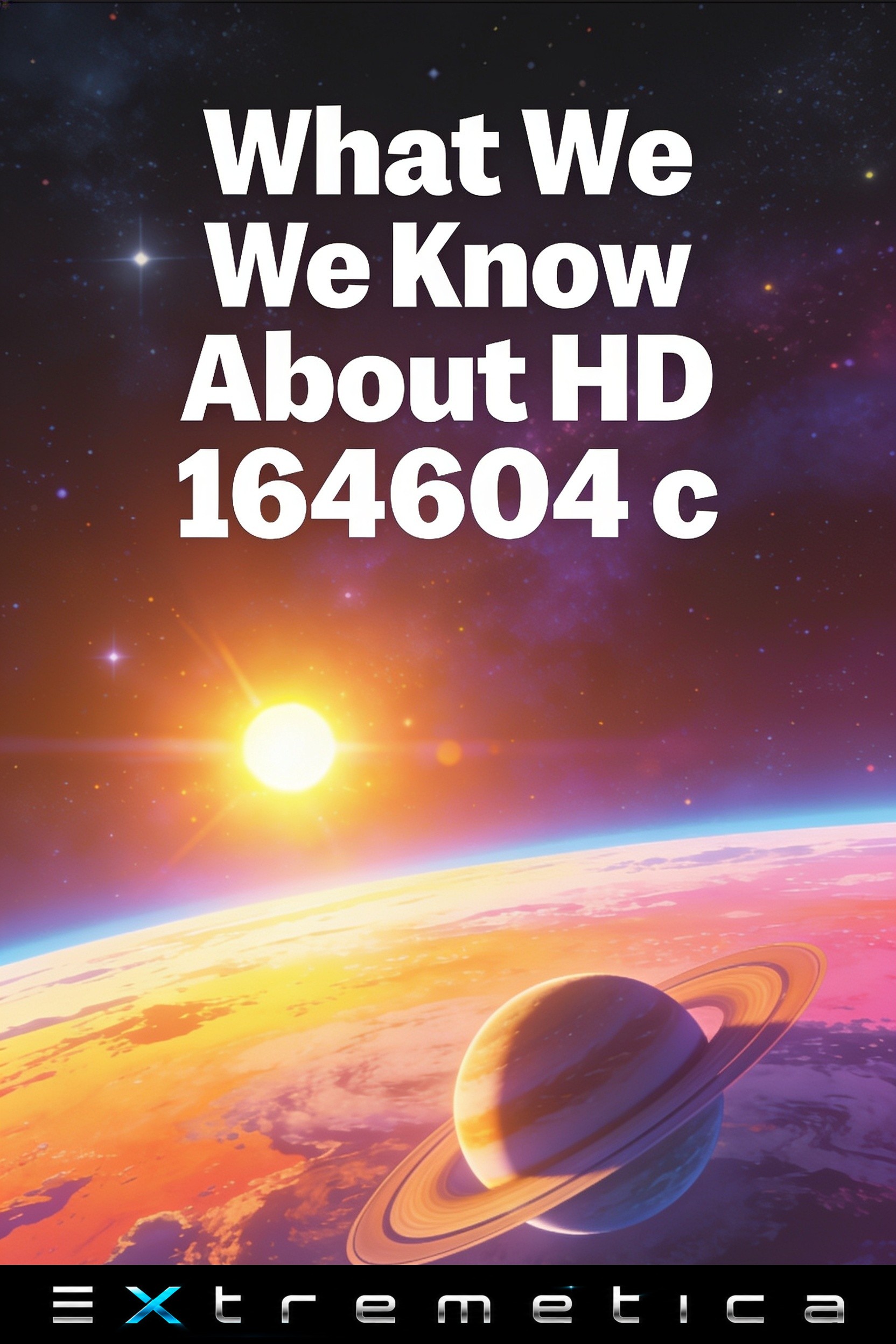
Even without a direct photo, the data we have is striking. HD 164604 c has a radius about 12.5 times that of Earth. To picture that, imagine lining up nearly thirteen Earths side by side — that is roughly how wide this planet appears to be.
Its mass is where things get really surprising: 3,019 times the mass of Earth. That is an enormous amount of material. For comparison, Jupiter — the largest planet in our own solar system — is about 318 times Earth’s mass. HD 164604 c is roughly nine or ten times more massive than Jupiter. Planets this massive are sometimes called super-Jovian worlds, meaning they are far larger than Jupiter. Some scientists would even debate whether an object this massive sits closer to the boundary between a giant planet and a brown dwarf — a brown dwarf being an object too big to be a planet but not quite massive enough to ignite like a true star.
A Very Long Year
One orbit of HD 164604 c around its star takes 5,387 Earth days. That is almost 14 and three-quarter Earth years for a single year on this world. In that same time, a child born on Earth would have grown through most of their childhood and into their teenage years — and HD 164604 c would have completed just one trip around its sun.
Such a long orbit suggests this planet is quite far from its host star. Planets that orbit far out tend to be very cold, though scientists haven’t published a temperature measurement for HD 164604 c yet.
What Kind of World Might This Be?
With a mass so far beyond Jupiter’s, HD 164604 c is almost certainly not a rocky world like Earth or Mars. Scientists think it is most likely a gas giant — a planet made mostly of hydrogen and helium gas, with no solid surface to stand on. At this mass, the planet’s gravity would be immense. Its atmosphere, if it has layers we would recognize as such, would be compressed under tremendous pressure deep inside.
We do not know whether this planet sits in its star’s habitable zone — the range of distances where liquid water could, in the right conditions, exist on a surface. Given the very long orbit and the likely cold temperatures far from the star, scientists have not suggested this as a candidate for life. But honestly, with a world this size and this massive, the more interesting question may be about any smaller moons that could orbit it — though no such moons have been detected.
Two Planets, Many Questions
HD 164604 is now known to host at least two planets, making it one of many multi-planet systems astronomers are piecing together across the galaxy. HD 164604 c is the more dramatic of the two confirmed worlds — vast, heavy, and slow in its long orbit. Future observations may sharpen what we know about its size, its temperature, and its companion planet. For now, it stands as a good example of how much we can learn about a world we cannot see — by watching the gentle, tell-tale wobble of the star it calls home.