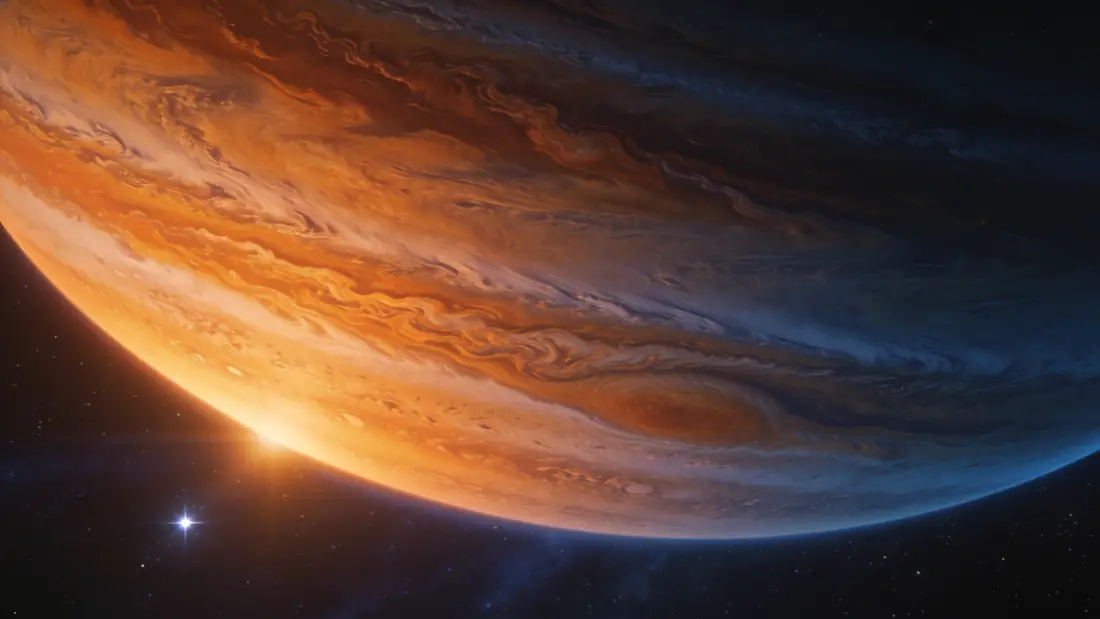
There is a planet out there called HD 114386 c, and nobody has ever seen it with their own eyes — or even through a telescope. Yet scientists are confident it exists. How can that be? The answer has everything to do with clever detective work, careful measurement, and a deep understanding of how stars and planets move together.
A Star 91 Light-Years Away
HD 114386 c orbits a star called HD 114386. That star sits about 91.1 light-years from Earth. A light-year is the distance light travels in one year — roughly 9.5 trillion kilometres. So 91.1 light-years is an enormous distance, far beyond anything a spacecraft could reach in a human lifetime.
The star HD 114386 has a surface temperature of 4,895 K. (K stands for kelvin, a unit scientists use to measure very high temperatures. For comparison, our own Sun’s surface is about 5,778 K.) That makes HD 114386 a cooler, slightly dimmer star than the Sun. Stars like this are often called orange dwarfs, or K-type stars — they glow with a warm, orange-yellow light.
So far, astronomers have confirmed two planets orbiting HD 114386. HD 114386 c is one of them. There could be others waiting to be found, but as of now, two is the official count.
What We Know About HD 114386 c
Even without a photograph, scientists have measured some important things about this world. HD 114386 c has a radius — that is, the distance from its centre to its surface — about 13.4 times larger than Earth’s. Its mass, meaning how much matter it contains, is around 118 times Earth’s mass. Those are large numbers. For reference, our solar system’s biggest planet, Jupiter, has a mass roughly 318 times Earth’s. So HD 114386 c sits somewhere in the middle: much heavier than Earth, but not quite in Jupiter’s league.
One year on HD 114386 c lasts 444 Earth days. That is how long it takes to complete one full orbit around its star — a little longer than our own year of 365 days. Scientists haven’t yet measured exactly how far from its star the planet sits in kilometres, so we can’t say whether it falls in the habitable zone — the range of distances where liquid water could potentially exist on a surface. That question remains open for now.
HD 114386 c was discovered in 2026, using a method called radial velocity, which we will look at closely in the next section.
How the Radial Velocity Method Works

You might imagine that a planet simply orbits its star while the star stays perfectly still. In reality, both the star and the planet pull on each other through gravity. The planet tugs on its star just a little, causing the star to wobble — a tiny back-and-forth motion as the planet goes around it.
Astronomers can detect this wobble by studying the star’s light spectrum — the rainbow of colours and wavelengths that a star gives off. When the star moves very slightly toward Earth, those wavelengths get compressed together and shift toward the blue end of the spectrum. When it moves away, the wavelengths stretch out and shift toward the red end. Scientists call this the Doppler effect, and it is the same basic reason a siren sounds higher as an ambulance approaches and lower as it drives away.
By watching how a star’s spectrum shifts back and forth over time, astronomers can work out the mass of the planet causing the wobble, and how long each orbit takes. The bigger the planet, the stronger the tug, and the easier the wobble is to spot. This is exactly how HD 114386 c was found — its gravitational pull on its star left a clear, repeated signal in the data.
If you’d like to explore this idea hands-on, you can try our interactive simulator that lets you see how the wobble method works in real time.
How the Transit Method Works

The radial velocity method is not the only tool astronomers use. Another powerful technique is called the transit method. A transit happens when a planet passes directly between its star and Earth, briefly blocking a small slice of the star’s light.
Think of it like walking in front of a lamp. The lamp doesn’t go dark, but if you were far away, you would notice a tiny dip in its brightness. A planet transiting its star does the same thing. The light dip is very small — sometimes less than one percent — but sensitive telescopes can measure it precisely.
Here is how astronomers use it, step by step. First, they watch a star’s brightness steadily over days, weeks, or months. Second, they look for a repeating pattern of tiny dips. Third, they check that each dip is the same depth and happens at the same interval. If all that checks out, a planet is almost certainly the cause. The size of the dip tells scientists roughly how big the planet is compared to the star.
Together, the transit method and the radial velocity method are the two most successful ways humans have found planets around other stars. They each provide different pieces of the puzzle, and when both work on the same planet, scientists can learn even more.
Why We Cannot See This Planet Directly
At 91.1 light-years away, HD 114386 c is simply too far for current telescopes to pick out as a point of light on its own. Even setting distance aside, a planet shines only by reflecting its star’s light, the way the Moon reflects sunlight. Stars are millions of times brighter than the planets around them. Trying to spot a planet next to its star is a bit like trying to see a firefly hovering next to a lighthouse from several cities away. The glare drowns out everything else.
Scientists are working on new tools — like specially designed screens that block a star’s light called coronagraphs — to make direct imaging of planets like this one possible someday. But for now, indirect methods like the ones above are our best window into these distant worlds.
What Kind of World Might This Be?
With a mass 118 times Earth’s and a radius 13.4 times larger, HD 114386 c is most likely a giant planet made mostly of gas or ice and gas — similar in nature to the large outer planets in our own solar system. Scientists think planets this size probably don’t have a firm rocky surface you could stand on. Instead, they likely have deep, thick atmospheres that gradually become denser the further in you go.
Could it host life? Scientists are careful here. We don’t know enough about the planet’s distance from its star, its atmosphere, or its temperature to say anything meaningful. It sits in a very different size class from Earth, which makes it quite unlike the rocky, temperate worlds that researchers tend to focus on in the search for life. For now, HD 114386 c is a fascinating data point — a world we know exists, even though we have never truly seen it, a quiet reminder of how far human ingenuity can reach.