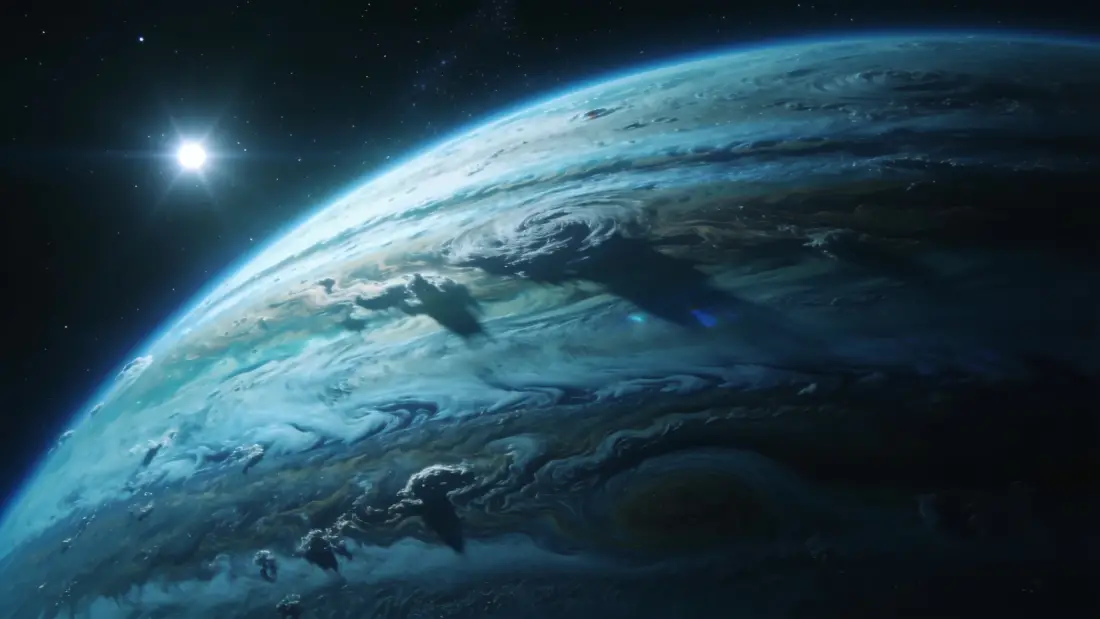
Somewhere out in space, about 357 light-years from Earth, a world larger than ours circles a star we are just beginning to study. That world is DMPP-9 b, and scientists confirmed it in 2026. It is a good example of how patient, careful sky-watching can turn a tiny signal into a real discovery.
How Scientists Found DMPP-9 b
Astronomers did not take a photo of DMPP-9 b. That is almost never how exoplanets — planets orbiting stars beyond our Sun — are found. Instead, the team used something called the radial velocity method. Here is what that means.
A planet does not just orbit its star. The star and planet actually pull on each other. As the planet moves around the star, it tugs the star very gently toward it, then away, then toward it again. That tiny back-and-forth motion changes the light we receive from the star in a regular pattern. Scientists can measure this shift in the light and work backward to figure out that a planet must be there doing the pulling.
The radial velocity method is especially good at giving us a planet’s mass. For DMPP-9 b, that measurement told scientists the planet weighs about 14.4 times as much as Earth. That is a meaningful piece of information, as you will see in the next section.
If you are curious about other worlds found this way, the discovery timeline shows how detection methods have grown and changed over the years.
What Kind of World Is DMPP-9 b?
DMPP-9 b belongs to a category called a mini-Neptune. In our own solar system, Neptune is an ice giant — a large planet with a thick atmosphere and no solid surface we could stand on. A mini-Neptune is a smaller version of that idea. It is bigger than Earth but smaller than Neptune.
The numbers help paint the picture. DMPP-9 b has a radius — that is, the distance from its center to its surface — of 3.89 times Earth’s radius. So if Earth were the size of a tennis ball, DMPP-9 b would be roughly the size of a softball. Its mass of 14.4 times Earth’s tells scientists the planet is fairly heavy for its size.
When scientists compare a planet’s size to its mass, they get an idea of what the planet might be made of. A planet that is large but surprisingly light might be mostly gas and fluff. One that is smaller but heavy might be packed with rock and metal. DMPP-9 b sits in an interesting middle range. Scientists think it likely has a thick atmosphere, possibly with a rocky or icy core underneath, but we do not yet have enough information to say for certain.
Mini-Neptunes turn out to be one of the most common types of planet in the galaxy, as far as we can tell. Yet we have none in our own solar system. That makes worlds like DMPP-9 b genuinely interesting to study — they represent a type of planet our neighborhood simply does not have.
A Very Fast Year

On DMPP-9 b, a year goes by quickly. The planet completes one full orbit around its star in just 12.7 Earth days. That is less than two weeks for a full trip around the sun.
To do that, DMPP-9 b must be orbiting very close to its star. The closer a planet is to its star, the faster it has to travel to stay in orbit. Scientists haven’t published the exact distance between DMPP-9 b and its star, but its short year is a strong clue that the planet sits much nearer to its star than Earth sits to the Sun.
Being that close to a star usually means a world is very hot. However, scientists have not yet measured the surface temperature of DMPP-9 b directly. What the temperature actually is would depend on the planet’s atmosphere and how it handles heat — and we simply do not have that data yet.
The Star at the Center of It All
Every planet has a star, and DMPP-9 b’s star is called DMPP-9. One important measurement we have for this star is its surface temperature: 6,092 Kelvin. Kelvin is a temperature scale scientists use. To give you a sense of scale, our own Sun has a surface temperature of about 5,778 Kelvin. That means DMPP-9 runs a little hotter than our Sun.
A star’s temperature shapes its color and the kind of light it pours out onto its planets. A slightly hotter star tends to give off a bit more blue-white light compared to a cooler, more orange star. For DMPP-9 b, orbiting so close to a star like this, the energy environment would be intense.
So far, only one planet has been confirmed in this system. That does not mean DMPP-9 b is alone — other planets may simply be too small or too far out to have shown up in the data yet. More observations could change that picture.
What We Still Don’t Know
Honest science means being clear about the gaps. We do not know what DMPP-9 b’s atmosphere is made of. We do not know its surface temperature. We do not know whether it has moons, rings, or sibling planets. Scientists have not measured its exact distance from its star. These are not failures — they are the next questions, waiting for better tools and more telescope time.
DMPP-9 b joins a long list of worlds that remind us how much of the universe is still coming into focus. You can explore many of them in the atlas of known exoplanets. Each new planet is one more piece of a picture we are slowly, carefully assembling — and DMPP-9 b is a fine addition to it.