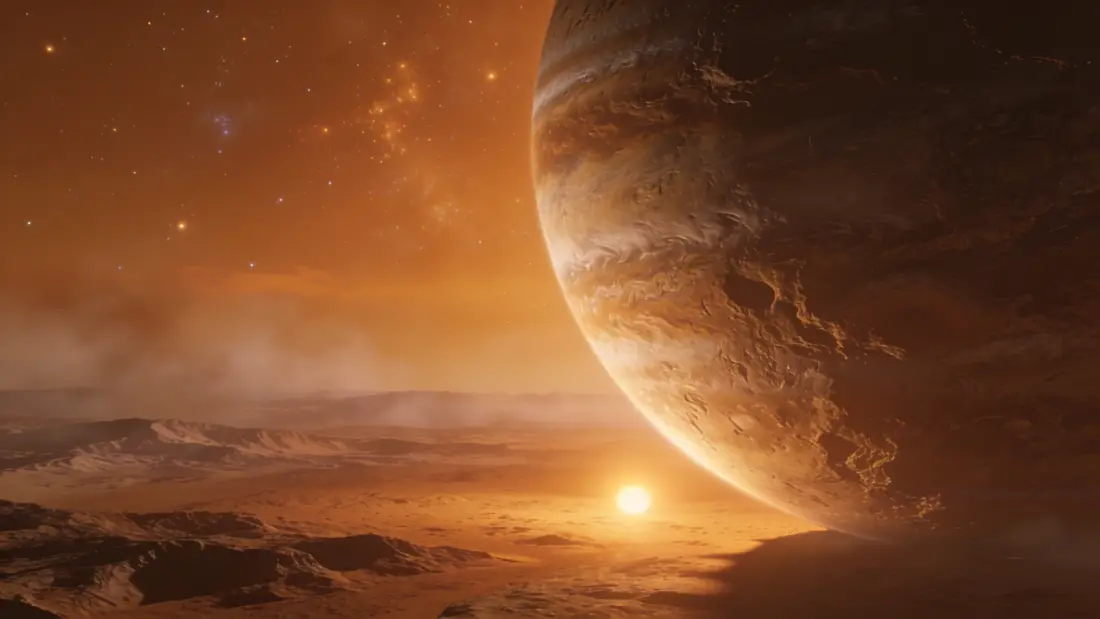
About 127 light-years from Earth, a quiet star called HD 23472 holds a small family of at least five planets close to its side. Scientists are still piecing together what these worlds are like, and the picture that is forming is a fascinating one. Planet HD 23472 b is the member of the family we know the most about, and even its story is full of open questions.
The Star at the Center
HD 23472 is an orange dwarf star. An orange dwarf is smaller and cooler than our Sun, sitting between the very cool red dwarfs and the bright yellow stars like the one in our own Solar System. Its surface temperature is 4,684 K — where K stands for Kelvin, a scale scientists use to measure very high temperatures. For comparison, our Sun’s surface sits at about 5,778 K, so HD 23472 is noticeably cooler and gives off a warmer, more amber-colored light.
Cooler stars like this one burn their fuel slowly and carefully. That means they can shine steadily for a very long time — far longer than our Sun. Whether that gives any planets in this system a better or worse chance of being interesting places, scientists are still working out.
The star sits about 127 light-years away from us. A light-year is the distance light travels in one year, and light moves at about 300,000 kilometers every second. So 127 light-years is an enormous distance — far too far for any spacecraft we have today to reach in a human lifetime. Everything we know about this system comes from studying the light that travels across that huge gulf of space and reaches our telescopes here on Earth.
HD 23472 b: The Planet We Know Best

Of the five known planets around HD 23472, the one called HD 23472 b has been measured most carefully. It was first confirmed in 2019, and the numbers scientists have gathered give us a real sense of how different it is from Earth.
HD 23472 b orbits very close to its star. One full orbit — what we would call a year on that planet — takes just 17.7 Earth days. To put that in perspective, our own Mercury, the closest planet to the Sun, takes 88 days to complete one orbit. HD 23472 b moves through space much faster than that, racing around its star in under three weeks.
Being so close to a star has a big effect on temperature. Scientists estimate the likely temperature at HD 23472 b is around 543 K, which works out to about 270 degrees Celsius. That is far hotter than even the hottest days ever recorded on Earth, and well above the boiling point of water. Any water on the surface of this planet — if there ever was any — would not stay liquid for long under those conditions.
A Hot, Dense World
The measurements scientists have taken tell us something interesting about what HD 23472 b might be made of. The planet has a radius — that is, the distance from its center to its surface — of about twice Earth’s radius. But its mass, meaning how much material is packed into it, is about 8.32 times Earth’s mass. That means a lot of material is squeezed into a body that is only twice as wide as Earth.
When a planet is notably more massive than you might expect for its size, scientists call it dense. A very dense planet tends to have a large rocky or metallic core, and may not have a thick, fluffy atmosphere the way some lighter planets do. HD 23472 b falls into a category researchers sometimes call a “super-Earth” — a rocky planet bigger and heavier than Earth, but not as large as the ice giants in our Solar System like Uranus or Neptune. Scientists think it may have a dense rocky interior, but they haven’t been able to confirm exactly what lies beneath the surface.
What is almost certain is that HD 23472 b does not sit in the habitable zone — the band of distances around a star where temperatures might allow liquid water to exist on a planet’s surface. This planet is much too close, and much too hot, for that possibility.
Five Worlds, One Star

HD 23472 b is not alone. Scientists have confirmed at least five planets orbiting the star HD 23472. Systems with multiple planets packed around a single star are not unusual in our galaxy — our own Solar System has eight — but each one has its own personality.
Unfortunately, the detailed measurements for the other four planets in this family have not all been fully published or verified in a way that lets us state their sizes, masses, or orbits with confidence here. What scientists do know is that the planets seem to be arranged in a fairly compact way, with several of them orbiting closer to their star than Mercury orbits our Sun. That kind of tight arrangement is quite different from what we see in our Solar System, where the planets are spread across enormous distances.
Compact multi-planet systems like this one are common finds in modern planet surveys. Studying how those planets are spaced, and how their orbits relate to each other, helps scientists understand how planets form and settle into place over millions of years. You can explore other known planetary families using our system explorer.
How Scientists Found These Planets
The planets around HD 23472 were discovered using the transit method. When a planet passes directly in front of its star from our point of view, it blocks a tiny fraction of the star’s light. Telescopes can detect that small dip in brightness. By watching how often those dips happen and how deep they are, scientists can figure out how long the planet’s orbit is and how big the planet is compared to its star.
Measuring mass takes a second step. Scientists watch for tiny wobbles in the star’s motion caused by the gravitational pull of orbiting planets. The bigger and heavier a planet, the stronger its tug, and the bigger the wobble. By combining the transit data with these wobble measurements, researchers can estimate both the size and the mass of a planet — which is exactly how we got such detailed numbers for HD 23472 b.
Why This System Is Worth Watching
Dense, hot planets close to their stars are useful reference points. By studying a world like HD 23472 b — where the conditions are so extreme — scientists can test their ideas about how rocky planets form, what their interiors look like, and how atmospheres survive or get stripped away by heat and radiation. Every measurement from a system like this one adds a small piece to a much bigger picture of how planetary families come to be across the galaxy. HD 23472 is 127 light-years away, but what it teaches us could change how we understand the universe right on our doorstep.