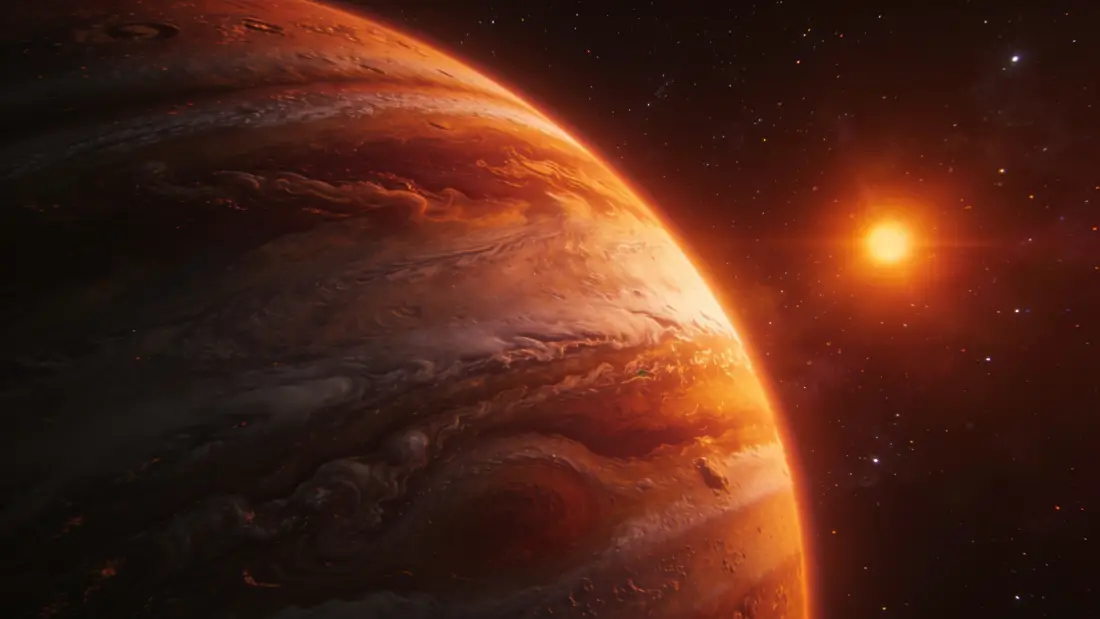
TOI-4662 b is a world bigger than Earth but smaller than Neptune, sitting 362 light-years away in space. Scientists found it in 2026, and it has already given us a lot to think about. It belongs to a group of planets that are surprisingly common in our galaxy, yet nothing quite like them exists in our own solar system.
Where TOI-4662 b Lives
To reach TOI-4662 b, you would need to travel 362 light-years from Earth. A light-year is the distance light travels in one year — about 9.5 trillion kilometres. That number is hard to picture, but in galaxy terms, this planet is a fairly close neighbour.
The planet orbits a star called TOI-4662. So far, astronomers have found only one planet in this system, though that does not mean others do not exist. It simply means none have been spotted yet. Space is patient, and so are the scientists studying it.
How Scientists Found It
TOI-4662 b was discovered in 2026 using the transit method. A transit happens when a planet passes in front of its star, as seen from our direction. When that occurs, the star looks very slightly dimmer. By measuring that tiny dip in brightness, scientists can work out how big the planet is relative to its star.
The name TOI stands for TESS Object of Interest. TESS is a space telescope that watches large patches of the sky and looks for those small dips in starlight. When it flags a promising signal, that world earns a TOI number while scientists study it further.
Mass — how much stuff a planet contains — is harder to measure than size. Scientists use a technique called radial velocity, which means watching for a tiny wobble in the star caused by the planet’s gravity tugging on it. That wobble tells them how heavy the planet is. Both methods were used to understand TOI-4662 b.
Size, Mass, and What the Numbers Tell Us
TOI-4662 b has a radius of 2.88 times Earth’s and a mass of 8.65 times Earth’s. On their own, those figures are interesting. Together, they are genuinely revealing.
When you know both size and mass, you can calculate density — how tightly packed the material inside a planet is. A planet that is large but surprisingly light is probably full of gas or water. A planet that is small but heavy is likely made of rock and metal. TOI-4662 b sits in a middle range that scientists call a mini-Neptune.
Mini-Neptunes are planets roughly two to four times Earth’s size. They are too big to be simply rocky like Earth, but too small to be gas giants like Jupiter. Scientists think they usually have a rocky or icy core wrapped in a thick layer of gas or water. TOI-4662 b fits that picture well, though its exact interior is still a matter of research.
If you enjoy comparing planet sizes, you can explore the size comparison tool to see how TOI-4662 b stacks up against Earth, Neptune, and other worlds. You can also look at the mass-radius diagram to see where this planet falls among the thousands of worlds scientists have measured.
What Might Be Inside

Scientists study a planet’s density to make careful guesses about what it is made of. TOI-4662 b’s combination of radius and mass suggests it is not a dense, purely rocky world. Its density is lower than Earth’s, which points to lighter materials playing a big role.
One possibility is that the planet has a rocky core surrounded by a thick atmosphere of hydrogen and helium — the lightest gases in the universe. Another possibility is that much of the planet’s interior is made of water, though not in the form we know on Earth. At the temperatures and pressures deep inside a planet like this, water behaves in strange ways — it can become a hot, dense fluid that is not quite liquid and not quite gas. Scientists sometimes call this a water world or a super-fluid interior.
We do not know for certain which picture is correct for TOI-4662 b. Telling these interiors apart is one of the big challenges in planet science right now. The density alone gives hints, but it cannot give a definitive answer. Future observations may help narrow it down.
A Very Hot, Very Fast Orbit
TOI-4662 b completes one full orbit around its star in just 4.7 Earth days. Our own year is 365 days, so this planet moves extraordinarily quickly. It is extremely close to its star — far closer than Mercury is to our Sun.
That closeness comes with heat. Scientists estimate the planet’s equilibrium temperature — the expected temperature based on how much starlight it receives — at 741 K, which is roughly 468 degrees Celsius. That is far too hot for liquid water to exist on the surface. Whether or not there is an atmosphere, and how that atmosphere might change the actual surface temperature, scientists haven’t measured yet.
A planet this close to its star is also likely tidally locked, which means one side always faces the star and the other is always in darkness. This is the same reason we always see the same face of the Moon from Earth. On a tidally locked planet, the day side and night side would have very different conditions. Scientists think about how heat might move between those sides, and what that means for the planet’s atmosphere, if it has one.
The Orange Star at the Centre
TOI-4662 sits at the heart of this system. With a surface temperature of 4,520 K, it is cooler than our Sun, which burns at about 5,778 K. Stars are sorted by colour and temperature, and at 4,520 K, TOI-4662 is what astronomers call a K-type star, or an orange dwarf.
Orange dwarfs are smaller and cooler than our Sun, but they are thought to be very stable — they tend not to flare as violently as even cooler red dwarf stars. Some scientists consider them good candidates for hosting planets, because their steady light does not constantly blast nearby worlds with harmful radiation. Of course, TOI-4662 b sits so close to its star that this advantage matters much less for this particular planet.
TOI-4662 b is a reminder of how varied planets can be. A world nearly nine times heavier than Earth, racing around an orange star in under five days, at temperatures that would melt lead — it would be unrecognisable to us, and yet the same physics that shapes Earth shaped it too. That shared language of size, mass, and density is how scientists slowly read what these distant worlds are made of, one careful measurement at a time.