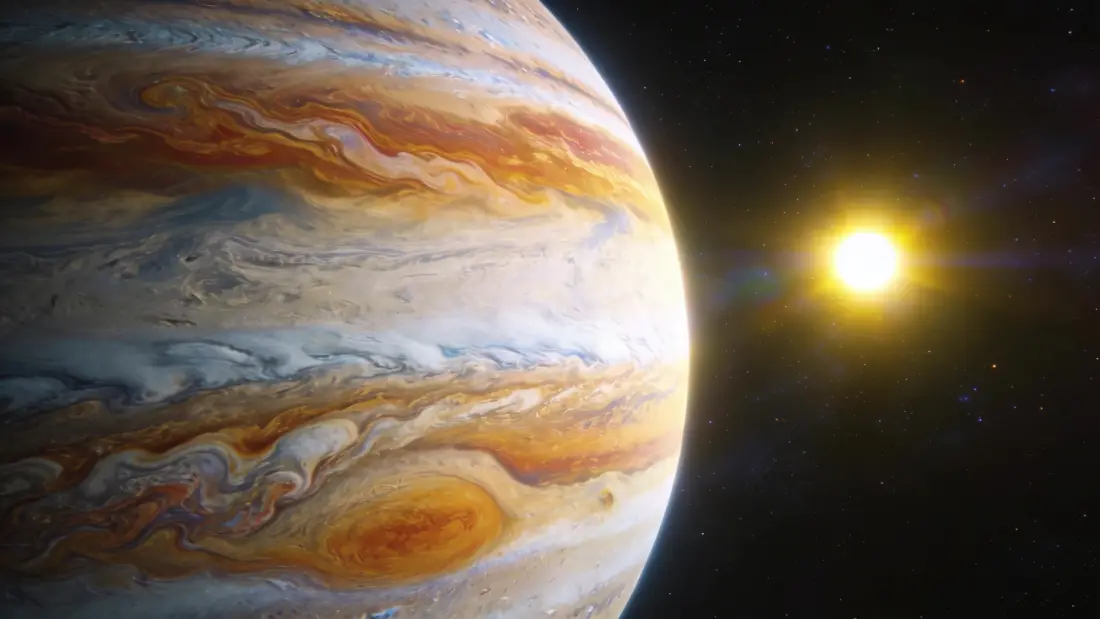
About 117 light-years from Earth — a light-year is the distance light travels in a whole year — there is a star called HD 20782. It has at least five planets circling it, making it one of the more crowded planetary systems we know of beyond our own neighborhood. The planet HD 20782 b is the one scientists know the most about, and it has some very interesting qualities worth exploring.
The Star at the Center
HD 20782 is the star that holds this whole family together. Its surface temperature is 5,782 K — K stands for Kelvin, a scale scientists use to measure very high temperatures. Our own Sun has a surface temperature of about 5,778 K. That is remarkably close. In other words, HD 20782 and our Sun are about the same warmth on the surface, which makes HD 20782 a solar-type star, meaning a star that behaves a lot like the Sun.
That similarity is one reason scientists find this system interesting. When a star is close in temperature to our Sun, it gives off a similar kind of light. That can matter when researchers think about whether conditions on any planet there could be comfortable for life — though we want to be clear that nothing has been found to suggest life exists around HD 20782.
At 117 light-years away, HD 20782 is not our nearest stellar neighbor, but it is close enough that telescopes can study it in real detail. For comparison, the Milky Way galaxy is roughly 100,000 light-years across, so 117 light-years is practically next door on that scale.
Meet HD 20782 b
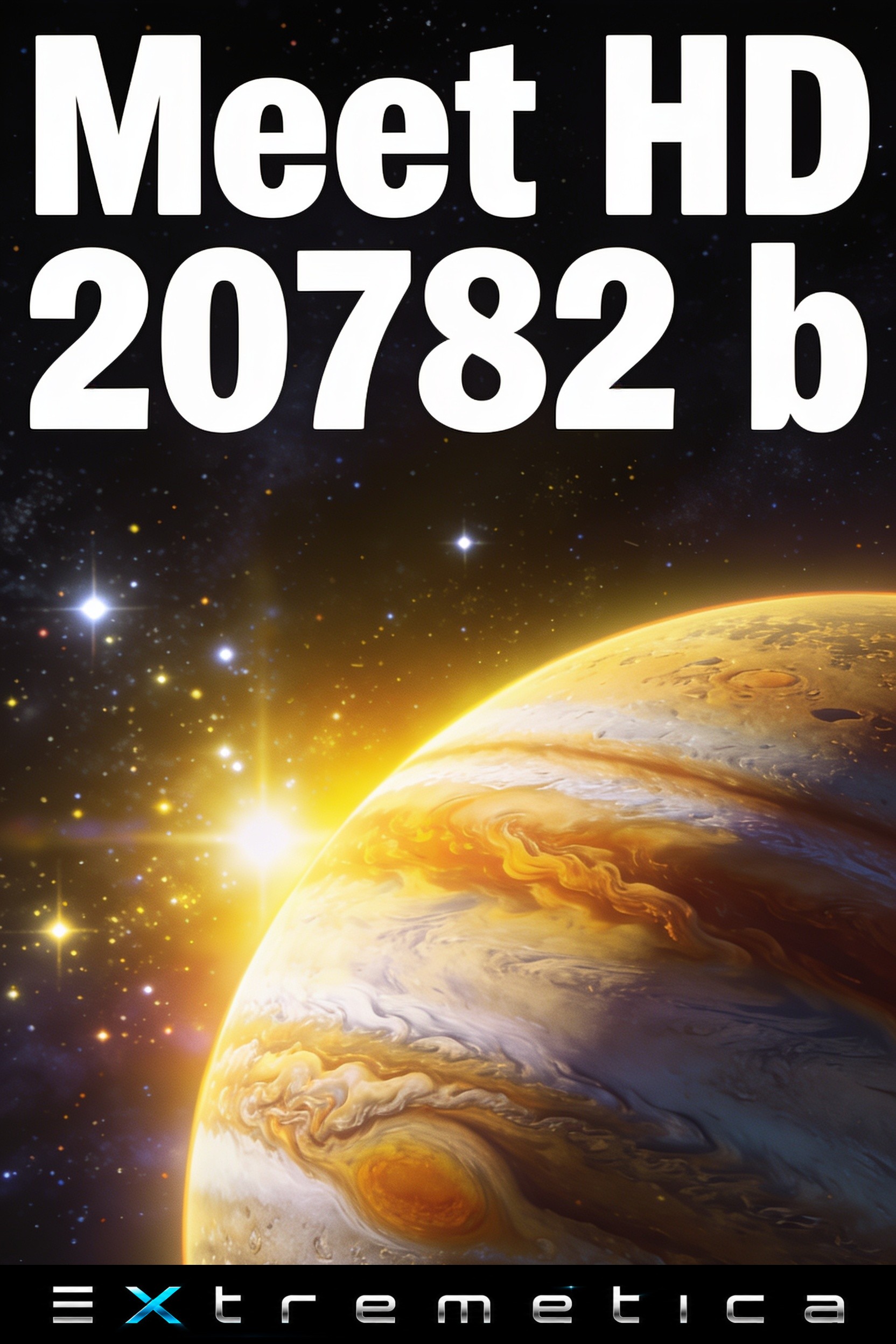
HD 20782 b is the one planet in this system for which scientists have measured detailed numbers. And those numbers are striking. The planet has a radius — that is, the distance from its center to its surface — of 13.6 times the radius of Earth. It also has a mass of 473 times the mass of Earth. To put that in perspective, Jupiter, the biggest planet in our Solar System, has a mass of about 318 times Earth’s mass. HD 20782 b is heavier than even Jupiter.
A planet this large and massive is called a giant planet. Scientists think it is most likely a gas giant, a world made mostly of gases like hydrogen and helium rather than solid rock. We should say “think” and “likely” here because scientists haven’t been able to look at the planet directly and confirm exactly what it is made of. These are careful estimates based on size and mass.
HD 20782 b takes 597 Earth days to complete one full orbit around its star. That is about 1.6 Earth years. Our own Jupiter takes about 12 Earth years to go around the Sun, so in that sense HD 20782 b moves faster and sits closer to its star than Jupiter does to ours — though the exact distance from the star hasn’t been confirmed in our data set, so we won’t guess at a number.
How HD 20782 b Was Found
HD 20782 b was discovered in 2006 using a technique called the radial velocity method. Here is how it works. A planet’s gravity tugs on its star as it orbits. That tug makes the star wobble very slightly — not enough to see with your eyes, but enough to detect with a sensitive instrument. When the star wobbles toward us, its light shifts slightly toward the blue end of the color spectrum. When it wobbles away, the light shifts toward red. Scientists measure these tiny color shifts and use them to figure out that a planet must be pulling on the star.
The radial velocity method is very good at measuring a planet’s mass, because a heavier planet causes a stronger wobble. It does not give a perfect measurement of size on its own, which is why some numbers — like the radius — sometimes come from combining different kinds of observations. The discovery of HD 20782 b was an early example of this kind of careful detective work that astronomers use to find worlds they cannot see directly.
The Rest of the Family
HD 20782 b is not alone. The system is known to contain five planets in total. However, the NASA Exoplanet Archive data we have access to includes detailed measurements only for HD 20782 b. For the other four worlds, scientists haven’t published — or haven’t yet confirmed — the same level of detail about their sizes, masses, and orbits.
This is actually very common in exoplanet science. Exoplanets are planets found outside our Solar System, and studying them is genuinely hard. Often, one planet in a system gets a thorough write-up while the others remain partly described. As telescopes improve and more observations come in, the picture tends to get sharper over time. The other four planets in the HD 20782 system may be much better understood in the years ahead.
How This System Compares to Ours
Our Solar System has eight planets arranged in a fairly orderly way, with smaller rocky planets close to the Sun and large gas giants farther out. The HD 20782 system, with its giant planet on a roughly 597-day orbit, raises interesting questions about how planetary systems get arranged in the first place.
Some systems have giant planets in surprising places — closer to their star than scientists once expected. Others are spread out differently from our own. Each system scientists study adds a data point to a growing picture of how common or unusual our own Solar System really is. You can explore many of these arrangements using our system explorer, which shows how different planetary families compare to each other.
The fact that HD 20782’s star is so similar in temperature to our Sun makes the comparison even more interesting. Two stars can be nearly twins and still end up with very different families of planets around them.
What Scientists Are Still Working Out
There is a lot still unknown about HD 20782. The masses, sizes, and orbital paths of the four other planets are not fully measured yet, as far as current published data shows. Scientists also haven’t determined whether any of these planets sit in the habitable zone — the region around a star where temperatures might allow liquid water to exist on a planet’s surface. That does not mean no such planet is there, only that we don’t know yet.
HD 20782 b itself, being a gas giant, is not the kind of world where scientists expect to find surface conditions friendly to life as we know it. But it may have moons — and large moons around giant planets are one place researchers sometimes wonder about. That is very speculative thinking for now, and no moons have been detected.
What we do know is that HD 20782, sitting just 117 light-years away around a Sun-like star, is a system worth watching as our tools get better. Planetary science moves forward one careful observation at a time, and systems like this one help researchers understand the many ways a family of worlds can be put together.