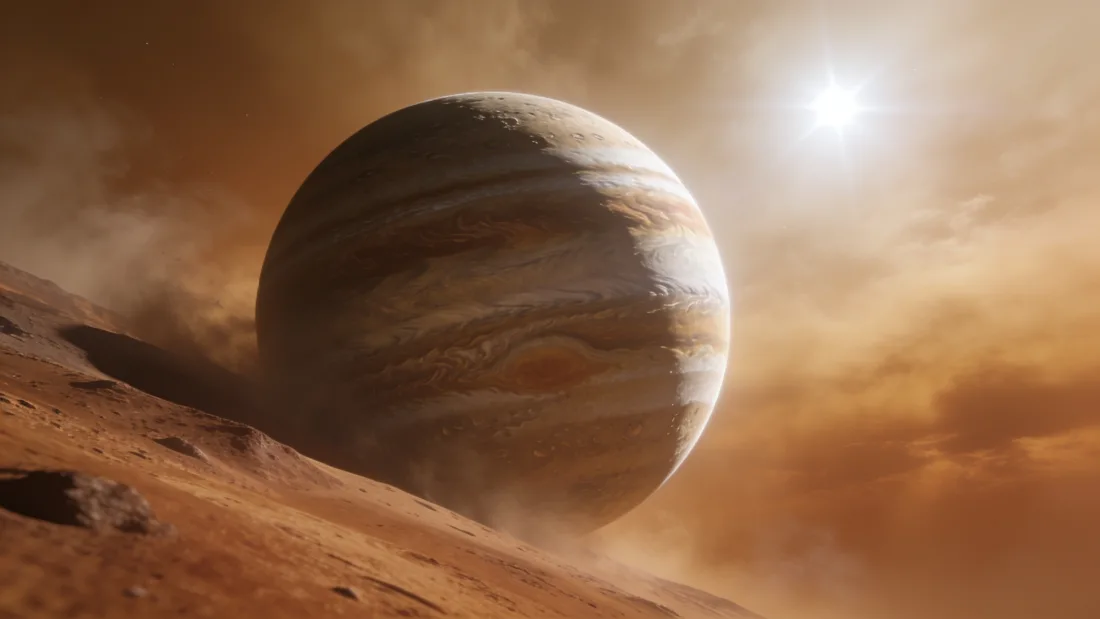
Three hundred and forty-seven light-years away, a star called HIP 41378 hosts one of the more interesting planetary families astronomers have found so far. Six planets circle this star, each one a little different from the others. One of them, HIP 41378 d, gives scientists a rare close look at what these distant worlds might be made of.
The Star at the Center
HIP 41378 is the sun at the heart of this system. A light-year is the distance light travels in one year — about 9.5 trillion kilometers. At 347 light-years away, this star is far too distant to visit, but modern telescopes can still study it carefully.
The surface temperature of HIP 41378 is about 6,320 K. Scientists measure star temperatures in Kelvin, or K, which is a scale that starts at absolute zero — the coldest anything can be. Our own Sun has a surface temperature of around 5,778 K. That makes HIP 41378 a little hotter and a little brighter than the Sun. Stars like this are called F-type stars, and they tend to be slightly more massive and larger than our Sun too.
Because HIP 41378 is a bit like our Sun, scientists find it especially interesting. When a star is not too different from the Sun, the planets around it might orbit in conditions that are at least somewhat familiar to us.
How Scientists Found the Family
The six planets of HIP 41378 were not spotted by looking through a telescope and seeing them directly. They were found using the transit method. A transit happens when a planet passes in front of its star from our point of view. When that happens, the star dims ever so slightly. Scientists measure that tiny dip in brightness and use it to figure out that a planet is there.
The first planets in this system were discovered in 2016. Astronomers used data from a space telescope watching many stars at once and noticed the repeated patterns of dimming that reveal orbiting planets. Each planet dims the star by a different amount, and each one takes a different amount of time to complete one orbit. By studying those differences carefully, scientists can work out how big each planet is and how long its year lasts.
The transit method is very good at measuring a planet’s size. But on its own, it cannot tell you how heavy a planet is. For that, scientists need a second technique called radial velocity — a way of measuring how much the planet’s gravity makes the star wobble. Combining both methods gives the fullest picture of what a planet is actually like.
Meet HIP 41378 d
Of the six known planets in this system, HIP 41378 d is one of the best studied. Scientists have measured both its size and its mass, which together tell us something about what it might be made of.
HIP 41378 d has a radius of 3.54 times Earth’s radius. That makes it close to the size of a sub-Neptune — a type of planet that is smaller than Neptune but noticeably bigger than Earth. These kinds of planets do not exist in our Solar System, so they are especially interesting to study.
Its mass is 4.6 times Earth’s mass. When you know both the size and the mass, you can work out a planet’s density — how tightly packed its material is. A planet that is large but not very heavy is probably made mostly of gas or has a thick, puffy atmosphere. A planet that is small but heavy is likely made of rock or metal. HIP 41378 d sits in a range where scientists think it could have a rocky core surrounded by a significant layer of gas or water, but we are not certain yet.
One orbit around its star takes HIP 41378 d about 278 Earth days — so its year is a little shorter than ours. The estimated temperature at the top of its atmosphere is around 367 K, which is about 94 degrees Celsius. That is hotter than boiling water. Scientists haven’t yet measured what its atmosphere is made of, so there is a lot still to learn.
Six Worlds in One System
HIP 41378 d is only one member of a six-planet family. Having six known planets around a single star is not common. It tells scientists that this star had plenty of material around it when it was young, and that material was able to clump together into several distinct worlds.
Scientists haven’t measured detailed sizes and masses for all six planets yet, so a full comparison is difficult to make. What we do know is that the planets seem to vary in size, and they orbit at different distances from the star, with different year lengths. Some of the other planets in the system are also thought to be sub-Neptunes or larger, but scientists are still working to pin down their exact properties. For now, HIP 41378 d is the planet in this family that we can describe most precisely.
How This System Compares to Our Solar System
Our Solar System has eight planets, so HIP 41378 with six known planets is not far off. But the arrangement seems quite different. In our Solar System, the four inner planets — Mercury, Venus, Earth, and Mars — are small and rocky. The four outer planets are much larger and made mostly of gas or ice.
In the HIP 41378 system, the planets we know about so far seem to be in the sub-Neptune to larger range — bigger than Earth but perhaps smaller than Neptune. It is possible that smaller rocky planets exist in the system and haven’t been detected yet, because small planets produce fainter signals and are harder to spot.
The star being slightly hotter than the Sun also means the habitable zone — the range of distances where liquid water could exist on a planet’s surface — sits a little farther out than it does in our Solar System. Scientists haven’t confirmed whether any of the six planets sits squarely in that zone.
What Scientists Still Want to Learn
There are many open questions about HIP 41378. Researchers want to study the atmospheres of planets like HIP 41378 d to find out what gases are present. They want better mass measurements for the other five planets. And they want to know whether any world in this system sits in a place where conditions could, in theory, support liquid water on its surface.
This system is also a good target for newer, more powerful telescopes that can look at starlight filtered through a planet’s atmosphere and identify the gases inside. That kind of observation could reveal whether any of these planets have the ingredients that make them scientifically interesting beyond their size and orbit.
HIP 41378 and its family of six are a reminder of how much variety the universe holds, and how much patient, careful science it takes to understand even one distant solar system. You can explore more planetary systems like this one in our System Explorer.