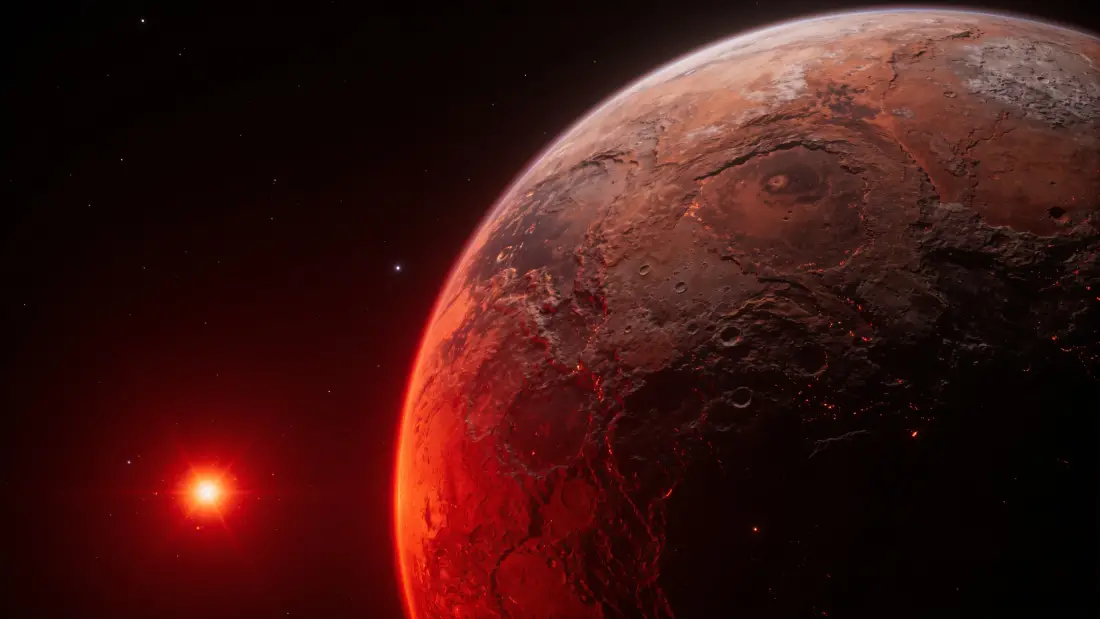
About 240 light-years away, a planet called TIC 88692598 b orbits a dim, cool star in a year that lasts less than three Earth days. Scientists confirmed its existence in 2026, and it is already teaching us something interesting about worlds that are bigger than Earth but smaller than Neptune.
A Cool, Quiet Star
TIC 88692598 b orbits a star also called TIC 88692598. The star’s surface temperature is 3,483 Kelvin. Kelvin is a way of measuring temperature that scientists use; for comparison, our own Sun has a surface temperature of about 5,778 Kelvin. That makes TIC 88692598 a much cooler and dimmer star than the Sun.
Stars this cool are called red dwarfs. They glow with a reddish-orange light, and they are by far the most common type of star in the Milky Way. Red dwarfs burn their fuel very slowly, which means they can live for tens of billions of years — far longer than stars like our Sun.
The star sits about 240 light-years from Earth. A light-year is the distance light travels in one year, which works out to nearly 9.5 trillion kilometers. At 240 light-years, TIC 88692598 is close enough for telescopes to study carefully, but still unimaginably far away for any spacecraft we have today.
So far, TIC 88692598 b is the only planet confirmed in this system. Scientists haven’t found any companions yet, though that could change as observations continue.
How Scientists Found It
TIC 88692598 b was discovered in 2026 using the transit method. This method works by watching a star’s brightness over time. When a planet passes in front of its star, from our point of view, the star gets very slightly dimmer — just as a tiny bug crossing a lamp would block a small amount of its light. By measuring how much the brightness dips, and how often those dips repeat, scientists can figure out that a planet is there.
The transit method also tells us the planet’s size. A bigger planet blocks more starlight, so a deeper dip in brightness means a larger world. From those careful measurements, astronomers worked out that TIC 88692598 b has a radius — that is, a distance from its center to its surface — of 1.81 times Earth’s radius. It is bigger than our planet, but not hugely so.
Because this star is a cool red dwarf, it gives off less light than brighter stars. That can actually make it easier to spot a planet passing in front of it, because the planet blocks a bigger share of the star’s total light. Many planets around red dwarfs have been found this way.
Size and Mass — Reading the Numbers
With a radius of 1.81 times Earth and a mass of 3.94 times Earth, TIC 88692598 b falls into a category astronomers call a super-Earth. A super-Earth is simply a planet more massive than Earth but less massive than the ice giants Uranus and Neptune. The name says nothing about whether the planet is actually Earth-like — it is just about size and mass.
Those two numbers together — radius and mass — are very useful. On their own, each tells only part of the story. A planet could be large but light, like a balloon, or small but very heavy, like a ball of iron. When you have both measurements, you can calculate density, which tells you how tightly packed the material inside the planet is. Density is what really helps scientists guess what a world is made of.
If you enjoy comparing sizes across planets, the size comparison tool on this site lets you place TIC 88692598 b next to Earth, Neptune, or any other world to get a feel for the differences.
What Might Be Inside
With a radius of 1.81 Earths and a mass of 3.94 Earths, TIC 88692598 b is denser than a pure gas world would be, but scientists can’t be certain exactly what is inside. A few possibilities are on the table.
One idea is that the planet has a rocky core — a solid, mineral-rich interior like Earth’s — possibly surrounded by a thick layer of gas or water. Another idea is that it could be what some scientists call a water world, a planet where a large fraction of the interior or surface is made of water, possibly under enormous pressure. At those pressures, water would not look like the liquid in a glass — it might exist in exotic forms that only happen deep inside a planet.
A third possibility is a denser rock-and-iron planet with little or no atmosphere. Scientists haven’t measured TIC 88692598 b’s atmosphere yet, so we can’t say for sure which picture is closest to the truth. To learn more about how mass and radius together point toward different interiors, you can explore the mass-radius diagram, which shows where different types of planets tend to cluster.
A Very Short Year
TIC 88692598 b completes one full orbit around its star in just 2.65 Earth days. That is an extremely short year. For comparison, Earth takes 365 days, and even Mercury — the fastest planet in our solar system — takes about 88 days to go around the Sun.
This short orbit means the planet is very close to its star. Even though TIC 88692598 is a cool, dim star, being that close still means the planet receives a lot of radiation — energy coming from the star. Scientists haven’t measured the planet’s surface temperature yet, so we can’t say exactly how hot it gets. But a planet this close to any star is unlikely to be a comfortable place by human standards.
The planet almost certainly does not sit in what astronomers call the habitable zone — the range of distances from a star where liquid water could exist on a planet’s surface. At 2.65 days per orbit, TIC 88692598 b is orbiting far too close for that.
Where Super-Earths Fit in the Bigger Picture
Super-Earths are one of the most common types of planets we find around other stars, yet our own solar system has none. Everything here is either smaller, like Earth and Mars, or much larger, like Uranus and Neptune. That makes planets like TIC 88692598 b genuinely interesting to study — they represent a kind of world we have no local example to compare with.
By collecting data on many super-Earths, scientists slowly piece together patterns. Some seem rocky, some watery, some gassy. Each new confirmed planet, including TIC 88692598 b, adds one more data point to that growing picture. We are still early in understanding these worlds, and there is honest uncertainty in almost every conclusion. But that uncertainty is part of what makes the search worth doing.