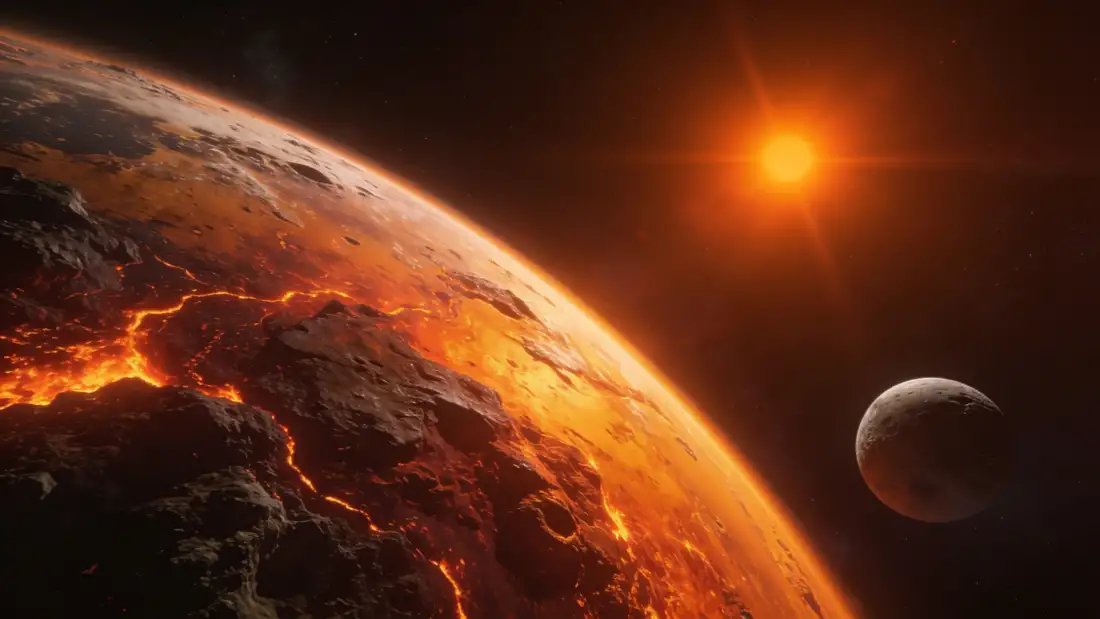
188 light-years away, a small world crosses in front of its star once every little more than a day. That crossing is almost invisible from Earth — but it is just enough for astronomers to find it. The planet is called TOI-6281 b, and its discovery in 2026 is a good example of how patient, careful science can spot worlds we will probably never visit.
A Quick Look at TOI-6281 b
TOI-6281 b is an exoplanet — a planet orbiting a star other than our Sun. It sits about 188 light-years from Earth. A light-year is the distance light travels in one year, roughly 9.5 trillion kilometres, so 188 light-years is an enormous distance by any human measure.
Here is what scientists have measured so far:
- Radius: 1.92 times the radius of Earth
- Mass: 4.36 times the mass of Earth
- Year length: just 1.05 Earth days for one full orbit
- Likely temperature: around 2,240 K, which is about 1,967 degrees Celsius
TOI-6281 b is the only planet known in its system so far. Scientists haven’t measured things like its exact atmosphere or surface conditions yet, and we should be careful not to guess at details that haven’t been confirmed.
How the Transit Method Works
The transit method — the technique used to discover TOI-6281 b — is built on a simple idea. When a planet passes directly between its star and Earth, it blocks a tiny slice of the star’s light. That brief dimming is called a transit.
Here is how astronomers use it, step by step:
- A telescope stares at a star and measures its brightness very carefully, thousands of times.
- If a planet is in the right position, it will pass in front of the star from our point of view. This is called a transit.
- During the transit, the star looks very slightly less bright. The drop can be less than one percent — sometimes much less.
- The telescope records this dip in brightness.
- If the same dip repeats on a regular schedule, scientists begin to suspect a planet is the cause.
- After checking other possible explanations, they confirm whether a planet is really there.
It takes patience. Astronomers watch the same stars for months or years to catch repeated transits. If you want to get a feel for this process, the How We Find Them simulator lets you see a transit in action.
What the Dip in Light Tells Us

The transit itself carries real information. The size of the dip — how much the star dims — tells scientists how big the planet is compared with its star. A bigger planet covers more of the star, causing a deeper dip. That is how astronomers worked out that TOI-6281 b has a radius of 1.92 times Earth’s.
The timing of the dip tells scientists how long the planet’s year is. TOI-6281 b transits its star every 1.05 Earth days, meaning it completes a full orbit in just over one day. That is an extremely short year — our own year is 365 days long.
The transit method is powerful, but it has a limit. It can tell us a planet’s size and how often it orbits. It cannot, on its own, tell us the planet’s mass. For that, scientists use a second technique.
The Wobble Method: Learning the Mass
The wobble method has a more technical name: radial velocity. Radial means “along the line of sight,” and velocity means speed. Here is the idea.
A planet does not simply orbit a star. Gravity works both ways. The planet pulls on the star just as the star pulls on the planet. Because the planet is much lighter, the star’s motion is tiny — but it is real. The star wobbles slightly back and forth as the planet goes around it.
When a star wobbles toward Earth, the light it sends us gets squeezed to slightly shorter wavelengths — wavelengths are like the distance between waves of light — making it look very slightly bluer. When the star wobbles away, the light stretches to longer wavelengths and looks very slightly redder. This shift is called the Doppler effect. You hear the same thing with sound when a siren changes pitch as a car drives past you.
By measuring these tiny colour shifts, scientists can work out how hard the planet is pulling on the star, which tells them the planet’s mass. That is how we know TOI-6281 b has a mass of 4.36 times Earth’s.
The Star TOI-6281 b Orbits
Every exoplanet story starts with a star. TOI-6281 b orbits a star called TOI-6281. Its surface temperature is 4,533 K. Our own Sun has a surface temperature of about 5,778 K, so TOI-6281 is noticeably cooler. Stars like this are often classified as orange or K-type stars, though scientists haven’t confirmed all the details of this star’s full classification in the data we have here.
A cooler star produces less intense light and heat than the Sun does. That matters a great deal for any planet nearby. However, as we will see, TOI-6281 b orbits so close that even a cooler star bakes it thoroughly.
A Scorching World Close to Its Sun
TOI-6281 b completes a full orbit in just 1.05 Earth days. To do that, it must be orbiting extremely close to its star — far closer than Mercury, our own solar system’s innermost planet, is to the Sun. Mercury takes 88 days to orbit the Sun. TOI-6281 b takes roughly one.
At that distance, the planet’s likely temperature is around 2,240 K, which works out to about 1,967 degrees Celsius. That is hot enough to melt most metals and rocks. Scientists call worlds like this ultra-hot planets. This temperature figure is what’s called an equilibrium temperature — a careful estimate of how hot the planet would be given the starlight it receives. The real surface temperature could differ, depending on things like whether it has an atmosphere, which scientists haven’t confirmed.
Super-Earth or Mini-Neptune?
With a radius of 1.92 times Earth’s and a mass of 4.36 times Earth’s, TOI-6281 b sits in an interesting middle ground. Planets in this size range are sometimes called super-Earths — worlds larger than Earth but smaller than Neptune — or mini-Neptunes, which scientists think might have thick gassy layers around a rocky or icy core. The dividing line between the two is not perfectly sharp, and scientists are still working out which category TOI-6281 b belongs to.
Given its extreme heat, any light gases in its atmosphere — if it has one — might have been stripped away long ago by the star’s radiation. Or some gases might remain. We simply do not know yet. What we do know, thanks to careful observation of tiny dips in starlight and tiny wobbles in a star’s colour, is that this world exists and that its basic shape and weight are real, measured things. That, in itself, is a remarkable achievement.