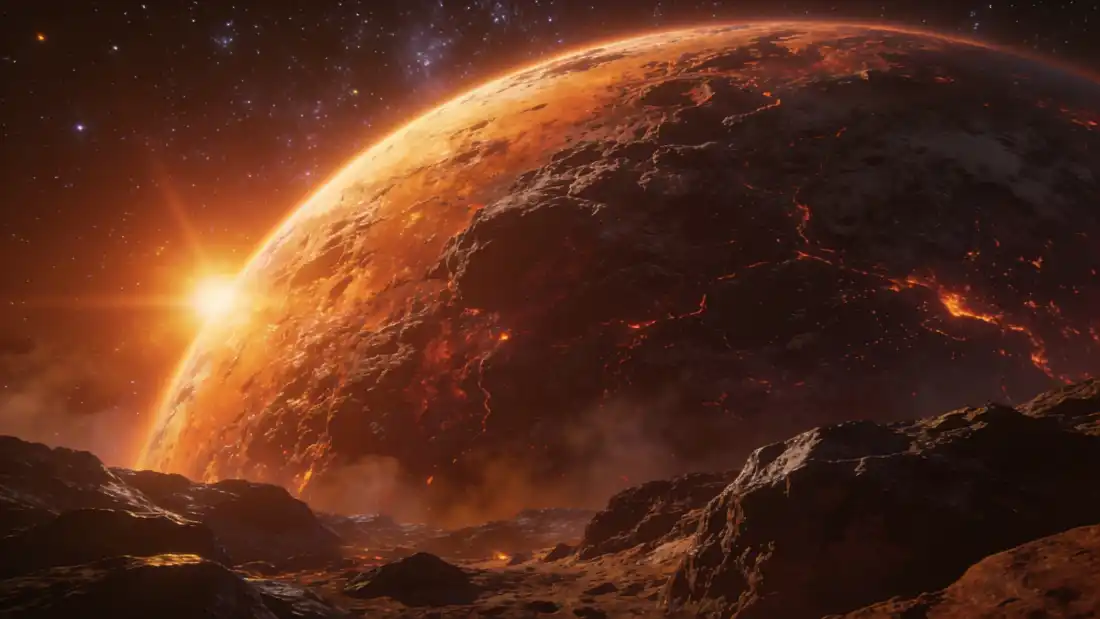
In 2026, astronomers confirmed a new planet orbiting a star about 320 light-years from Earth. That planet is TOI-808 b, and it sits in a system we are only beginning to understand. Here is what we know so far — and what remains a mystery.
How TOI-808 b Was Found
Scientists discovered TOI-808 b using the transit method. A transit happens when a planet passes in front of its star, as seen from Earth. When that occurs, the star’s light dips very slightly — a bit like a tiny bug walking across a lamp. Sensitive space telescopes can detect that small dimming and use it to figure out that a planet is there.
The name TOI stands for TESS Object of Interest. TESS is a space telescope designed to watch many stars at once and look for exactly these kinds of brightness dips. When TESS flags a star as interesting, follow-up observations help confirm whether the signal really comes from a planet. That careful checking process is how TOI-808 b earned its confirmed status.
You can see how this discovery fits into the longer story of planet hunting on our discovery timeline.
The Star at the Center: TOI-808
Every planet story starts with its star. TOI-808 is the sun that TOI-808 b orbits. Its surface temperature is about 5,078 K — where K stands for Kelvin, a scale scientists use to measure very high temperatures. For comparison, our own Sun has a surface temperature of around 5,778 K, so TOI-808 runs a little cooler than the Sun. That makes it what astronomers call a K-type star, sometimes nicknamed an orange dwarf. These stars are slightly smaller and dimmer than the Sun, but they are still quite stable and long-lived.
TOI-808 sits 320 light-years away. A light-year is the distance light travels in one year — roughly 9.5 trillion kilometres. So 320 light-years is an enormous distance by everyday standards, though it is actually fairly close in the grand scale of our galaxy.
So far, TOI-808 b is the only confirmed planet known in this system. That does not mean it is alone — smaller planets or planets with orbits that do not cross our line of sight could easily be hiding there. Scientists simply have not found others yet.
Size, Mass, and What Kind of World This Might Be

TOI-808 b has a radius about 2.2 times that of Earth. It is also about 5.49 times as massive as Earth. These two numbers together are very useful, because they let scientists estimate a planet’s density — how tightly its material is packed. Density is one of the best clues we have about what a planet is made of.
A world in this size range — between roughly 1.5 and 2.5 times Earth’s radius — is often called a sub-Neptune. Planets like this appear to be common around other stars, yet we do not have one in our own solar system to study up close. That alone makes them scientifically interesting.
Based on its radius and mass, TOI-808 b probably has a rocky core surrounded by a thick layer of gas or water. Scientists think it is unlikely to be a purely rocky world like Earth, but they are not certain of the exact mix. Pinning down a planet’s true composition from a distance is genuinely hard, and researchers continue to refine their models.
Curious about how TOI-808 b compares to other confirmed worlds? Our atlas of exoplanets lets you explore planets by size and type.
A Scorching Orbit Close to Home
One of the most striking things about TOI-808 b is how fast it travels around its star. One full orbit — what we would call a year on that planet — takes only 9.74 Earth days. For context, Mercury, the closest planet to our Sun, takes about 88 days to complete one orbit. TOI-808 b moves much faster than that.
Moving so quickly means the planet is very close to TOI-808. And being that close to a star comes with serious heat. Scientists estimate TOI-808 b’s likely temperature at about 711 K, which works out to roughly 438 degrees Celsius. That is far hotter than a kitchen oven, hot enough to melt many metals, and well beyond any temperature where liquid water could exist on the planet’s surface.
This kind of planet — small, close to its star, and very hot — is sometimes called a hot sub-Neptune. Astronomers find these worlds intriguing partly because they raise a puzzle: planets tend to form farther out in a solar system, where it is cooler. How did TOI-808 b end up so close to its star? Did it form there, or did it drift inward over time? Scientists are still working on answers.
Why a Planet Like TOI-808 b Matters
TOI-808 b is not a place anyone could visit or live. It is scorching hot, likely wrapped in thick gas, and orbiting at a blistering pace. But that is exactly why it is worth studying. Each confirmed planet adds a data point to our growing map of how solar systems form and evolve.
Sub-Neptunes are among the most common types of planet found around other stars, yet they remain poorly understood. Every new example — including TOI-808 b — gives scientists one more chance to test their ideas about planet formation, atmospheric chemistry, and how a star shapes the worlds around it. The more we find, the clearer the bigger picture becomes.