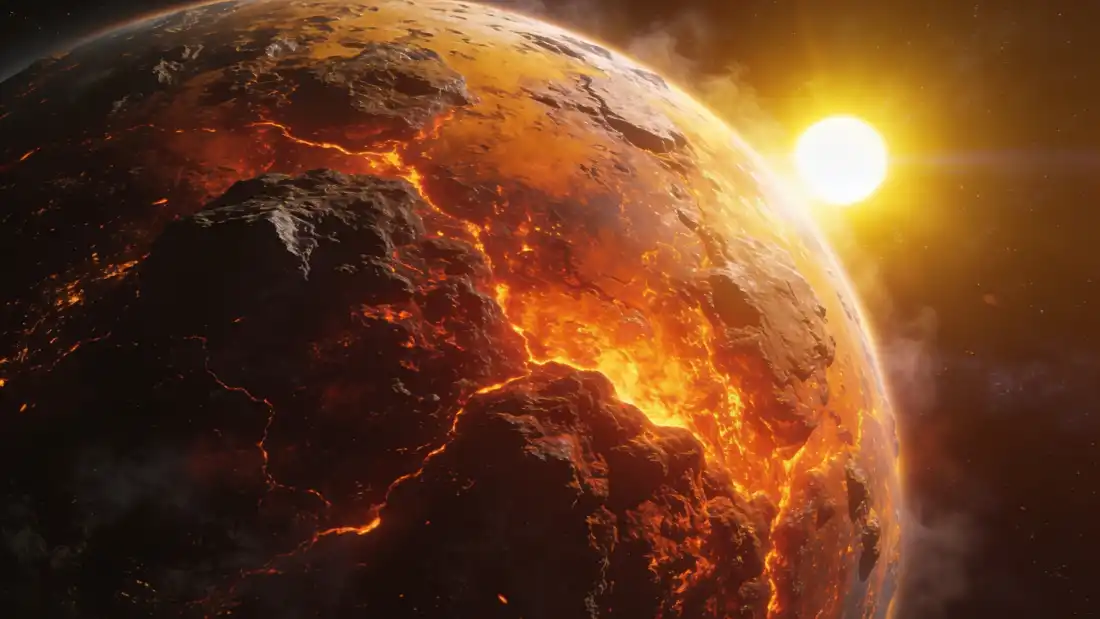
In 2026, astronomers added a new world to the growing list of known planets beyond our solar system. That world is TOI-1839 b, a planet quite different from Earth, sitting nearly 400 light-years away. Here is what we know about it so far — and what is still a mystery.
Where in the Sky Is TOI-1839 b?
TOI-1839 b orbits a star called TOI-1839. That star sits about 379 light-years from Earth. A light-year is the distance light travels in one year — roughly 9.5 trillion kilometres. So 379 light-years is an enormous distance, far beyond anything any spacecraft we have built could reach in a human lifetime.
Even so, in the language of the galaxy, 379 light-years is not that far. Our Milky Way galaxy stretches roughly 100,000 light-years across. TOI-1839 is practically a neighbour by cosmic standards. You can explore other confirmed planets at similar distances in our planet atlas.
What Kind of World Is TOI-1839 b?
Scientists describe TOI-1839 b as a mini-Neptune. A mini-Neptune is a planet that is bigger than Earth but smaller than the planet Neptune in our own solar system. It sits in a size range that does not exist among the eight planets we know best — making worlds like this particularly interesting to study.
The numbers we have help paint a picture. TOI-1839 b has a radius — that is, the distance from its centre to its surface — about 2.22 times the radius of Earth. Its mass, which is a measure of how much matter it contains, is about 5.56 times Earth’s mass. Taken together, these two values suggest the planet likely has a thick layer of gas or water wrapped around a rocky or icy core, though scientists haven’t confirmed what is inside it yet.
One thing scientists are fairly confident about is the temperature. Models suggest TOI-1839 b reaches around 1,405 K — that is about 1,132 degrees Celsius. To put that in perspective, iron melts at around 1,538 degrees Celsius. This planet is startlingly hot. That heat rules out any chance of liquid water on its surface, and with it, any realistic hope of life as we know it.
A Very Fast Year
On Earth, one year — one full trip around the Sun — takes 365 days. On TOI-1839 b, a year lasts just 1.42 Earth days. That means this planet completes its entire orbit in a little over one day and ten hours.
Such a short orbit tells us that TOI-1839 b is extremely close to its star. The closer a planet is to its star, the faster it has to travel to stay in orbit. That closeness also explains why the planet is so hot. It is being blasted by starlight and heat at very short range, with no room to cool down.
A planet this close to its star is sometimes called a hot short-period planet. It is a very different environment from anything in our solar system’s inner region.
A Star That Is a Little Like Our Sun

The star TOI-1839 has a surface temperature of 5,316 K. Our own Sun has a surface temperature of about 5,778 K. So TOI-1839 is a bit cooler than the Sun, but not drastically so. It belongs to a similar family of stars — what astronomers call G-type or K-type stars, depending on how precisely it is classified. These are mid-sized, stable stars.
Scientists haven’t published detailed measurements of the star’s size or age in the data we have for TOI-1839 b, so we can’t say exactly how similar it is to the Sun in those respects. What we do know is that its temperature puts it in a familiar range — not a cool red dwarf (a small, dim star much fainter than the Sun) and not a blazing blue giant. It is a fairly ordinary star, which makes studying its planets a little easier to compare with planets we already know.
How Scientists Found It
TOI-1839 b was found using the transit method. When a planet passes in front of its star from our point of view, it blocks a tiny amount of the star’s light. Telescopes can detect that small dip in brightness. By watching how often the dip repeats and how deep it is, scientists can work out how big the planet is and how long its orbit takes.
The name TOI stands for TESS Object of Interest. TESS is a space telescope that watches large patches of sky, looking for exactly these kinds of brightness dips. Once a candidate planet is spotted, other telescopes follow up to confirm it is really there. You can see where TOI-1839 b fits into the broader story of how we find planets on our discovery timeline.
Two Worlds in One System
TOI-1839 b is not alone. The data tells us there are two known planets in the TOI-1839 system. The second planet has not yet been described in detail in the confirmed data we have, so it is hard to say much about it without guessing. Scientists haven’t released full measurements for it yet.
Still, the fact that there are at least two worlds here is a useful reminder. Planets tend to come in groups. Most stars with one planet have more than one. Finding TOI-1839 b likely means there is more to learn about this system in the years ahead.
TOI-1839 b is a small, scorching, fast-moving world that would be nothing like home. But it adds one more data point to our growing understanding of how planets form and what shapes they take across the galaxy — and that knowledge, built one world at a time, is something genuinely worth having.