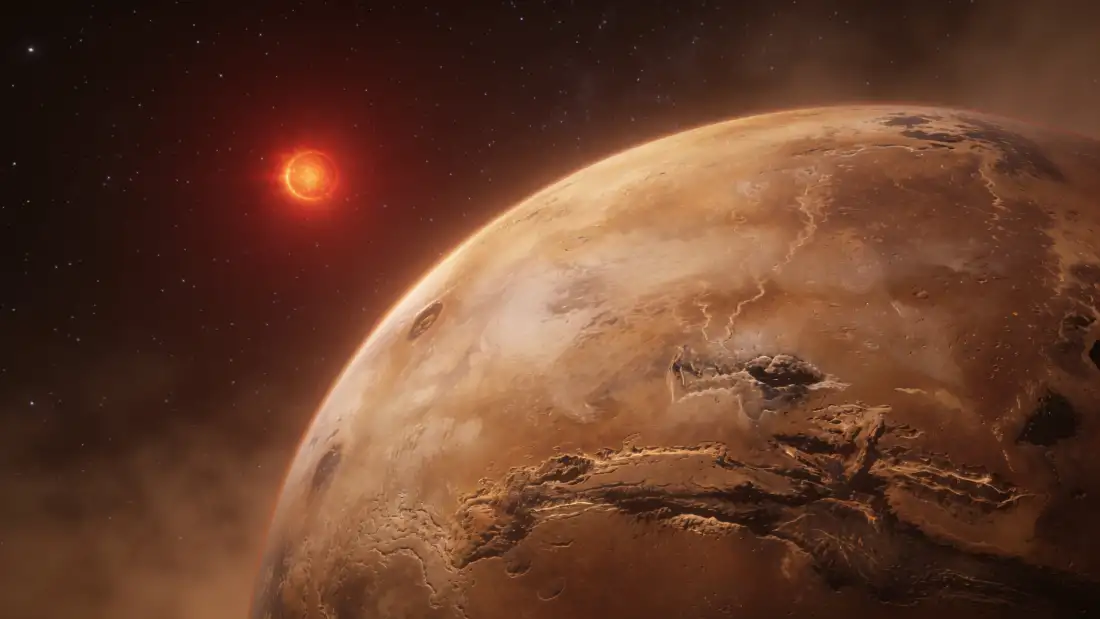
YZ Cet c is one of our closest known exoplanet neighbors — a world orbiting a star just 12.1 light-years from Earth. That sounds close in space terms, and in a way it is. Yet the distance still puts it almost impossibly far beyond our reach. Here is what scientists have learned so far about this small, nearby world.
What We Know About YZ Cet c
Scientists discovered YZ Cet c in 2017 using a technique called the radial velocity method. This method works by watching a star very carefully. When a planet orbits a star, its gravity gives the star a tiny wobble. That wobble changes the color of the star’s light just a little bit — and sensitive instruments can pick that up. By measuring those changes, scientists can figure out that a planet is there and estimate some of its properties.
From those measurements, we know that YZ Cet c is remarkably close in size to Earth. Its radius — that is, the distance from its center to its surface — is about 1.05 times Earth’s radius. Its mass is about 1.14 times Earth’s mass. In other words, it is just a little bigger and a little heavier than the world you are standing on right now. Finding a planet this close to Earth’s size around such a nearby star is genuinely interesting to scientists.
One important thing to keep in mind: the radial velocity method is very good at measuring mass, but estimating radius from it involves extra steps and assumptions. The numbers we have are scientists’ best careful estimates, not perfect measurements. As instruments improve, these values may be refined.
A Star That Glows Red and Cool
YZ Cet c orbits a star called YZ Cet. This star is what astronomers call a red dwarf — a type of star that is much smaller, dimmer, and cooler than our Sun. The surface of YZ Cet sits at about 3,151 Kelvin (Kelvin is a temperature scale scientists use, where 0 Kelvin is the coldest anything can ever be). For comparison, our Sun’s surface is close to 5,778 Kelvin. So YZ Cet is a significantly cooler star, and it gives off a deep reddish-orange glow rather than the bright white-yellow light of our Sun.
Red dwarfs are actually the most common type of star in our galaxy — the Milky Way. They burn their fuel very slowly, which means they can live for tens of billions of years. That is far longer than our Sun is expected to last. Scientists are very interested in red dwarfs because so many of them have planets, and some of those planets sit in what is called the habitable zone — the region around a star where temperatures could allow liquid water to exist on a planet’s surface. YZ Cet c, however, is not in that zone, as we will see shortly.
Just How Far Is 12.1 Light-Years?

A light-year is the distance that light travels in one year. Light moves at about 300,000 kilometers per second — the fastest speed known in the universe. In one year, light covers roughly 9.46 trillion kilometers. Multiply that by 12.1, and you start to get a sense of how far away YZ Cet c really is.
Put another way: if you could somehow see YZ Cet c’s star in the night sky right now, the light reaching your eyes left that star 12.1 years ago. You would be looking into the past. The cosmic map on this site can help you picture where YZ Cet sits in the wider neighborhood of stars around our Sun — it is genuinely one of our closest stellar neighbors, yet still staggeringly remote.
Within the Milky Way, which stretches roughly 100,000 light-years across, 12.1 light-years is a tiny step. But from a human perspective, it represents a distance no spacecraft we have ever built could cross in any reasonable amount of time.
Getting There: A Journey Beyond Imagination
Our fastest spacecraft so far have traveled at roughly tens of kilometers per second relative to the Sun. At those speeds, crossing 12.1 light-years would take tens of thousands of years — far longer than all of recorded human history. Even the most ambitious proposals for future spacecraft — ideas that exist only on paper — would still take hundreds or thousands of years to cover such a distance.
You can explore what a journey to nearby stars would look like using the distance and travel time tool on this site. Plug in different speeds and see just how long a trip to YZ Cet c would really take. The numbers are humbling. For now, everything we know about this world comes from careful study of light — faint signals gathered by telescopes over years of patient observation.
A Year in Three Days
One of the most striking things about YZ Cet c is how fast it orbits its star. One full orbit — its year — takes just 3.06 Earth days. That is faster than most people’s working week. The reason is that the planet orbits very close to YZ Cet. When a planet is close to its star, gravity pulls it around quickly, just as a ball on a short string swings faster than one on a long string.
For comparison, Earth takes 365 days to complete one orbit around our Sun, and even Mercury — our own solar system’s innermost planet — takes about 88 days. YZ Cet c moves far more quickly than that, completing many orbits in the time it takes you to get through a single month.
Too Hot for Life as We Know It
Being so close to its star means YZ Cet c receives a great deal of energy. Scientists estimate its likely surface temperature at around 410 Kelvin, which works out to roughly 137 degrees Celsius. That is well above the boiling point of water at sea level on Earth. At those temperatures, liquid water as we know it could not sit on the planet’s surface.
That does not make YZ Cet c a failure as a world to study — far from it. Understanding hot, rocky planets helps scientists learn how planetary systems form and evolve. It also helps them better identify which other worlds might be more suitable for the conditions life needs. Scientists have not measured YZ Cet c’s atmosphere, if it even has one, so many questions remain open.
Two Neighbors in the Same System
YZ Cet c is not alone. Scientists have identified three planets in total orbiting YZ Cet. The other two are known as YZ Cet b and YZ Cet d. All three were discovered in 2017. Having multiple planets in a system is common — our own solar system has eight — and studying several planets around the same star helps scientists understand how they each formed and how they affect one another.
Details about YZ Cet b and YZ Cet d, such as their sizes and temperatures, have not been included here because the verified data available for those planets is limited, and it would not be right to guess. What we can say is that YZ Cet is a lively little system packed close around a cool red star, sitting quietly just 12.1 light-years from our own.
YZ Cet c is a reminder of how strange and varied planets can be, even around the stars closest to us. We have only just begun to map this cosmic neighborhood, and every careful measurement brings a little more of it into focus.