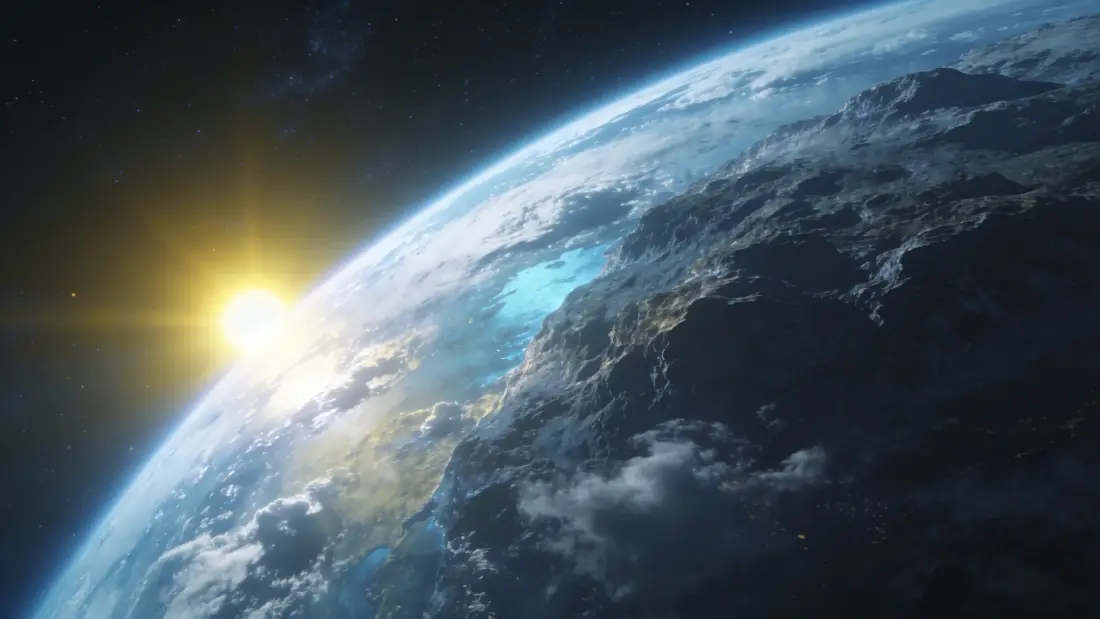
Far across the galaxy, a planet called Kepler-452 b orbits a star that looks a lot like our own Sun. Scientists have wondered ever since its discovery whether this distant world might have the right conditions for liquid water. That question leads straight to one of the most exciting ideas in astronomy: the Goldilocks Zone.
What Is Kepler-452 b?
Kepler-452 b is a planet located about 1,799 light-years from Earth. A light-year is the distance light travels in one year — roughly 9.5 trillion kilometres. So 1,799 light-years is an almost unimaginable distance. No spacecraft we have today could reach it in any human lifetime.
The planet circles a star called Kepler-452. That star has a surface temperature of 5,757 K (K stands for Kelvin, a scale scientists use to measure heat). Our own Sun’s surface sits at about 5,778 K. Those two numbers are very close, which means Kepler-452 is a near twin of the Sun in terms of warmth and colour.
One year on Kepler-452 b — the time it takes to complete one full orbit around its star — lasts 385 Earth days. That is only about three weeks longer than our own year. Scientists discovered the planet in 2015. So far, it is the only known planet in this star system.
What Is the Goldilocks Zone?
The Goldilocks Zone is a nickname for something scientists call the habitable zone. The habitable zone is the band of space around a star where temperatures might allow liquid water to exist on the surface of a rocky planet. Not too hot, not too cold — just right, like the porridge in the old fairy tale.
Liquid water matters because, as far as scientists know, every living thing on Earth needs it. Water helps carry nutrients into cells and carry waste out. Without it, life as we understand it cannot work. Scientists are careful to say that the habitable zone is where liquid water could exist — not where it definitely does.
The size and heat of a star set where the habitable zone falls. A hot, bright star has a wider zone that sits farther out. A cooler, dimmer star has a tighter zone that sits much closer in. Our Sun’s habitable zone reaches from roughly the orbit of Venus to a little beyond the orbit of Mars — and Earth sits comfortably inside it.
You can explore how different stars shape their habitable zones using our habitable zone explorer, which lets you see exactly how the zone shifts depending on the star.
Does Kepler-452 b Sit in the Zone?
This is the key question. Scientists who studied Kepler-452 b concluded that yes, it does orbit inside the habitable zone of its star. Because Kepler-452 is so similar to our Sun, and because Kepler-452 b takes 385 days to complete one orbit, the planet sits at a distance from its star that is very close to Earth’s distance from the Sun.
The estimated likely temperature for Kepler-452 b is 265 K, which works out to about -8 degrees Celsius. That is below the freezing point of pure water. But this figure is an estimate, and it does not account for any greenhouse effect. A greenhouse effect happens when a planet’s atmosphere traps heat, warming the surface above what sunlight alone would provide. Earth itself is warmer than a simple calculation would suggest, thanks to its own greenhouse gases. If Kepler-452 b has a thick atmosphere, its actual surface temperature could be higher — possibly warm enough for liquid water. Scientists don’t know whether it has such an atmosphere, though.
So the honest answer is: Kepler-452 b sits in the zone where liquid water could exist, depending on what its atmosphere is like. That is very different from saying it has liquid water. We simply do not know yet.
A Bigger, Heavier World
Even though Kepler-452 b is in an interesting location, it is not a small, Earth-like world. Its radius is 1.63 times Earth’s, and its mass is 3.29 times Earth’s. Scientists sometimes call planets in this size range super-Earths — worlds bigger than Earth but likely smaller than the ice giants Uranus and Neptune.
A higher mass means stronger gravity. If you could stand on Kepler-452 b — which is purely imaginary at this point — you would feel noticeably heavier than you do on Earth. Scientists think a planet with this much mass could hold onto a thick atmosphere, which might boost surface temperatures through that greenhouse effect mentioned earlier. But a very thick atmosphere could also create pressures and chemistry that are very different from anything life on Earth would cope with.
Whether Kepler-452 b is rocky like Earth or has a deep layer of water or gas beneath its surface, scientists haven’t been able to determine yet. Its size puts it in a range where either is possible.
How Scientists Found It
Kepler-452 b was discovered using the transit method. When a planet passes in front of its star from our point of view, it blocks a tiny fraction of the star’s light. Sensitive telescopes can detect that small dip in brightness. By watching how often the dip repeats, scientists figure out how long the planet’s year is. By measuring how deep the dip is, they can estimate the planet’s size.
The planet was found in 2015 using data from NASA’s Kepler space telescope, which spent years staring at hundreds of thousands of stars, looking for exactly these tiny signals. The transit method is good at revealing a planet’s size, but it tells us less about mass, atmosphere, or surface conditions. That is one reason so many details about Kepler-452 b remain uncertain.
What We Still Don’t Know
The list of unknowns is long, and that is worth being honest about. Scientists have not measured the composition of Kepler-452 b’s atmosphere — or confirmed it has one. They do not know whether its surface is rocky or covered in water or ice. They cannot yet say whether conditions there are friendly or hostile to life.
At 1,799 light-years away, the planet is far too distant for any current or near-future telescope to study its atmosphere in detail. Future, more powerful observatories might begin to answer some of these questions for closer planets, but Kepler-452 b may remain mysterious for a long time.
If you want to see how Kepler-452 b compares with other candidates, take a look at our most Earth-like worlds list, which gathers the planets scientists think are most similar to our own.
Kepler-452 b is a genuinely interesting world — a planet the right distance from a Sun-like star, with a year almost as long as ours. But interesting is not the same as habitable, and habitable is not the same as inhabited. What this planet does well is remind us how much there is still to learn, and how carefully we need to look before drawing conclusions about worlds we can barely see.