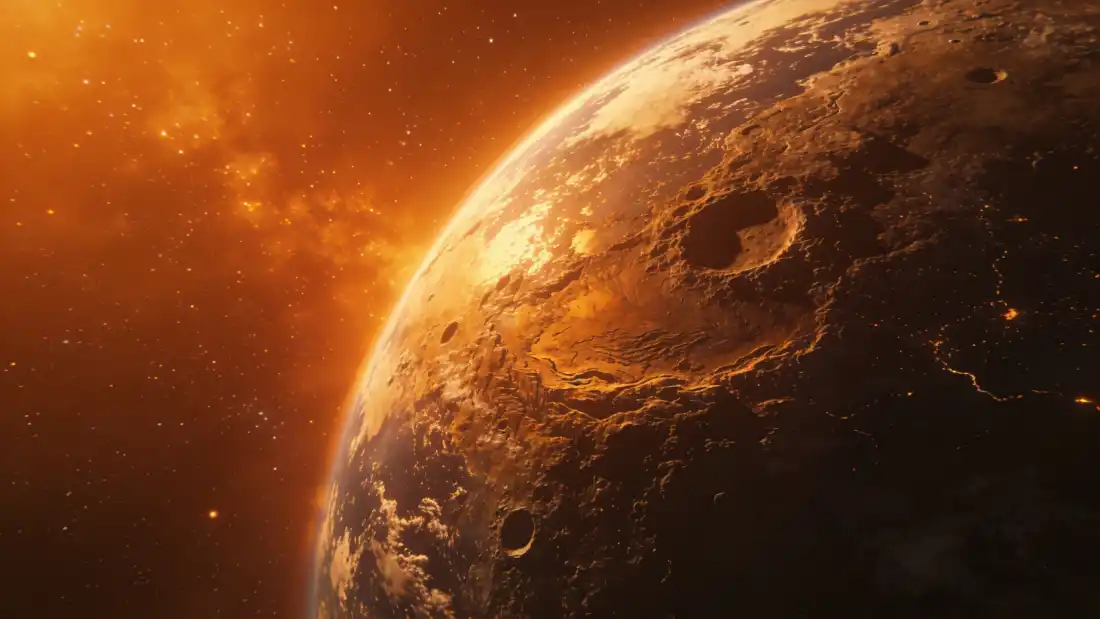
117 light-years away — that is about 688 trillion miles — a star called HD 20781 holds at least five worlds in its gravity. Scientists have been studying this system closely, and one of its planets, HD 20781 b, gives us a fascinating place to start exploring. What can a family of distant planets teach us about how worlds form and arrange themselves around a star?
A Star with Five Worlds
Most stars we can see in the night sky probably have planets. But finding a system where we can identify five planets around a single star is still something special. It gives scientists a chance to study a whole family of worlds, not just one lone traveler in space.
HD 20781 is that kind of system. As far as we know right now, it holds five planets — and all of them were found using careful, patient observation from Earth. Studying all five together helps scientists understand patterns: how planets line up, how close they sit to their star, and why some systems look so different from our own Solar System.
You can explore the layout of this system and others like it using our interactive System Explorer.
Meet HD 20781 b
The planet HD 20781 b is the one we know the most about from the data scientists have gathered so far. It is a small, rocky-sounding world — at least by the numbers we have.
Its radius — that means how wide it is from its center to its edge — is 1.21 times Earth’s radius. So it is slightly bigger than our planet, but not by a huge amount. Its mass, which is how much matter is packed into it, is 1.93 times Earth’s mass. That means it is nearly twice as heavy as Earth, even though it is only a little wider.
When a planet is denser than Earth — more mass squeezed into a size that is not much larger — scientists think it might be made mostly of rock or metal, similar to Earth. But we have to be careful. We do not yet know what HD 20781 b is made of for certain. Scientists use mass and radius together to make careful guesses about a planet’s interior, and those guesses can change as we learn more.
One of the most striking things about HD 20781 b is how fast it travels around its star. One full orbit — its year — takes only 5.31 Earth days. That is less than a week. To complete an orbit that quickly, a planet has to be very close to its star. We do not have a confirmed distance from the star listed in the data, but an orbit this short almost certainly means HD 20781 b sits far inside what we would call the habitable zone. The habitable zone is the range of distances from a star where temperatures might allow liquid water to exist on a planet’s surface. A planet zipping around in just over five days is almost certainly very hot.
The Star at the Center

Every planet in the HD 20781 system orbits the same star: HD 20781. The star has a measured surface temperature of 5,256 Kelvin. Kelvin is a temperature scale scientists use; 5,256 Kelvin is roughly 4,983 degrees Celsius, or about 8,999 degrees Fahrenheit.
For comparison, our own Sun has a surface temperature of about 5,778 Kelvin. That means HD 20781 is a little cooler than the Sun. Stars that are slightly cooler than the Sun tend to burn a bit less brightly and look slightly more orange-yellow rather than the pure white of hotter stars. Based on its temperature, HD 20781 is probably what astronomers call a G-type or K-type star — a category of stars that are similar in size and behavior to our Sun, though we do not have enough confirmed data here to say exactly which type it falls into.
A slightly cooler star also means its habitable zone sits a little closer in than the Sun’s habitable zone. That is worth keeping in mind when we think about where the five known planets might sit around it.
How Scientists Found These Planets
All five planets in this system, including HD 20781 b, were discovered in 2019 using something called the radial velocity method. Here is how it works.
When a planet orbits a star, it does not just circle silently around it. The planet also pulls on the star — just a tiny bit — through gravity. That gentle tug makes the star wobble back and forth very slightly. When the star wobbles toward us, the light it gives off shifts to slightly bluer wavelengths. When it wobbles away, the light shifts to slightly redder wavelengths. Scientists call this a Doppler shift, the same effect that makes a siren sound higher as an ambulance comes toward you and lower as it drives away.
By measuring these tiny shifts in starlight very precisely, scientists can detect a planet’s presence without ever seeing the planet directly. They can also work out the planet’s mass and how long its orbit takes.
A Crowded Inner System
Five planets in one system raises a big question: where are they all? With HD 20781 b completing an orbit in just 5.31 days, it is likely packed in very close to the star. Scientists think many of the other planets in this system may also orbit relatively close in, though the exact orbits of all five worlds have not all been confirmed in the data available here.
Tightly packed systems like this one are not rare in the universe. Astronomers have found many star systems where several planets crowd into orbits that would all fit inside Mercury’s orbit in our own Solar System. This challenges older ideas about how solar systems form, because for a long time scientists assumed every system would look roughly like ours — with rocky planets close in and giant planets far out. Nature turns out to be far more varied than that.
Comparing HD 20781 to Our Solar System
Our Solar System has eight planets spread across a wide range of distances from the Sun. The inner planets — Mercury, Venus, Earth, and Mars — are rocky. The outer planets — Jupiter, Saturn, Uranus, and Neptune — are giant worlds made mostly of gas and ice.
HD 20781 looks quite different, at least from what we know so far. Its five known planets may all live in a zone that would be considered the very inner region by our standards. Whether any of them are gas giants sitting farther out, scientists haven’t confirmed yet.
What HD 20781 reminds us is that our Solar System is just one example of how a planetary family can be arranged. The universe seems to enjoy variety. Every new system we study — like the one you can explore in the System Explorer — adds another piece to a much bigger puzzle about how planets, and perhaps life, come to exist.