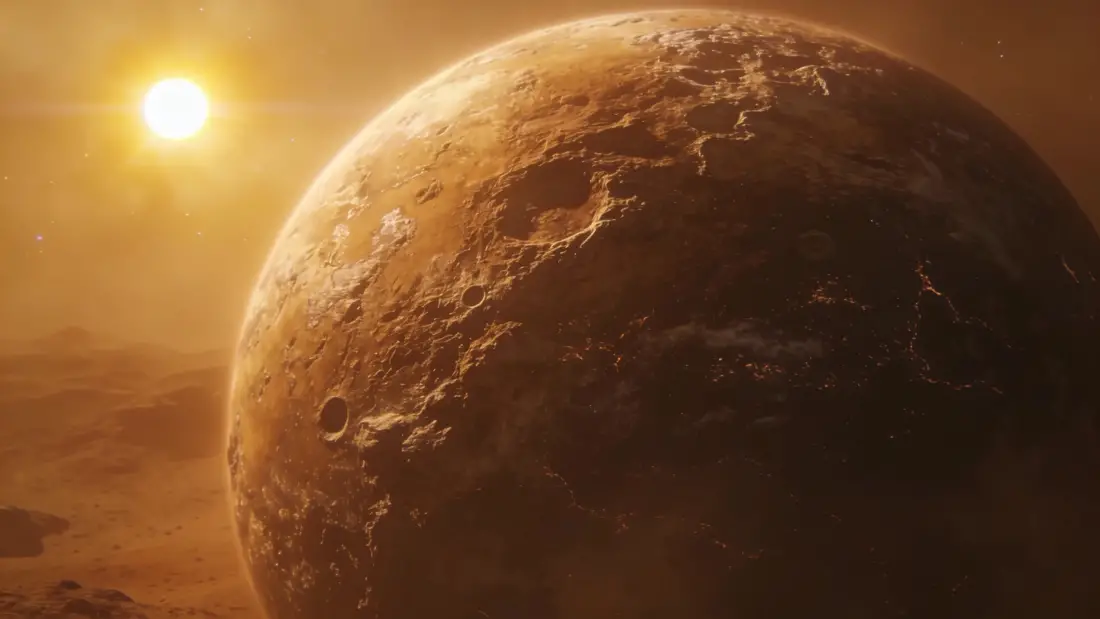
TOI-4513 b is a world we have never seen directly, yet we know it exists, roughly how big it is, and even how warm it probably gets. That knowledge comes from clever detective work — watching starlight with extraordinary care. Here is how astronomers pulled that off.
A Quick Portrait of TOI-4513 b
TOI-4513 b orbits a star called TOI-4513, sitting about 335 light-years from Earth. A light-year is the distance light travels in one year — roughly 9.5 trillion kilometres — so 335 light-years is an almost unimaginably large gap. No spacecraft we have today could reach it in a human lifetime.
The planet itself is larger than Earth but smaller than Neptune. Its radius — the distance from its centre to its surface — is about 2.35 times Earth’s radius. Its mass, meaning how much matter it contains, is roughly 6.11 times Earth’s mass. Scientists call worlds in this size range super-Earths or sub-Neptunes, depending on what they are made of. We are not yet sure which category fits TOI-4513 b best.
One year on this planet lasts only 9.76 Earth days, because it races around its star in a very tight orbit. That closeness also makes it very hot. Scientists estimate its temperature at around 653 K, which is about 380 degrees Celsius — far too scorching for life as we know it. TOI-4513 b was confirmed in 2026, making it a recent addition to our growing list of known worlds.
The Transit Method: A Tiny Shadow in the Light
Astronomers found TOI-4513 b using the transit method. A transit happens when a planet passes directly in front of its star, as seen from our direction. When that occurs, the planet blocks a small slice of the star’s light, causing the star to look very slightly dimmer for a short time.
Think of holding a pea in front of a lamp across a room. The lamp gets a tiny bit darker where the pea covers it. Planets do the same thing to their stars, just on a much grander scale — and from 335 light-years away, the dimming is extremely small.
Here is how the process works, step by step:
- A telescope stares at a star continuously, measuring how bright it looks thousands of times.
- When a planet passes in front, the star’s brightness dips by a small, measurable amount.
- The dip ends when the planet moves away, and brightness returns to normal.
- If the same dip happens again and again at regular intervals, scientists know something is orbiting the star on a steady path.
- The size of the dip tells them how large the planet is compared to the star. A bigger planet blocks more light, so it causes a deeper dip.
The transit method works best when a planet’s orbit is lined up just right, so the planet crosses the face of its star as seen from Earth. If the orbit is tilted a different way, we miss the transit entirely. This means there are likely many planets out there we simply cannot spot this way.
From Dip to Discovery: What the Data Showed
For TOI-4513 b, astronomers saw that regular dip in the star’s light repeating every 9.76 Earth days. That repeat time is what tells us the length of the planet’s year. Each time the planet completed one lap around its star, the signal appeared again like clockwork.
The depth of the dip told scientists the planet’s radius: 2.35 times Earth’s. They compare the amount of light blocked to what they know about the star’s size, and from that comparison the planet’s size follows mathematically.
The host star, TOI-4513, has a surface temperature of 5,624 K. Our own Sun’s surface sits at about 5,778 K, so TOI-4513 is slightly cooler than the Sun — though still blazing by everyday standards. Knowing the star’s temperature and the planet’s tight orbit helps scientists estimate that the planet itself bakes at around 653 K. That estimate assumes certain things about how the planet reflects and absorbs light, so it is a careful calculation rather than a direct reading.
Right now, TOI-4513 b is the only planet confirmed in this system, though that could change as astronomers look more closely.
The Wobble Method: Gravity Gives a Planet Away
The transit method is great at measuring a planet’s size, but it cannot directly tell us the planet’s mass. For that, scientists often turn to a second technique called the radial velocity method — often nicknamed the wobble method.
Here is the key idea: a planet does not simply orbit a star. Both the planet and the star pull on each other through gravity. While the planet makes a wide orbit, the star makes a tiny wobble in place. That wobble is very small, but it shifts the star’s light in a way telescopes can detect.
When the star wobbles toward Earth, its light waves get squeezed slightly closer together, shifting toward the blue end of the colour spectrum. When it wobbles away, the waves stretch out, shifting toward red. Scientists call this the Doppler effect — the same reason a siren sounds higher-pitched as a car approaches and lower as it drives away.
By measuring how much the starlight shifts, and how fast, astronomers can calculate the minimum mass of the planet causing the wobble. For TOI-4513 b, this approach gave a mass of about 6.11 times Earth’s. Combined with the radius from transits, scientists can work out the planet’s density and make educated guesses about whether it is mostly rock, water, or gas.
If you want to explore these detection methods yourself, the How We Find Them simulator lets you experiment with transits and wobbles interactively.
What We Know — and What We Don’t
We know TOI-4513 b’s radius, mass, orbital period, and estimated temperature. Those are real, measured quantities. What we do not yet know is what the planet looks like up close. Scientists haven’t measured its atmosphere, if it has one. We don’t know its colour, its surface conditions in detail, or whether it has moons. The planet sits well inside what astronomers call the habitable zone — the region around a star where liquid water could exist — so at 380 degrees Celsius, it is far too hot for life as we understand it. These are honest gaps in our knowledge, and filling them will take more observations.
Why Finding Worlds Like This Matters
Super-Earths and sub-Neptunes are among the most common types of planets in our galaxy, yet our own solar system has none. Every time we pin down the size and mass of a world like TOI-4513 b, we add one more data point to a larger puzzle: how do planets form, and why does our neighbourhood look the way it does? Slowly, planet by planet, careful measurement brings us closer to answers.