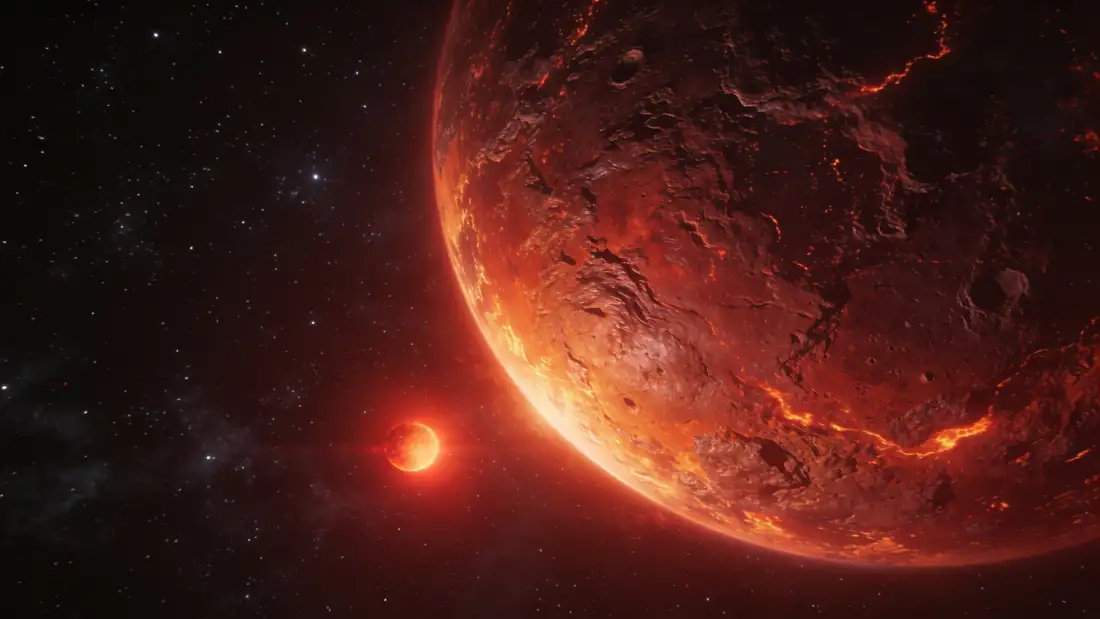
TOI-1752 b is a world about halfway between Earth and Neptune in size. It sits 336 light-years away, and scientists discovered it in 2026. Even from that distance, the numbers we have already tell an interesting story about what kind of place it might be.
Where TOI-1752 b Lives in Space
To reach TOI-1752 b, you would need to travel 336 light-years. A light-year is the distance light covers in one full year — about 9.5 trillion kilometres. Even at the speed of light, that journey would take 336 years. In the grand scale of our galaxy, that is actually a fairly nearby neighbourhood.
The planet orbits a star called TOI-1752. That star sits in a part of the sky that telescopes like TESS regularly watch. TOI-1752 b is one of two planets scientists have found in this system so far.
How Scientists Found It
TOI-1752 b was discovered in 2026 using something called the transit method. A transit happens when a planet passes in front of its star, as seen from Earth. When that happens, the star’s light dips ever so slightly — like a moth flying in front of a lamp. Scientists measure those tiny dips in brightness very carefully. If the dips happen again and again at regular intervals, that is a strong sign a planet is going around the star.
The transit method does more than just reveal that a planet exists. The amount the starlight dims tells scientists how big the planet is compared to its star. Combined with other observations, researchers can also work out the planet’s mass and how long it takes to complete one orbit. That is a lot of useful information from a small flicker of light.
Size and Mass — What the Numbers Tell Us
TOI-1752 b has a radius — that is, the distance from its centre to its surface — of about 1.69 times Earth’s radius. Its mass is about 3.51 times Earth’s mass. Both of those measurements put it firmly in the category scientists call a super-Earth, which is simply a rocky or rocky-and-water world larger and heavier than Earth but smaller than the ice giants like Uranus or Neptune.
Size and mass together give scientists a very useful clue: density. Density tells you how much matter is packed into a given space. A world made mostly of iron and rock will be much denser than one made mostly of water or gas. When scientists look at TOI-1752 b’s radius and mass side by side, they can start to guess what the planet is made of — though getting that right takes careful modelling and a bit of caution.
TOI-1752 b is not enormously massive for its size. That hints it might not be a pure iron-and-rock ball. Scientists think it could contain a significant amount of water or other lighter materials alongside rock. But we are not certain yet. If you enjoy comparing planet sizes and densities, you might find the mass-radius diagram a helpful way to see where TOI-1752 b sits among thousands of other known worlds.
A Scorching Orbit — Why TOI-1752 b Is So Hot
One of the most striking things about TOI-1752 b is how fast it travels around its star. One full orbit takes only about 0.94 Earth days — less than a single day on Earth. That means its year is shorter than our day.
To move that fast, the planet must be extremely close to its star. And being that close has consequences. Scientists estimate its likely temperature is around 1,036 K, which is roughly 763 degrees Celsius. That is far hotter than any oven, and well above the melting point of many types of rock.
At those temperatures, liquid water on the surface would be impossible. Any atmosphere the planet might have would be under enormous stress from the star’s heat and radiation. Scientists say it could still have some kind of atmosphere, but what that atmosphere looks like — if it exists at all — is something we haven’t worked out yet.
This kind of very short orbit is actually quite common among the exoplanets — planets outside our solar system — that telescopes find. Planets close to their stars are easier to detect with the transit method, because they cross in front of the star more often. That means our current catalogue of known exoplanets has a natural lean toward these hot, fast-moving worlds.
The Star TOI-1752 — A Cool Red Dwarf
The star TOI-1752 has a surface temperature of 3,762 K. Our own Sun’s surface is about 5,778 K, so TOI-1752 is noticeably cooler. A star that cool glows in deep orange and red tones rather than the yellow-white of our Sun. Stars like this are called red dwarfs, and they are the most common type of star in the Milky Way.
Red dwarfs are smaller and dimmer than the Sun. That means a planet has to be very close to one just to receive enough warmth for scientists to measure a meaningful temperature. It also means that even though TOI-1752 b is scorchingly hot, it is receiving its heat from a star that is, overall, putting out much less energy than our Sun does.
Red dwarf stars are also known for giving off energetic bursts of radiation called flares. These flares can strip away a planet’s atmosphere over long periods. Whether TOI-1752 b has held onto any atmosphere despite this is, so far, unknown.
A Two-Planet System
Scientists have found two planets in the TOI-1752 system. TOI-1752 b is one of them. We don’t yet have detailed published data about the second planet to share here, but having two planets already suggests this system has been active in forming worlds. Many star systems turn out to hold several planets once scientists look carefully enough. It is quite possible that more planets in this system are waiting to be found.
What Might Be Inside TOI-1752 b
Figuring out what a planet is made of from 336 light-years away is not simple. Scientists use the radius and mass together to build models — careful mathematical guesses — about the interior. For TOI-1752 b, the combination of its size and mass suggests it is denser than a pure water world but possibly less dense than a pure rock-and-iron planet. One possibility is a rocky core surrounded by a layer of water or ice, though at its surface temperature, any water would exist in exotic, high-pressure forms rather than as a calm liquid ocean.
Scientists call planets in this uncertain zone between rocky super-Earths and mini-Neptunes — the smaller cousins of the ice giants — transitional worlds. Understanding them better is one of the big goals of modern planet science. You can explore how scientists use size and mass together with the size comparison tool to get a feel for just how varied these worlds can be.
TOI-1752 b is a good reminder that even a handful of measurements — radius, mass, temperature, orbit — can open up a whole set of careful, honest questions about a world we have never visited and may never see up close. That, in its own quiet way, is what makes exoplanet science so worth following.