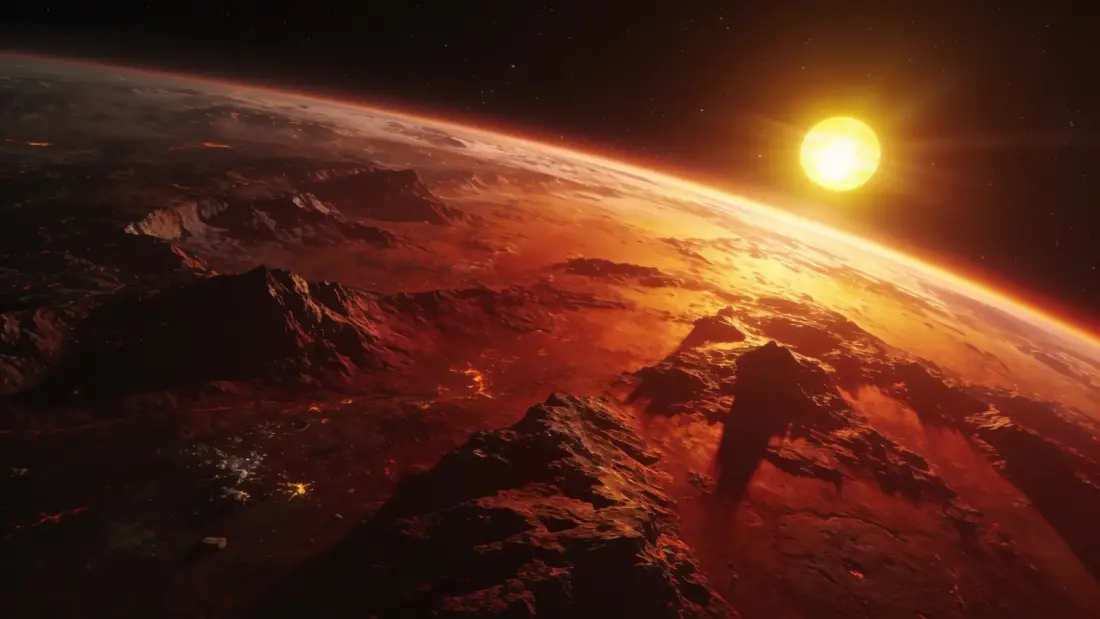
TOI-5624 c is an exoplanet — a planet orbiting a star other than our Sun. It sits about 332 light-years from Earth, and scientists confirmed it in 2026. It belongs to a family of worlds called mini-Neptunes, and understanding what that label means tells us a lot about how planets form and what they are made of.
A Star 332 Light-Years Away
TOI-5624 c orbits a star called TOI-5624. A light-year is the distance light travels in one year — about 9.5 trillion kilometres. So 332 light-years is an enormous distance by everyday standards, though it is fairly close in the grand scale of our galaxy, the Milky Way.
The star TOI-5624 has a surface temperature of 5,327 K. The K stands for kelvin, a unit scientists use to measure very high temperatures. Our own Sun has a surface temperature of about 5,778 K, so TOI-5624 is a little cooler and probably a little smaller than the Sun. It is what astronomers call a G-type or K-type star — a calm, long-lived kind of star. Scientists have not yet published a precise measurement of its mass or exact size, so we will leave those details for future studies.
The distance of 332 light-years means the light reaching our telescopes from TOI-5624 left that star long before most people reading this were born. We are, in a sense, seeing the past when we study it.
How Scientists Found TOI-5624 c
TOI-5624 c was discovered in 2026 using the transit method. The transit method works like this: when a planet passes in front of its star, it blocks a tiny bit of starlight. Telescopes detect that dip in brightness. If the dip happens over and over on a regular schedule, scientists know a planet is making those crossings.
The name TOI is short for TESS Object of Interest. TESS is a space telescope designed to watch hundreds of thousands of stars for exactly these small dips in brightness. When TESS flags a star as interesting, ground-based telescopes and other instruments follow up to confirm whether a real planet is there.
The transit method tells us two key things right away: how big the planet is (from how much light it blocks) and how long its year is (from how often the transit repeats). To learn the planet’s mass, scientists usually need a different technique — measuring the tiny gravitational tug the planet gives its star. For TOI-5624 c, both the radius and the mass have been measured, which puts us in a good position to figure out what this world might be made of.
Size and Mass — Reading the Numbers
TOI-5624 c has a radius of 2.47 times Earth’s radius and a mass of 4.8 times Earth’s mass. These two measurements together are very useful.
When you know a planet’s size and mass, you can work out its density — how much material is packed into a given space. Density is one of the best clues we have about what a planet is made of. A small, heavy planet is probably made of rock or metal. A planet that is larger but lighter for its size probably has a thick atmosphere or a lot of water and ice in its interior.
TOI-5624 c is roughly two and a half times wider than Earth but only about five times heavier. That combination suggests it is not a dense, rocky world. Its density is lower than you would expect from pure rock. Scientists think it likely has a thick envelope of gas, or a large amount of water and ice beneath that gas, or both. You can explore how size and mass relate to planet types using our mass-radius diagram, which plots thousands of known exoplanets.
What Makes Something a Mini-Neptune
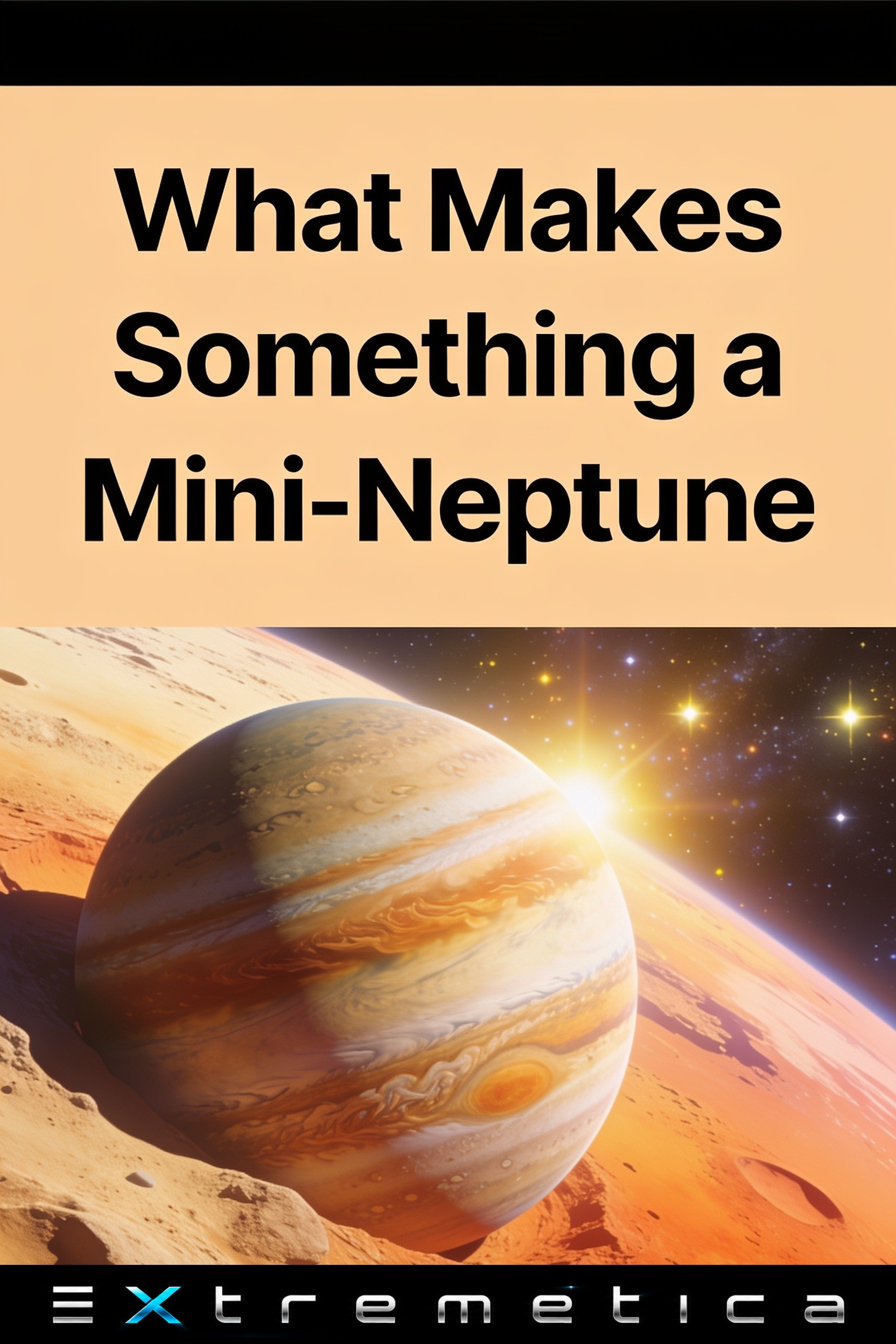
The label mini-Neptune describes a whole class of exoplanets. Neptune, in our own solar system, is an ice giant — a planet with a rocky or icy core wrapped in thick layers of water, ammonia, methane, and hydrogen gas. A mini-Neptune is simply a smaller version of that basic idea.
Mini-Neptunes typically have radii between about 2 and 4 times Earth’s radius. TOI-5624 c, at 2.47 Earth radii, fits comfortably in that range. Scientists think these worlds have cores made of rock or ice, surrounded by thick atmospheres that can include hydrogen, helium, and water vapour. We cannot see inside them directly, so the internal structure is always a careful estimate based on the mass and radius together.
Mini-Neptunes are actually one of the most common types of planet found so far in the galaxy — more common than planets like Earth or Jupiter, as far as we know. Our own solar system has no mini-Neptune, which makes them an interesting puzzle. Studying worlds like TOI-5624 c helps scientists understand why so many planetary systems end up with them.
If you want to see how TOI-5624 c compares physically to Earth, Neptune, and other known exoplanets, take a look at our size comparison tool.
A Very Hot and Very Fast World
TOI-5624 c completes one full orbit around its star in just 7.89 Earth days. That is its year. For comparison, Earth takes 365 days to orbit the Sun. TOI-5624 c moves very quickly because it orbits extremely close to its star.
That closeness has a dramatic effect on temperature. Scientists estimate the planet’s equilibrium temperature — the temperature based on how much starlight it receives — at 857 K, or about 584 degrees Celsius. That is far hotter than the surface of Venus, the hottest planet in our solar system.
At those temperatures, liquid water on the surface is not possible. TOI-5624 c sits well outside what astronomers call the habitable zone — the range of distances from a star where liquid water could exist on a planet’s surface. This is not a world where scientists are looking for signs of life.
Five Worlds Around One Star
TOI-5624 c is not alone. Scientists have found five planets in the TOI-5624 system so far. Multi-planet systems like this are fascinating because the worlds often interact with each other gravitationally, nudging each other’s orbits over long stretches of time. Studying all five planets together gives scientists more information than they could get from any single planet on its own.
Each planet in the system likely formed from the same original disc of gas and dust that surrounded TOI-5624 long ago. Why some ended up as mini-Neptunes and whether the others are rocky or gassy is something researchers are still working out. Systems like this are natural laboratories for understanding how planets of different sizes and compositions can grow around the same star.
TOI-5624 c is, in many ways, a typical mini-Neptune — and that is exactly what makes it worth studying. The more worlds like it we measure carefully, the clearer our picture of planetary formation across the galaxy becomes.