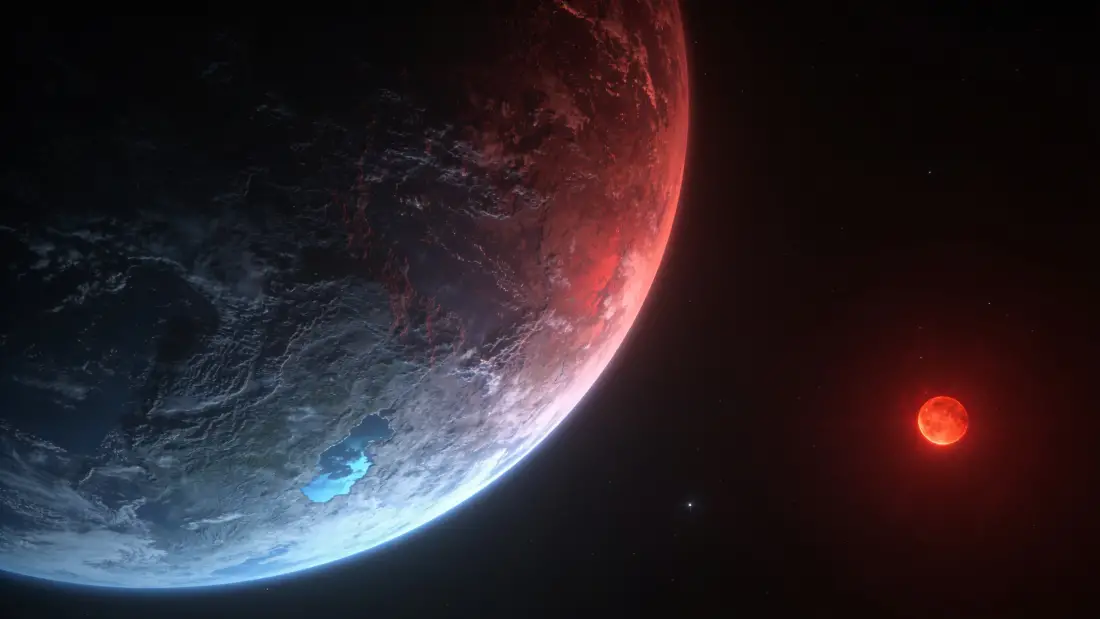
Far across the galaxy, about 903 light-years from Earth, a planet called Kepler-705 b travels around a dim, cool star. Scientists have measured some of its basic features, and one number stands out: its likely temperature puts it right in a range where liquid water could exist. But does that mean it is a friendly place for life? The answer, as with most things in space, is more complicated than it first looks.
How We Found Kepler-705 b
Kepler-705 b was discovered in 2016, using something called the transit method. Here is how that works. When a planet passes in front of its star, it blocks a tiny amount of starlight. A space telescope watching that star will see the light dip slightly. If the same dip happens again and again, on a regular schedule, scientists know a planet is making those crossings.
The telescope that spotted this planet was NASA’s Kepler space telescope, which watched hundreds of thousands of stars at once and logged thousands of planet candidates over its lifetime. Kepler-705 b is one of those finds — a world confirmed from the pattern of light it left behind, even though no human will travel there anytime soon.
One orbit of Kepler-705 b takes just 56.1 Earth days. That is its year — shorter than two of our months. This quick orbit is one of the clues scientists used to estimate the planet’s temperature.
The Star at the Center of This System

Every planet’s story starts with its star. Kepler-705 is what astronomers call a red dwarf — a star that is smaller, cooler, and dimmer than our Sun. We know this because its surface temperature is measured at 3,722 K. For comparison, our Sun’s surface sits at about 5,778 K. That means Kepler-705 puts out far less heat and light than our Sun does.
Red dwarfs are the most common type of star in the Milky Way. They burn their fuel very slowly, which means they can live for tens of billions of years — much longer than stars like our Sun. That long lifetime is interesting to scientists who think about life, because it means any planets around a red dwarf have a very long time to develop.
At the moment, Kepler-705 b is the only planet scientists have found in this system. There could be others, but none have been confirmed yet.
The Goldilocks Zone — What It Really Means
You may have heard the term Goldilocks Zone. Scientists call it the habitable zone — the band of space around a star where conditions might allow liquid water to exist on a planet’s surface. Not too hot, not too cold. Just right — like the porridge in the old story.
The location of this zone depends entirely on the star. A hot, bright star has a habitable zone far away from it. A cool, dim star — like a red dwarf — has a habitable zone much closer in. That is why a planet with a 56-day year can still be in the zone around a red dwarf, even though it would be roasted alive at that distance around a star like our Sun.
It is very important to understand what the habitable zone does not mean. Being inside it does not mean a planet has water. It does not mean it has air, oceans, or life. It simply means that if the planet has the right kind of atmosphere and enough surface pressure, liquid water could exist there. Many other things have to line up for a world to be truly welcoming to life. You can explore how the habitable zone works in more detail on this site.
Where Kepler-705 b Sits in the Zone
So where does Kepler-705 b land? Scientists have estimated its likely temperature at 265 K, which works out to about -8 degrees Celsius. That is just below the freezing point of water — roughly the temperature of a cold winter day in many parts of the world.
This temperature estimate puts Kepler-705 b at or near the cool edge of its star’s habitable zone. At -8 C, liquid water would normally be frozen. However, this temperature calculation is based on a fairly simple model. It assumes the planet has no atmosphere, or a very basic one. A real atmosphere — especially one containing greenhouse gases like carbon dioxide — could trap heat and push the surface temperature above freezing. Scientists think this is possible, but they haven’t measured the planet’s atmosphere yet. In fact, we don’t know if it has one at all.
The honest answer is that Kepler-705 b sits in a promising position — close enough to the habitable zone that liquid water might be possible, depending on conditions we cannot yet see.
What the Planet Itself Is Like
Kepler-705 b is noticeably bigger than Earth. Its radius is 2.11 times Earth’s, and its mass is about 5.1 times Earth’s. A world in this size range is often called a super-Earth — bigger than our planet, but smaller than the ice giants like Neptune.
What is it actually made of? Scientists haven’t worked that out yet. A planet of this size could be a rocky world with a thick atmosphere, or it could have a large amount of water ice, or it might have a small rocky core wrapped in a deep layer of gas. Each of those possibilities would make the planet very different from Earth. Knowing a planet’s mass and radius helps scientists make guesses about its inside, but the uncertainty is still large for a world this far away.
If you stood on the surface — if there is a solid surface — gravity would feel stronger than on Earth, because of the planet’s greater mass. But scientists haven’t measured it directly, so this remains a careful estimate.
What We Still Don’t Know
Kepler-705 b is an interesting world because several of its properties point in hopeful directions. Its temperature estimate is in a workable range. Its size suggests it could be rocky. Its star, while cooler than our Sun, is stable and long-lived. For these reasons, it appears on some lists of planets worth watching, alongside other candidates you can find on our Most Earth-Like Worlds list.
But the list of unknowns is long. We don’t know if the planet has an atmosphere. We don’t know its surface conditions. We don’t know if it has water in any form. Red dwarf stars can also send out strong bursts of radiation called flares, which can strip away a planet’s atmosphere over time — and we don’t know how active Kepler-705 is in that way.
Science rarely gives us a clean yes or no. Kepler-705 b sits near the edge of the Goldilocks Zone around a cool star, and that alone makes it worth knowing about. Whether it is truly a world where something could live is a question that will take much better telescopes — and a lot more time — to begin to answer.